
Buckeye Arizona Real Estate Investment Guide For 2026
A comprehensive resource for investors targeting one of America’s fastest-growing cities, where wide-open land, aggressive industrial development along the Loop 303, and among the lowest entry prices in the entire Phoenix metro create an extraordinary long-term appreciation play for patient investors
Quick answers: Top 5 most searched Buckeye investment questions ▼
Migration data: Where people are moving from to Buckeye ▼
In This Guide
Click on any section to navigate directly to that content
1. Buckeye Market Overview
Market Fundamentals
Buckeye is the great frontier of the Phoenix metro real estate market. Covering over 640 square miles, it is one of the largest cities by land area in the United States, and only a fraction of that land has been developed. With a population that has grown from under 10,000 in 2000 to more than 120,000 today and projections suggesting 500,000 or more at full buildout, Buckeye represents a generational land development story that is still in its early chapters.
Key economic indicators defining Buckeye’s investment case:
- Population: 120,000+ and accelerating with industrial job growth
- Major Employers: Lucid Motors (EV factory), Amazon (multiple fulfillment centers), Microsoft (data campus), Google (data center), Nuvation Energy, various logistics and distribution operators along Loop 303
- Median Household Income: $68,000+ and rising with tech and industrial employment growth
- Land Area: 640+ square miles, larger than Los Angeles, with enormous development runway
- Loop 303 Corridor: One of the most active industrial development corridors in the Western United States
- White Tank Mountains: Regional park providing outdoor recreation access that adds lifestyle value
The Lucid Motors factory in Buckeye is a watershed moment for the city’s economic identity. Arizona’s largest electric vehicle manufacturing facility directly employs thousands and has catalyzed a supplier and service ecosystem that is transforming Buckeye from a bedroom community into a genuine employment center. This fundamentally changes the investment thesis: Buckeye renters no longer need to commute to Phoenix or the East Valley to sustain their income.
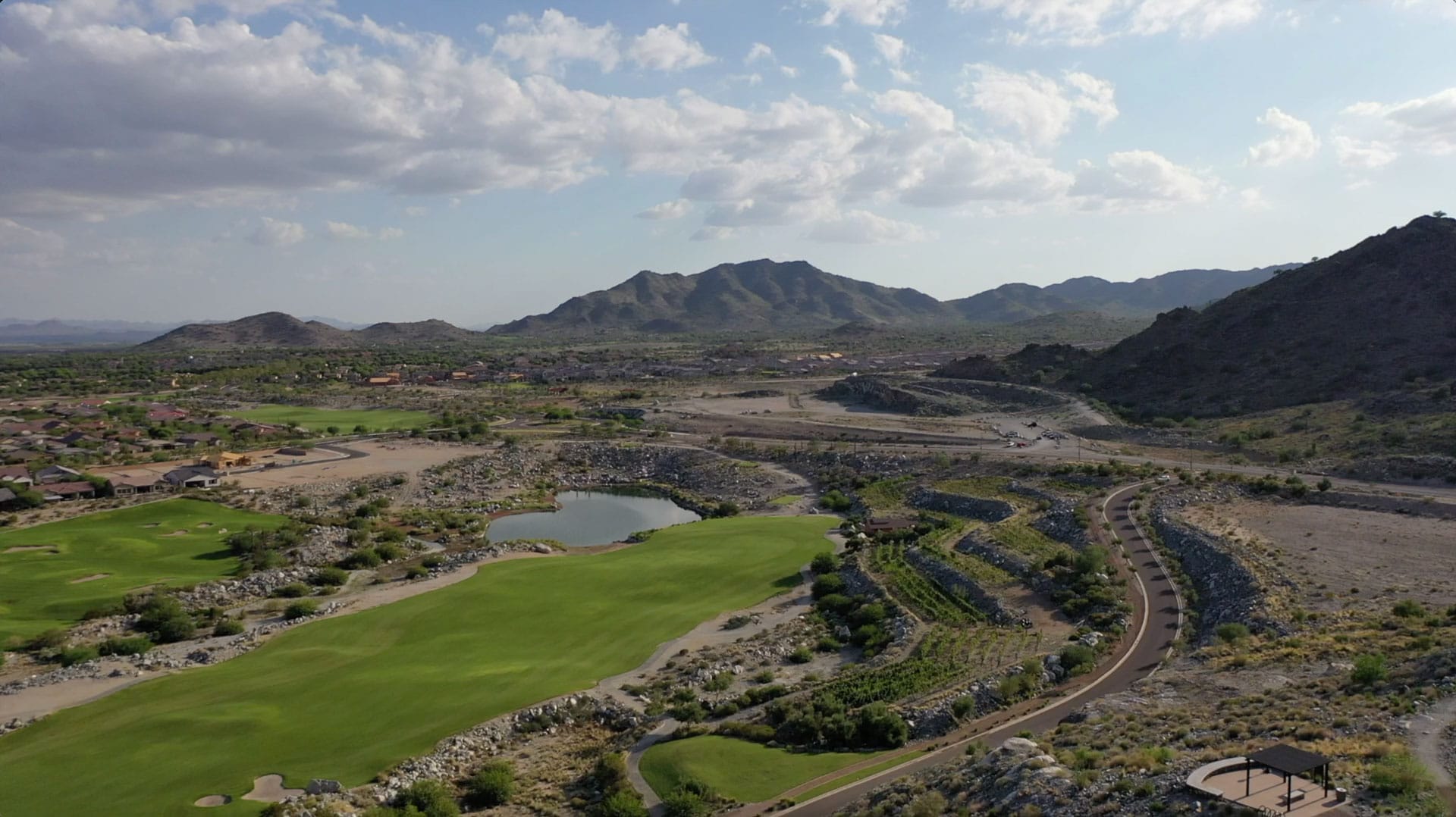
Buckeye’s vast open land and proximity to the White Tank Mountains define a city still in the early stages of its growth story
2026 Economic Outlook
- Lucid Motors production ramping up and supply chain employment expanding
- Microsoft and Google data campuses adding high-income tech employment locally
- Loop 303 industrial corridor attracting continued logistics and manufacturing investment
- Tartesso and Verrado expansions adding residential inventory for growing workforce
- I-10 corridor improvements reducing commute times to central Phoenix
Investment Climate
Buckeye’s investment environment is fundamentally different from any other Phoenix metro market. Rather than incremental appreciation within an already-developed suburban fabric, Buckeye offers a land development appreciation story with a potentially decades-long runway. The investment climate has several distinct characteristics:
- Genuine positive cash flow possible at current interest rates on many Buckeye properties, a rarity in the Phoenix metro
- Higher vacancy risk than established markets due to abundant new construction supply competing with existing rental stock
- Longer-term tenant profile required, as the market rewards patience over rapid appreciation plays
- Industrial employment anchor in Lucid Motors reduces the pure commuter-city risk that challenged earlier Buckeye investment theses
- Infrastructure catch-up risk remains real, as roads, schools, retail, and services continue to develop more slowly than population
Arizona’s landlord-friendly legal framework gives Buckeye investors the same strong protections as elsewhere in the state. No rent control, fast eviction timelines of 3 to 6 weeks, and no just-cause requirements create a clean operating environment.
Historical Performance
| Period | Market Driver | Avg Annual Appreciation | Key Event |
|---|---|---|---|
| 2010-2014 | Recovery from deep 2008 crash; Verrado establishing | 3-6% | Verrado proves master-planned model can work in far west Phoenix |
| 2015-2019 | California migration, Loop 303 development begins | 6-10% | Loop 303 industrial corridor activating; Buckeye population doubles |
| 2020-2022 | Remote work migration, pandemic demand explosion | 28-40% | Buckeye among the top appreciating markets nationally; Lucid Motors announces factory |
| 2023-2024 | Rate shock, new construction competition | 0-3% | Correction modest; Lucid production begins stabilizing local employment |
| 2025-2026 | Industrial maturation, rate stabilization | 5-9% (projected) | Lucid ramp-up, Microsoft/Google data campus employment driving local demand |
Demographic Trends Driving Demand
- Lucid Motors Workforce – Factory workers, engineers, and supply chain employees choosing Buckeye housing over Phoenix commutes, creating the most important structural demand shift in the city’s history
- California Affordability Migration – Families priced out of Surprise and Goodyear choosing Buckeye as the last affordable frontier in the Phoenix metro with good school prospects
- Data Center Technicians – Microsoft and Google data campus employees, typically earning $70,000 to $100,000, who prioritize affordable housing near their Buckeye workplaces
- Loop 303 Logistics Workers – Amazon, Walmart, and other distribution center employees at $45,000 to $75,000 annual income creating steady working-family rental demand
- Young Families – Buckeye’s median age of 34.8 reflects a young family formation community where couples buy homes or rent before buying, creating multi-year rental tenures
- Retirees and Snowbirds – A smaller but growing segment drawn by affordability, White Tank Mountain access, and the amenities of Verrado’s active lifestyle community
📚 New to real estate investing? Master the fundamentals with our professional course Learn more →
2. Neighborhood Hotspots
Buckeye Investment Neighborhood Map
Interactive map of Buckeye’s investment neighborhoods. Green stars show top hotspots, blue circles mark established markets, and orange circles highlight emerging areas.
Core Investment Neighborhoods
Detailed Submarket Analysis: Buckeye Neighborhoods
| Neighborhood | Price Range (SFH) | Cap Rate | Growth Drivers | Best Strategy |
|---|---|---|---|---|
| Verrado | $400K-$600K | 6.0-7.5% | Master-planned amenities, top schools, mountain views | Premium hold, California migrant tenants |
| Tartesso | $330K-$480K | 6.5-8.0% | New construction, Loop 303 employment, family demand | Buy-and-hold, industrial worker tenants |
| Watson Road / Loop 303 | $310K-$440K | 7.0-8.5% | I-10 access, Loop 303 employment, dual commute | Balanced returns, established rental demand |
| Lucid Motors Adjacent | $330K-$460K | 7.0-8.5% | Local employment anchor, no Phoenix commute needed | Industrial worker housing, local employment play |
| Sun Valley Parkway | $320K-$450K | 7.0-8.5% | Central location, I-10 and Loop 303 access, new construction | Balanced hold, new construction, good cash flow |
| Sundance | $300K-$410K | 7.0-8.5% | Established community, value-add older stock | Value-add, cash flow, BRRRR |
| Rovey Farm / Old Town | $250K-$365K | 7.5-9.5% | Highest cap rates, value-add older stock, city services | Maximum cash flow, BRRRR, high yield |
| Far West Buckeye | $290K-$390K | 6.5-8.0% | Lowest prices, maximum long-term appreciation runway | Long-term appreciation, 10+ year patient hold |
Expert Insight: “The Lucid Motors factory changes everything about the Buckeye investment thesis. Before Lucid, Buckeye was a pure commuter city and the investment case depended entirely on Phoenix employment accessibility. Now you have 4,000-plus direct Lucid employees plus a growing supply chain ecosystem where people can genuinely work and live in Buckeye without ever touching the I-10 to Phoenix. That transition from bedroom community to employment hub is the most powerful appreciation catalyst a frontier market can have, and Buckeye is living it right now. Investors who buy near the industrial corridor and hold 7 to 10 years are going to look very smart.” – Lisa Park, West Valley Industrial Real Estate Group
3. Property Types
| Investment Goal | Best Property Type | Best Neighborhoods | Minimum Capital |
|---|---|---|---|
| Maximum Cash Flow | Value-add or Rovey Farm older stock | Rovey Farm, Sundance, older east Buckeye | $70,000+ |
| Best Long-Term Appreciation | New construction in Verrado or Tartesso | Verrado, far west Buckeye development | $85,000+ |
| Industrial Employment Play | SFH near Loop 303 / Lucid Motors | Tartesso, Lucid adjacent, Watson Road | $85,000+ |
| Lowest Entry Point | Older stock or far west new construction | Old Town, Rovey Farm, far west | $65,000+ |
Don’t guess the costs. Our Complete Renovation & Remodeling Cost Guide covers 400+ pages of project-by-project breakdowns with real contractor pricing ranges.
4. Cost Analysis
Acquisition Cost Breakdown (Buckeye, Arizona)
| Expense Item | Typical Cost | Example ($355,000 Property) | Notes |
|---|---|---|---|
| Down Payment | 25% (investment) | $88,750 | Standard investment financing; well within conforming limits |
| Closing Costs | 2-3% | $7,100-$10,650 | No Arizona transfer tax; new construction builders often cover 2-3% in incentives |
| Home Inspection | $350-$550 | $400 | Include HVAC, roof; always inspect new construction independently |
| Termite Inspection | $75-$150 | $100 | Required by most lenders; active in Maricopa County |
| Pool Inspection | $150-$300 | $200 | If applicable; critical in Arizona heat. Pool adds rent premium but budget maintenance. |
| HOA Setup | $100-$400 | $250 | Verrado and Tartesso have HOAs; verify rental caps and rules before purchase |
| Initial Repairs | 0-10% | $0-$35,500 | New construction = $0. Older Sundance or Rovey Farm stock often needs significant work. |
| Reserves (6 months) | 3-5 months expenses | $7,000-$12,000 | AC replacement is the primary Arizona reserve need |
| TOTAL MINIMUM ENTRY | ~27-32% | $103,900-$147,350 | Among the most accessible entry points of any established Phoenix metro market |
Sample Cash Flow Analysis: Watson Road Corridor 3-Bedroom Single-Family
| Item | Monthly | Annual | Notes |
|---|---|---|---|
| Gross Rent | $1,850 | $22,200 | 3BR, 2BA, Watson Road area, updated condition |
| Less Vacancy (7%) | -$130 | -$1,554 | Higher than inner suburbs due to new construction competition; conservative estimate |
| Property Taxes | -$177 | -$2,130 | ~0.60% of $355K assessed (rental classification) |
| Insurance | -$95 | -$1,140 | Landlord policy; Arizona rates favorable |
| HOA Fees | -$55 | -$660 | Basic HOA; Verrado HOAs are higher |
| Property Management (9%) | -$167 | -$1,998 | Competitive Buckeye PM market |
| Maintenance + CapEx (8%) | -$148 | -$1,776 | AC service, general repairs |
| Net Operating Income | $1,078 | $12,942 | Before mortgage |
| Mortgage ($355K, 25% down, 6.75%, 30yr) | -$1,541 | -$18,492 | P&I on $266,250 loan |
| CASH FLOW | -$463 | -$5,550 | Slightly negative at median; near breakeven and improving as rents rise with growth |
| Cap Rate | 3.64% | NOI / Purchase Price | |
| Total Return (8% appreciation) | ~21% | Including equity, appreciation, principal paydown on invested capital |
Rovey Farm and older Sundance properties at $270,000 to $330,000 with rents of $1,650 to $1,800/month regularly achieve positive cash flow of $200 to $600/month after all expenses at current rates. Buckeye’s lowest-priced stock is genuinely cash-flow-positive for investors who can find and manage it properly, making it one of the most compelling entry points in the Phoenix metro.
Expert Insight: “Investors need to use a 7 percent vacancy rate when underwriting Buckeye, not 5 percent. The new construction pipeline is still active enough that tenants have real choices and will move to a newer home if you do not maintain and market your property aggressively. But here is the flip side: rents are rising as Lucid, Amazon, and the data campuses add thousands of jobs with nowhere local to live. I am forecasting rent growth of 6 to 9 percent annually in the industrial corridors over the next 5 years. Investors who buy today and hold will look back in a decade and say they got in at exactly the right time.” – Roberto Guzman, Buckeye Investment Properties
5. Legal Framework
✅ Full Arizona Landlord Protections Apply in Buckeye
Buckeye operates entirely under Arizona’s Residential Landlord and Tenant Act. No rent control exists or can exist under state law. Evictions proceed on a 5-day timeline. No just-cause requirement at lease expiration. Buckeye’s municipal government is property-owner friendly and adds no local restrictions beyond Arizona state law.
Key Landlord Rights
- No Rent Control: Banned statewide. Full pricing flexibility at every renewal, forever.
- Fast Eviction: 5-day pay-or-quit for non-payment. Full process 3 to 6 weeks typically.
- No Just-Cause: Can decline lease renewal without stating cause. 30 days notice for MTM.
- Security Deposit: Up to 1.5 months rent. Return within 14 business days with itemized deductions.
- AC Habitability: Arizona courts treat AC as a habitability requirement. Budget for prompt service.
- Entry Rights: 2-day notice for non-emergency. Immediate entry for emergencies.
Buckeye-Specific Considerations
- Verrado HOA: Verrado’s master HOA has rental restrictions. Verify minimum lease terms and rental percentage caps before purchasing any Verrado property.
- New Construction Investor Caps: Tartesso and other active builder communities may limit investor purchase percentages. Verify with the specific builder before signing a purchase contract.
- STR Regulation: Buckeye requires STR registration and Arizona TPT tax collection. STR demand in Buckeye is limited (no Spring Training, no major tourism anchor), making long-term leases the dominant strategy.
- Property Tax Classification: Rental properties classified as Class 4 and taxed at a higher rate than owner-occupied. Budget approximately 0.60 to 0.75 percent of assessed value annually.
- Pool Safety Compliance: All pools must meet Arizona barrier requirements. Critical in Buckeye’s extreme summer heat.
- Infrastructure Notices: In rapidly developing areas, new construction nearby may affect property access or aesthetics during build phases. Not legally significant but worth tenant communication.
Key Resources
- City of Buckeye: buckeyeaz.gov
- Arizona Landlord Tenant Act: azleg.gov
- Verrado HOA: verradolife.com
- Arizona Multihousing Association: azama.org
| Regulation | Arizona / Buckeye Rule | Investor Impact |
|---|---|---|
| Rent Control | Banned statewide permanently | Full rent flexibility as Buckeye grows and rents rise. No government cap possible. |
| Eviction | 5-day notice, 3-6 week process | Fast resolution. Dramatically better than California or Northeast markets. |
| Lease Non-Renewal | No just-cause required | Can remove any tenant at expiration. Strong owner control. |
| Security Deposit | 1.5 months max; 14 business days return | Reasonable protection with clear documentation requirements. |
| Property Tax | Class 4 rental rate ~0.60-0.75% | Among lowest in any U.S. major metro. Meaningful cash flow advantage. |
| HOA Rental Rules | Varies by community; Verrado has rental caps | Must verify community-specific rules before purchasing. Critical due diligence step. |
6. Step-by-Step Buckeye Investment Playbook
Choose Your Buckeye Strategy
Buckeye requires more strategic clarity than established markets because the risk-return profile varies significantly by submarket and time horizon:
Premium Hold (Verrado)
Buy in Verrado. Target California migrants and Lucid/Microsoft professionals. Accept lower cap rates for the best tenant quality and most proven appreciation track record in Buckeye.
Industrial Employment Play (Tartesso / Lucid Adjacent)
Buy near the Loop 303 industrial corridor. Target Lucid, Amazon, and data center employees who need local housing. Accept proximity to industrial landscape in exchange for local employment-anchored demand.
Cash Flow Maximum (Rovey Farm / Sundance)
Buy older stock at $270,000 to $340,000 and renovate for $30,000 to $50,000. Achieve 8 to 9.5 percent cap rates and often positive monthly cash flow. Best cash return in Buckeye at the cost of prestige and appreciation ceiling.
Frontier Appreciation (Far West)
Buy at the development frontier for $290,000 to $380,000. Accept maximum risk, lower current rents, and patient waiting. Positioned to benefit enormously if Buckeye’s growth trajectory continues for 10 to 20 more years.
Build Your Buckeye Investment Team
- West Valley Investor Agent with Buckeye Expertise: Buckeye’s market is distinct from Peoria or Surprise. You need an agent who tracks the Lucid Motors hiring pipeline, the Loop 303 commercial development calendar, and builder inventory in Tartesso and Verrado specifically. Generic West Valley agents will not have this depth.
- Property Manager with Buckeye Vacancy Experience: Buckeye’s slightly higher vacancy rate (6 to 8 percent vs 4 to 5 percent in established markets) requires proactive management. Interview property managers specifically about their marketing strategy for vacant Buckeye properties and average days-to-lease metrics.
- Builder Contact (for new construction): National builders in Tartesso and the Sun Valley Parkway corridor actively negotiate investor purchase incentives. A good agent with builder relationships can secure $15,000 to $30,000 in credits that offset early carrying costs.
- HVAC Contractor on Contract: Non-negotiable in Arizona. Buckeye’s remoteness means some contractors charge travel premiums. Establish a local Buckeye-area HVAC relationship before purchasing.
- Arizona Real Estate Attorney: For Verrado HOA compliance, entity structure, and lease review specific to the Buckeye market’s growth dynamics.
Buckeye-Specific Due Diligence
Physical Checks
- Full inspection including HVAC age and condition
- Roof inspection (UV damage significant in far west desert)
- Termite inspection (required by lenders)
- Pool equipment condition if applicable
- Water softener condition (hard water throughout Maricopa County)
- Drainage and grading (desert flooding risk in monsoon season)
- New construction: independent inspection regardless of builder warranty
Financial and Market Checks
- HOA rental cap and current rental percentage (critical for Verrado)
- Builder investor purchase cap verification (Tartesso, Sun Valley communities)
- Comparable rental rates in your specific submarket (not citywide)
- Planned development in adjacent parcels that may create new competition
- Flood zone status (some Buckeye areas have active flood overlay)
- Title report review for liens, easements, access issues
- Utility availability confirmation for far west properties (well/septic vs municipal)
Maximize Buckeye-Specific Rental Performance
- Industrial employer marketing: Post listings directly in the Lucid Motors employee Facebook groups, LinkedIn, and company housing boards. Amazon and Microsoft data center employees are also excellent rental targets. Reaching these tenant pools before they start searching Zillow gives you a significant advantage.
- Commute time marketing: For east Buckeye properties, explicitly calculate and state the commute time to major Phoenix employment centers in your listing. Many prospective tenants from California overestimate how far Buckeye is from Phoenix employment. Accurate commute data converts hesitant prospects.
- White Tank Mountain marketing: For Verrado and north Buckeye properties, highlight proximity to White Tank Mountain Regional Park in listings. Outdoor-oriented California migrants and active families are a key demographic and trail access is a genuine premium they will pay for.
- Garage and RV gate premium: Like the rest of the Phoenix west valley, Buckeye has high rates of recreational vehicle, off-road vehicle, and boat ownership. Properties with 3-car garages, RV gates, or extended parking are significantly easier to rent and command $100 to $200/month premiums.
- New construction competition response: When new construction in your submarket is actively delivering and offering builder incentives, you must compete. Proactive updates, responsive maintenance, and professional staging between tenants are not optional in a market with abundant new supply.
7. Financing Options for Buckeye
| Loan Type | Down Payment | Rate Premium | Best For | Buckeye Note |
|---|---|---|---|---|
| Conventional Investment | 25% | +0.5-0.75% | W-2 investors, good credit | All Buckeye properties well within conforming limits; straightforward financing |
| DSCR Loan | 25-30% | +1.5-2.0% | Self-employed, multiple properties | Rovey Farm and Sundance properties regularly qualify at 1.0x+ DSCR; excellent for scaling |
| FHA (House Hack) | 3.5% | Standard + MIP | First investment, owner-occupying | Buckeye’s low prices make FHA very accessible; entry down payments as low as $10,000 on budget properties |
| Builder Financing | 20-25% | Often below market with buydowns | New construction in Tartesso, Sun Valley | Tartesso and Verrado expansion builders offering 2-1 buydowns; negotiate hard for investor incentives |
| Hard Money (BRRRR) | 15-25% | 9-12% rate | Value-add BRRRR acquisitions | Sundance and Rovey Farm BRRRR strategies; Arizona hard money market active |
| 1031 Exchange | 0% (from exchange) | Standard rate | California investors with appreciated property | Buckeye’s low prices allow a single California property sale to fund 2-3 Buckeye rentals in an exchange |
| Portfolio Loan | 20-25% | +1-1.5% | Scaling investors, 4+ properties | Arizona-based lenders active in Buckeye investor market; good for building a portfolio here |
Buckeye Financing Advantage: Buckeye’s median price of $355,000 is one of the lowest of any established Phoenix metro community, and older stock at $270,000 to $340,000 is dramatically below the conforming limit. This makes Buckeye exceptionally accessible for investors using DSCR loans (where positive DSCR is achievable on many properties), FHA house hacking, and 1031 exchanges where a single California property can fund multiple Buckeye rentals. The combination of low prices, DSCR viability, and builder incentive programs gives Buckeye more financing flexibility than any other established market in the Phoenix metro.
8. Frequently Asked Questions

Knowledge Quiz: Buckeye Arizona Real Estate Investment
Open Quiz
5 quick questions on what you just learned about Buckeye investing
1) What does the guide identify as the most significant single economic development event in Buckeye’s history and why does it matter for rental investors?
Answer: C
The Lucid Motors factory employs 4,000 to 5,000 workers at competitive wages and has catalyzed a supply chain ecosystem multiplying that employment. Critically, it transitions Buckeye from a bedroom community where every tenant commutes to Phoenix, to a local employment center where thousands of residents work within 10 to 15 minutes of their homes. This fundamentally de-risks the investment thesis.
2) What vacancy rate does the guide recommend investors use when underwriting Buckeye properties, and why is it higher than inner-suburb markets?
Answer: B
The guide recommends 6 to 8 percent vacancy for Buckeye versus 4 to 5 percent for established markets. The primary reason is new construction competition: multiple national builders are actively delivering homes with builder incentives, giving tenants real alternatives. This is a permanent feature of the Buckeye market, not a temporary condition, and investors must plan for it proactively.
3) How large is Buckeye by land area and what does this mean for the long-term investment thesis?
Answer: D
Buckeye covers over 640 square miles, larger than Los Angeles, with only a fraction currently developed. The city projects a full-buildout population of 500,000 or more compared to its current 120,000. This enormous land supply means development runway for decades, but also means new construction competition for existing rentals is a permanent feature of the market.
4) What does the guide say is the primary strategic difference between investing in Verrado versus Tartesso?
Answer: A
The guide frames Verrado as the choice for investors prioritizing tenant quality, management stability, and exit liquidity, at a 20 to 30 percent price premium. Tartesso wins for capital efficiency (lower entry), better cash flow metrics, and direct Loop 303 employment proximity for industrial worker tenants. The guide notes that total returns over 10 years are roughly comparable between the two; the choice depends on your priorities.
5) What does the guide compare Buckeye to historically, to illustrate its long-term appreciation potential?
Answer: C
The guide explicitly compares Buckeye’s current situation to Gilbert in the early 2000s, Chandler in the 1990s, and Scottsdale in the 1980s: all were frontier developments with uncertain infrastructure timelines that subsequently delivered extraordinary returns to early investors. The guide notes this is not a guarantee but observes that Buckeye’s fundamentals, particularly Lucid Motors, are stronger than those early-stage East Valley markets were at comparable development stages.
Work With a Local Expert in Buckeye
We are building a verified network of real estate professionals across every market we cover.

About Our Expert Network
We are finalizing partnerships with verified real estate professionals across every market featured on Builds and Buys. Each expert in our network is selected for their hands-on investment experience, local market knowledge, and commitment to helping buyers and investors make sound decisions.
- Proven experience with investment and income-producing properties
- Deep knowledge of local pricing, rental yields, and neighborhood dynamics
- Guidance on financing, legal structure, and due diligence
- Access to off-market and pre-market opportunities
- Full transaction support from search through closing
- Ongoing portfolio and property management referrals
Services Covered
- Property sourcing and acquisition
- Investment analysis and underwriting
- Buyer representation
- Market comparables and valuations
- Short-term and long-term rental strategy
- Value-add and renovation guidance
- Legal and title referrals
- Financing and lender connections
- Property management referrals
- Insurance and inspection referrals
- 1031 exchange coordination
- Exit strategy planning
Get Connected or Join Our Network
Looking for a local expert in Buckeye? Reach out and we will connect you with the right professional for your market and strategy.
Contact us at support@buildsandbuys.com
Find Specialized Buckeye Real Estate Professionals
Ready to Invest in Buckeye?
Buckeye is not a market for the impatient or the underprepared. But for investors who understand the growth thesis, choose their submarket deliberately, manage vacancy proactively, and commit to a 7 to 15 year time horizon, it offers something increasingly rare: genuine positive cash flow potential, the lowest entry prices in the Phoenix metro, and an appreciation runway anchored by Lucid Motors, Microsoft, Google, and a land development story still in its early chapters. The question is not whether Buckeye will be worth far more in 15 years. The question is whether you will have been part of it.
Continue Your Research
Arizona State Guide
See how Buckeye compares to Phoenix, Surprise, Gilbert, and other Arizona markets.
Step-by-Step Invest
Complete framework for building a real estate investment strategy from scratch.
144-Lesson Course
University-level real estate education covering financing, law, strategy, and management.
For further guidance, explore our State-by-State Investor guides, browse our expert articles, or follow our Step-by-Step Investment Guide.



