
Bend Oregon Real Estate Investment Guide For 2026
A comprehensive resource for investors targeting one of the Pacific Northwest’s most dynamic markets, where outdoor lifestyle appeal, remote worker migration, and a booming short-term rental economy converge in Central Oregon’s fastest-growing city
Quick answers: Top 5 most searched Bend investment questions ▼
Migration data: Where people are moving from to Bend ▼
In This Guide
Click on any section to navigate directly to that content
1. Bend Market Overview
Market Fundamentals
Bend is Oregon’s fastest-growing city and one of the most compelling outdoor lifestyle real estate markets in the American West. Situated at 3,600 feet elevation on the eastern slope of the Cascades, Bend receives 300+ days of sunshine annually and sits within 30 minutes of Mt. Bachelor ski resort, the Deschutes River, and some of the best mountain biking terrain in the United States. These geographic assets are not replicable elsewhere in Oregon, creating a demand foundation that is genuinely unique.
Key economic indicators that define Bend’s investment case:
- Population: 110,000+ city proper, 200,000+ Deschutes County
- Major Employers: St. Charles Health System, Les Schwab Tires (HQ), Oregon State University Cascades, Deschutes Brewery, Sun Country Industries, growing remote worker base
- Median Household Income: $72,000+ city, significantly higher for the remote worker cohort
- Job Growth: 3.1% annually, among Oregon’s highest
- Tourism: 1.5M+ annual visitors, sustaining a robust short-term rental economy
- Supply Constraint: National Forest and BLM land on all sides permanently limits developable acreage
Bend’s investment thesis is built on a permanent supply shortage meeting growing demand from two distinct sources: high-income remote workers relocating for lifestyle reasons and tourists generating short-term rental income. No other Oregon city has both drivers operating simultaneously at this scale.
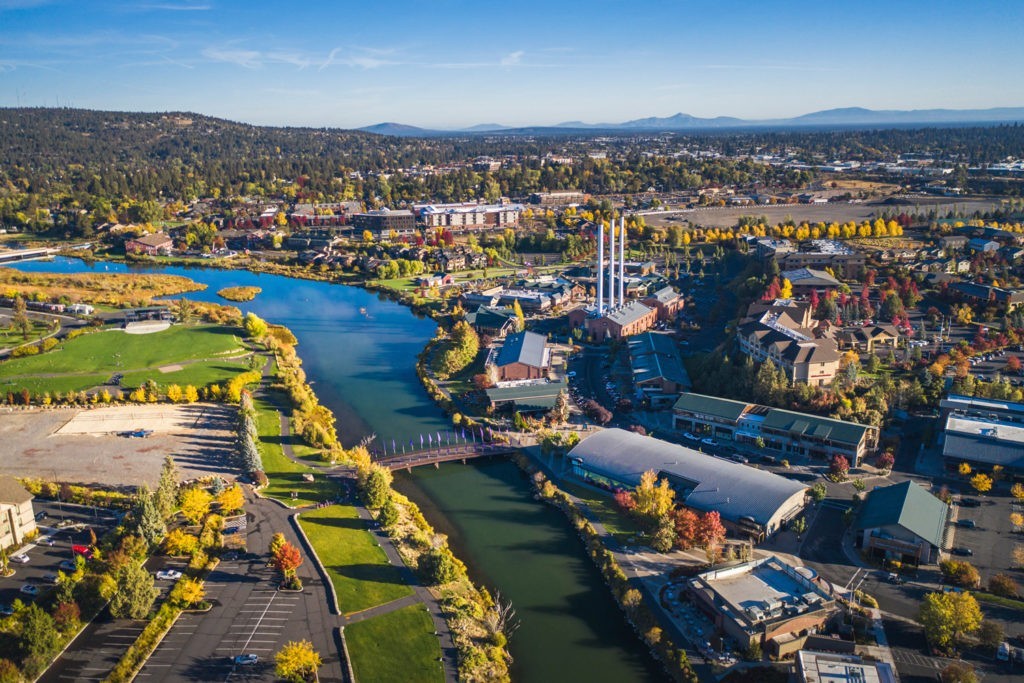
Bend’s combination of mountain access, sunshine, and outdoor lifestyle creates demand that no other Oregon market can replicate
2026 Economic Outlook
- OSU Cascades campus expansion driving student and faculty housing demand
- Remote work permanence sustaining high-income migration from coastal cities
- Mt. Bachelor ski area investment and capacity improvements
- Growing technology startup ecosystem attracted by quality of life
- Continued retirement migration from California and the Pacific Northwest
The Dual-Market Investment Opportunity
Bend is one of the few Oregon markets where investors must choose between two fundamentally different income strategies for the same property, and that choice drives every subsequent decision:
- Long-term rental (LTR): Lower income but passive management, Oregon SB 608 rent control compliance required, stable cash flow with lower variance. Best for investors who want predictability and minimal active involvement.
- Short-term rental (STR): Higher gross income ($40,000-$90,000/year for well-located properties) but active management or professional STR management required, city permit mandatory, seasonal income variation, and higher operating costs. Best for investors who want to maximize income and are willing to manage the complexity.
The gap between LTR and STR income in Bend is among the largest of any Oregon market. A property generating $2,400/month in long-term rent ($28,800/year) might generate $65,000/year gross as an STR. This differential is large enough to fundamentally change the investment math and must be understood before acquiring any Bend property.
Historical Performance
| Period | Market Driver | Avg Annual Appreciation | Key Event |
|---|---|---|---|
| 2010-2014 | Post-recession recovery, outdoor lifestyle rediscovery | 4-7% | Bend named one of America’s best places to live repeatedly |
| 2015-2019 | Portland overflow, remote work early adopters, STR boom | 9-14% | Airbnb STR market matures; Bend among top Oregon STR markets |
| 2020-2022 | Pandemic remote work surge, lifestyle migration explosion | 18-28% | Median price nearly doubles in 3 years; inventory hits historic lows |
| 2023-2024 | Rate shock, affordability correction | 0-3% | Market pauses but does not reverse; supply remains critically low |
| 2025-2026 | Rate stabilization, sustained remote work demand, STR recovery | 4-7% (projected) | OSU Cascades expansion and tech startup growth adding employment base |
Demographic Trends Driving Demand
- Remote Work Permanence – The pandemic proved that high-income professionals can work from anywhere. Bend offers what Portland cannot: sunshine, mountains, and small-city quality of life. This migration is ongoing and structural, not cyclical.
- Oregon State University Cascades – The growing branch campus adds thousands of students, faculty, and staff who create sustained rental demand in specific northside corridors
- Mt. Bachelor Tourism – 350+ inches of annual snowfall and a 12-month recreation calendar (skiing in winter, mountain biking in summer) drives 1.5M+ visitors annually, the foundational demand for Bend’s STR economy
- Retirement Migration – Active retirees from California, Seattle, and Portland choose Bend for its sunshine, outdoor access, and medical facilities (St. Charles is a major regional medical center)
- Federal Land Supply Cap – Deschutes National Forest and BLM land surrounds Bend on multiple sides. The city cannot sprawl outward the way Phoenix or Austin can. This permanent supply constraint is the bedrock of Bend’s long-term appreciation thesis
- Craft Beer and Food Tourism – Bend has more breweries per capita than almost any American city, creating a food and beverage tourism draw that extends the visitor season well beyond ski and summer recreation
📚 New to real estate investing? Master the fundamentals with our professional course Learn more →
2. Neighborhood Hotspots
Bend Investment Neighborhood Map
Interactive map of Bend’s investment neighborhoods. Green stars show top hotspots, blue circles mark established markets, and orange circles highlight emerging areas.
Core Investment Neighborhoods
Detailed Submarket Analysis: Bend Neighborhoods
| Neighborhood | Price Range | LTR Cap Rate | STR Gross Annual | Best Strategy |
|---|---|---|---|---|
| Old Bend / Downtown | $650K-$1.2M | 4.0-5.5% | $55,000-$80,000 | STR primary, LTR backup, appreciation hold |
| Northwest Crossing | $700K-$1.1M | 3.5-5.0% | $45,000-$65,000 | Family LTR, buy-and-hold appreciation |
| SE Bend / Larkspur | $520K-$750K | 5.0-6.5% | $40,000-$55,000 | Best value entry, balanced returns, ADU |
| River West | $600K-$900K | 4.5-6.0% | $50,000-$70,000 | STR and LTR, river access premium |
| Broken Top / Awbrey Butte | $900K-$2.0M+ | 3.5-5.0% | $60,000-$90,000+ | Luxury STR, executive LTR, appreciation |
| Tetherow | $800K-$2.0M | 3.5-5.0% | $55,000-$85,000 | Golf/ski STR, resort community appreciation |
| North Bend / Shevlin Area | $580K-$850K | 4.0-5.5% | $45,000-$60,000 | Trail access STR, OSU Cascades proximity |
| SE Murphy Crossing / New Dev. | $460K-$660K | 5.5-7.0% | $35,000-$50,000 | Best entry price, new construction advantage, LTR |
| South Bend / Deschutes River Woods | $500K-$850K | 4.5-6.5% | $45,000-$65,000 | Larger lots, Mt. Bachelor corridor STR, rural appeal |
Expert Insight: “The most overlooked opportunity in Bend right now is SE Bend, specifically the Larkspur and Murphy Crossing areas. You can buy a 3-bedroom home for $550,000-$620,000 that would cost $800,000 on the westside, with virtually identical access to trails, breweries, and Mt. Bachelor. As eastside amenities continue to develop over the next 3-5 years, that gap should compress meaningfully. The investors buying eastside Bend in 2025 and 2026 are positioning well ahead of that compression.” – Laura Thornton, Principal, Central Oregon Investment Group
3. Property Types
| Investment Goal | Best Property Type | Best Neighborhoods | Minimum Capital |
|---|---|---|---|
| Maximum Income (STR) | 3BR SFH with hot tub and mountain views | Old Bend, River West, Broken Top | $165,000+ |
| Maximum Appreciation | SFH in premium established neighborhood | Old Bend, Northwest Crossing, Broken Top | $175,000+ |
| Best Cash Flow (LTR) | Eastside SFH or new construction | SE Bend, Larkspur, Murphy Crossing | $120,000+ |
| Lowest Entry | Downtown condo or eastside townhome | Old Bend condos, SE new development | $105,000+ |
Don’t guess the costs. Our Complete Renovation & Remodeling Cost Guide covers 400+ pages of project-by-project breakdowns with real contractor pricing ranges.
4. Cost Analysis
Acquisition Cost Breakdown (Bend)
| Expense Item | Typical Cost | Example ($710,000 Property) | Notes |
|---|---|---|---|
| Down Payment | 25% (investment) | $177,500 | Many Bend properties now exceed conforming limit requiring jumbo financing |
| Closing Costs | 2-3% of price | $14,200-$21,300 | Title, escrow, lender fees, recording |
| Home Inspection | $450-$700 | $575 | Radon test recommended; elevated levels common in Central Oregon volcanic geology |
| Radon Test | $150-$300 | $200 | Central Oregon’s volcanic geology creates elevated radon risk; mitigation costs $800-$2,500 |
| STR Permit (if applicable) | $200-$500/year | $350 | City of Bend STR permit required. Verify permit availability before closing. |
| STR Furnishing (if applicable) | $15,000-$40,000 | $25,000 | Quality furnishings, hot tub ($5,000-$10,000), ski storage, outdoor equipment storage |
| Reserves (6 months) | 6 months expenses | $15,000-$22,000 | Larger reserves recommended for STR due to seasonal income variation |
| TOTAL ENTRY (LTR investor) | ~28-30% of value | $207,575-$221,575 | |
| TOTAL ENTRY (STR investor) | ~32-36% of value | $232,925-$264,925 | Includes furnishings and STR setup costs |
Side-by-Side: LTR vs. STR Cash Flow — Old Bend 3BR SFH ($710,000)
| Item | Long-Term Rental | Short-Term Rental | Notes |
|---|---|---|---|
| Gross Annual Income | $28,800 ($2,400/mo) | $68,000 (estimated) | STR at 70% occupancy, $275 avg nightly |
| Vacancy / Off-Season | -$1,440 (5%) | Included in occupancy rate above | |
| Property Taxes | -$3,550 | -$3,550 | ~0.5% of assessed value (Oregon low property tax) |
| Insurance | -$1,800 | -$3,200 | STR requires specific short-term rental or commercial policy |
| Management | -$2,880 (10%) | -$18,700 (27.5%) | STR mgmt companies charge 25-30% in Bend market |
| Utilities (STR pays utilities) | $0 | -$4,800 | Electric, gas, internet, streaming — landlord pays for STR |
| Cleaning and Supplies | $0 | -$5,500 | Turnover cleaning, linens, toiletries, consumables |
| Maintenance and CapEx | -$2,880 (10%) | -$4,800 (higher turnover wear) | STR properties experience higher wear from frequent guest turnover |
| Net Operating Income | $16,250 | $27,450 | Before mortgage |
| Mortgage ($710K, 25% down, 6.5%, 30yr) | -$33,805 | -$33,805 | P&I on $532,500 loan |
| ANNUAL CASH FLOW | -$17,555 | -$6,355 | STR dramatically reduces negative carry |
| Total Return (6% appreciation) | ~14% | ~19% | Including equity, appreciation, principal paydown |
This comparison shows why STR is the dominant investment strategy in close-in Bend. The same property under STR generates $11,200 more in net operating income annually, cutting the negative carry from $17,555 to $6,355. Over a 10-year hold with rising STR rates, that income differential compounds significantly. The tradeoff is higher management complexity, regulatory compliance, and seasonal income variation.
Expert Insight: “The investors who underperform in Bend are almost always those who buy without verifying STR permit availability and then discover the property is in an area where permits are capped or unavailable. The income difference between a permitted STR and a long-term rental on the same property in Old Bend can be $25,000-$35,000 per year. That changes the entire investment calculus. Verify the permit situation before you make an offer, not during due diligence.” – Kevin Walsh, Bend STR Specialist, Central Oregon Realty
5. Legal Framework
⚠️ Critical Bend STR Compliance Notice
Bend’s STR permit system is the most important legal consideration for Bend investors, separate from Oregon’s statewide rental laws. STR permits are required, tied to the property, and in some areas subject to density caps. Purchasing a Bend property with STR income in the financial model without first verifying permit availability is one of the most common and costly mistakes investors make in this market. Always confirm permit status before closing.
City of Bend STR Regulations
- Permit Requirement: All STR operations within Bend city limits require a City of Bend Short-Term Rental Permit. Operating without a permit carries fines of $500-$1,000 per day of violation.
- Permit Types: Type A (owner-occupied, renting rooms or unit when away) and Type B (non-owner-occupied investment STR). Most investment properties need a Type B permit.
- Density Caps: The City of Bend has implemented neighborhood density caps in some residential zones limiting the percentage of properties that can hold STR permits. Caps vary by zone and change as permits are issued and revoked.
- Liability Insurance: Minimum $500,000 liability insurance required and must be maintained as a permit condition.
- Neighbor Notification: Properties within 250 feet must be notified of STR operation. Neighbor complaints can trigger permit review.
- Noise and Occupancy Limits: Maximum occupancy rules and quiet hours enforced as permit conditions.
- Transient Lodging Tax: STR operators must collect and remit Oregon and Deschutes County transient lodging tax (typically 10-12% combined) on all guest stays.
- Annual Renewal: STR permits require annual renewal with compliance certification.
Oregon Statewide Law (Applies in Bend)
- SB 608 Rent Control: Annual rent increases for long-term rentals capped at 7% plus prior year CPI. New construction within 15 years of certificate of occupancy is exempt. Does not apply to STR.
- Just Cause Eviction: After 12 months of tenancy, documented just cause required to terminate a long-term tenancy. 90-day no-cause notice for qualifying situations. Does not apply to STR guests.
- Security Deposit Return: 31 days from move-out with itemized accounting.
- Deschutes County STR (outside city limits): Properties in Deschutes County but outside Bend city limits follow county STR rules, which are currently less restrictive than City of Bend rules. This is an important distinction for properties in Tumalo, Alfalfa, and other county areas.
Key STR Resources
- City of Bend STR Program: bendoregon.gov/str
- Deschutes County STR: deschutes.org
- Oregon Transient Lodging Tax: oregon.gov/dor
- Bend permit inquiry line: 541-388-5580
| Regulation | Bend City Limits | Deschutes County (outside city) | Investor Impact |
|---|---|---|---|
| STR Permit | Required, Type A or B, density caps apply | Required but less restrictive, fewer caps | Verify availability before purchase; county properties may be easier to permit |
| Rent Control (LTR) | Oregon SB 608 (7% + CPI cap) | Same statewide law | New construction exempt for 15 years |
| Transient Lodging Tax | Oregon (1.8%) + Deschutes County (8%) + City of Bend (varies) = ~10-12% total | Oregon + Deschutes County only (lower total) | Must collect and remit; platforms like Airbnb collect automatically in most cases |
| Portland Ordinances | Do not apply | Do not apply | No Portland relocation assistance, no mandatory screening disclosure |
| Eviction (LTR) | Oregon statewide just cause after 12 months | Same statewide law | Faster than Portland or Seattle; Oregon court process typically 30-60 days for non-payment |
6. Step-by-Step Bend Investment Playbook
Choose Your Bend Strategy
The LTR vs. STR decision is the most consequential choice a Bend investor makes. Every subsequent decision, including neighborhood, property type, budget, and management approach, flows from this primary choice:
STR Income Strategy
Maximize rental income through short-term rental operation. Best for: investors comfortable with active management or professional STR management fees, properties near downtown and outdoor recreation, and investors who want income to offset the significant negative carry of Bend’s premium prices.
LTR Appreciation Play
Buy in a premium established neighborhood and hold for long-term appreciation, accepting negative carry. Best for: high-income investors who can carry the property comfortably, those who want minimal management involvement, and investors with a 7-10+ year hold horizon.
Value-Add Eastside
Buy dated housing in SE Bend or eastside neighborhoods at a meaningful discount to westside comparables. Renovate to improve rents and ARV. Benefit from general Bend appreciation while starting from a lower basis. Best BRRRR opportunity in the Bend market.
New Construction LTR (Eastside)
Buy new construction in SE Bend development areas. Benefit from the 15-year Oregon rent control exemption, zero deferred maintenance, and appreciation as the community builds out. Lower income than established neighborhood STR but more predictable and passive.
Build Your Bend Team
- Bend Investment Specialist Agent: Must understand both STR and LTR investment math, know which neighborhoods have STR permit availability, and have experience with investment acquisitions specifically. Listing agents and residential buyer agents rarely have this expertise.
- STR Management Company (if STR strategy): Bend has several professional STR management companies. Interview them on their average occupancy rates, their cleaning turnaround process, and their dynamic pricing approach. Fees of 25-30% are standard. The best companies more than earn their fee through superior pricing and occupancy optimization.
- Oregon-Licensed Real Estate Attorney: For lease compliance on LTR properties, entity structure, and Oregon SB 608 guidance. Ensure they have Deschutes County experience.
- Oregon CPA with STR Experience: STR tax treatment differs significantly from LTR. Depreciation, the Augusta Rule, passive activity rules, and transient lodging tax compliance all require specialized expertise for Bend STR operators.
- Deschutes County Contractor: If pursuing value-add, your contractor needs permit experience with Deschutes County building department. Bend has experienced significant construction demand; build contractor relationships early.
Expert Tip: Before hiring a STR management company, ask to see their actual occupancy reports and average daily rate data for comparable properties they currently manage. Companies that refuse to share this data or only provide projections rather than actuals are a red flag. The Bend STR market has enough transaction history that a competent manager should be able to show you real performance data for real properties.
Bend-Specific Due Diligence
Physical Due Diligence
- Radon test: Central Oregon’s volcanic geology creates elevated radon risk; mandatory for every Bend purchase
- Roof condition: heavy snow load seasons affect roofing systems and structures
- HVAC: Central Oregon’s cold winters and hot summers create high HVAC demand; verify system age and capacity
- Water heater and insulation: older Bend homes often have undersized systems for STR’s higher usage
- Hot tub condition and electrical capacity if hot tub is part of STR appeal
- Wildfire risk zone designation: check Deschutes County’s wildfire hazard map for properties in or near forested areas
STR-Specific Due Diligence
- Verify City of Bend STR permit availability for the specific address and zone before making any offer contingent on STR income
- Confirm permit type (Type A or B) and any conditions attached to existing permits if acquiring a currently operating STR
- Review HOA CC&Rs if applicable: some Bend HOAs restrict or prohibit STR
- Pull transient lodging tax compliance history for any currently operating STR
- Review existing STR listing data (Airbnb, VRBO) for the property if it has been operated as STR
- Confirm insurance: standard homeowner policies do not cover STR liability; confirm proper coverage can be obtained before closing
Competing in Bend’s Market
- STR permit verification as offer condition: Make your offer contingent on confirmation of STR permit availability if STR income is part of your underwriting. This is standard practice among experienced Bend investors and sellers understand it.
- Pre-inspection for competitive offers: Bend’s desirable westside properties move quickly. Pre-inspecting a property before offer submission ($450-$700) allows clean non-contingent bids that frequently win over higher contingent offers.
- Shoulder season targeting: Bend’s buyer pool thins in January through March. Sellers with properties that have sat through the peak fall market are often more negotiable in the January to March window.
- Eastside direct mail: Long-term eastside Bend homeowners, particularly those in the Larkspur and Murphy Road corridors who have owned 15+ years, frequently consider off-market sales. Direct mail produces deals at below-list pricing that are unavailable to buyers competing on MLS.
- Wildfire risk discounts: Properties in WUI (Wildland-Urban Interface) zones often price at a discount due to insurance costs and buyer hesitancy. Investors comfortable with the risk (and properly insured) can access Bend inventory at better economics than comparable properties in lower-risk zones.
Managing a Bend STR Successfully
Key STR Optimization Factors
- Dynamic pricing: Use Pricelabs, Wheelhouse, or your management company’s pricing tool to automatically adjust nightly rates based on local demand, events, and booking pace. Static pricing leaves significant revenue on the table during peak ski and summer season.
- Minimum stay strategy: Require 2-night minimums on weekdays and 3-night minimums on peak weekends (holiday weekends, Mt. Bachelor ski days) to reduce cleaning costs and avoid low-value single-night bookings.
- Seasonal marketing: Actively market ski season (December through March) and summer recreation (June through September). Shoulder season marketing (October to November, April to May) requires more aggressive pricing and targeted outdoor recreation promotion.
- Hot tub and outdoor amenity investment: Properties with hot tubs consistently earn 15-25% more in Bend than comparable properties without. The investment of $5,000-$10,000 for a hot tub typically pays back in one season.
- Superhost status: Maintaining Airbnb Superhost and VRBO Premier Host status increases visibility in search results and commands 5-10% higher rates. Response time, review quality, and cancellation policy all factor in.
Typical Bend STR Management Fee Structures
- Full-service STR management: 25-30% of gross revenue
- Listing and pricing only (owner manages cleanings): 10-15%
- Cleaning fee: $150-$300 per turnover depending on property size
- Annual STR permit renewal management: $200-$400 if manager handles
- Transient lodging tax remittance: typically included in full-service management
7. Financing Options for Bend
| Loan Type | Down Payment | Rate Premium | Best For | Bend Note |
|---|---|---|---|---|
| Conventional Investment | 25% | +0.5-0.75% | Strong W-2 income, good credit | Works for properties under $806,500; SE Bend and eastside qualify |
| Jumbo Investment | 25-30% | +0.75-1.25% | Westside and premium properties | Required for most Old Bend, NWX, Broken Top properties above $806,500 |
| DSCR Loan | 20-25% | +1.5-2.5% | Investors using STR income for qualification | Some lenders allow STR income (from AirDNA or actual) for DSCR calculation. Verify lender policy. Rates are higher but STR income can make coverage ratios work. |
| STR-Specific Loan Programs | 20-25% | +1.5-2.5% | Purpose-built STR financing using market STR income | Several lenders now offer programs using Airbnb and VRBO market data for underwriting. Better than traditional DSCR for confirmed STR properties. |
| Portfolio Loan | 20-30% | +1-2% | Multiple properties, self-employed, complex income | Umpqua Bank and Central Oregon-based lenders offer portfolio products for Deschutes County investors |
| Hard Money (Bridge) | 15-25% | 9-12% rate | Value-add BRRRR, competitive offers | Eastside Bend value-add is the primary BRRRR use case; Oregon-based hard money lenders active in Deschutes County |
Bend Financing Reality: Bend’s median price of $710,000 puts many properties above the $806,500 conforming limit, requiring jumbo financing for westside and premium properties. This means stronger income documentation requirements and fewer lender options than SE Bend’s conforming-eligible properties. Investors targeting STR income should specifically look for lenders who will underwrite using STR market data or actual STR revenue, as traditional income documentation often understates the economic reality of a productive Bend STR property.
8. Frequently Asked Questions

Knowledge Quiz: Bend Oregon Real Estate Investment
Open Quiz
5 quick questions on what you just learned about investing in Bend
1) What is the single most important pre-purchase step for a Bend investor planning to operate a short-term rental?
Answer: C
The guide identifies STR permit verification as the most critical pre-purchase step in Bend. The city has implemented density caps in some neighborhoods, and operating without a permit carries fines of $500-$1,000 per day. The income difference between a permitted STR and a long-term rental on the same Old Bend property can be $25,000-$35,000 per year. Always verify permit availability before closing, ideally as a contingency in the offer.
2) What is the primary geographic factor that permanently supports Bend real estate values regardless of market cycles?
Answer: A
The guide identifies the surrounding National Forest and BLM land as the bedrock of Bend’s long-term appreciation thesis. Unlike Phoenix or Austin, Bend cannot sprawl outward. This permanent supply constraint supports values through market cycles because the city has a hard geographic ceiling on developable land that will never change.
3) According to the guide’s side-by-side comparison, how much more net operating income does a well-run STR generate compared to a long-term rental on the same Old Bend 3BR property?
Answer: D
The guide’s cash flow comparison shows the same $710,000 Old Bend property generating $16,250 NOI as a long-term rental and $27,450 NOI as a short-term rental, a difference of $11,200 annually. This reduces the annual negative cash flow from $17,555 (LTR) to $6,355 (STR) after mortgage, a meaningful improvement that compounds significantly over a 10-year hold.
4) What physical due diligence test does the guide describe as mandatory for every Bend property purchase, due to Central Oregon’s volcanic geology?
Answer: B
The guide identifies radon testing as mandatory for every Bend property purchase. Central Oregon’s volcanic geology creates elevated radon levels that are more prevalent than in many other Pacific Northwest markets. Radon mitigation costs $800-$2,500 if levels are elevated, which is manageable, but the test must be done. This appears in both the acquisition cost breakdown and the due diligence section.
5) Which Bend neighborhood does the guide identify as the best value-for-money opportunity in 2026, trading 20-30% below comparable westside properties?
Answer: C
The guide identifies SE Bend and the Larkspur area as Bend’s best value-for-money investment in 2026. Newer housing stock at 20-30% below comparable westside properties, improving retail along Reed Market Road, and strong appreciation momentum make this the neighborhood of choice for investors who believe in Bend’s long-term story but want a more accessible entry price. The expert quote notes that investors buying here in 2025-2026 are positioning ahead of eastside appreciation as amenities continue to develop.
Work With a Local Expert in Bend
We are building a verified network of real estate professionals across every market we cover.

About Our Expert Network
We are finalizing partnerships with verified real estate professionals across every market featured on Builds and Buys. Each expert in our Bend network is selected for their hands-on STR and LTR investment experience in Deschutes County, knowledge of Bend STR permit regulations, and relationships with professional STR management companies in the market.
- Proven experience with STR and investment properties in Bend and Deschutes County
- Current knowledge of Bend STR permit availability by neighborhood and zone
- Relationships with top-performing STR management companies in Central Oregon
- Wildfire risk zone assessment expertise and insurance referrals
- Full transaction support from search through closing and STR setup
Services Covered
- STR permit verification and acquisition
- Property sourcing and acquisition
- STR vs LTR income analysis
- STR management company referrals
- Wildfire risk and insurance guidance
- Value-add and renovation guidance
- Legal and title referrals
- Financing and lender connections
- STR-friendly property management
- Insurance and inspection referrals
- 1031 exchange coordination
- Exit strategy planning
Get Connected or Join Our Network
Looking for a Bend expert to help with your investment? Reach out and we will connect you with the right professional for your market and strategy.
Contact us at support@buildsandbuys.com
Find Specialized Bend Real Estate Professionals
Ready to Invest in Bend?
Bend is not a simple market. Premium pricing, STR permit complexity, wildfire risk in certain zones, and Oregon’s statewide rent control all require careful navigation. But for investors who do the work, verify the STR permit situation, match their strategy to the right neighborhood, and commit to a long-term hold, Bend has delivered some of the strongest total returns in Oregon over the past decade. The permanent supply constraint, year-round tourism economy, and sustained remote worker demand create a fundamentally sound investment case that outlasts individual market cycles.
Continue Your Research
Oregon State Guide
See how Bend compares to Portland, Eugene, Salem, and other Oregon markets.
Step-by-Step Invest
Complete framework for building a real estate investment strategy from scratch.
144-Lesson Course
University-level real estate education covering financing, law, strategy, and management.
For further guidance, explore our State-by-State Investor guides, browse our expert articles, or follow our Step-by-Step Investment Guide.



