Aurora Colorado Real Estate Investment Guide For 2026
The definitive guide to investing in Colorado’s second-largest city, anchored by the Anschutz Medical Campus, light rail expansion, and one of the most diverse and growing rental populations in the Mountain West
Quick answers: Top 5 most searched Aurora investment questions ▼
Migration data: Where people are moving from to Aurora ▼
In This Guide
Click on any section to navigate directly to that content
1. Aurora Market Overview
Market Fundamentals
Aurora is Colorado’s second-largest city and one of the most strategically positioned real estate investment markets in the Mountain West. Where Denver attracts the lifestyle-premium buyer, Aurora delivers something equally valuable but often overlooked: genuine cash flow potential anchored by four distinct, non-correlated demand drivers that provide remarkable rental market stability regardless of broader economic conditions.
The Anschutz Medical Campus is Aurora’s crown jewel, a 227-acre health sciences complex that is one of the largest academic medical centers in the United States. With UCHealth University of Colorado Hospital, Children’s Hospital Colorado, the CU School of Medicine, and dozens of research institutes all operating from the same campus, Anschutz generates over 30,000 employees and students who need housing within a reasonable commute.
- Population: 395,000+, Colorado’s second-largest city
- Major Employers: UCHealth, Children’s Hospital Colorado, Buckley Space Force Base, Amazon fulfillment, DIA (Denver International Airport adjacent), Aurora Public Schools
- Median Household Income: $62,000
- Unemployment: 3.8%, tracking closely with the broader Denver metro
- Vacancy Rate: 4 to 6% citywide, tighter near Anschutz and light rail stations
- Light Rail Access: I-225 light rail corridor connects Aurora directly to Denver Union Station and the entire RTD network
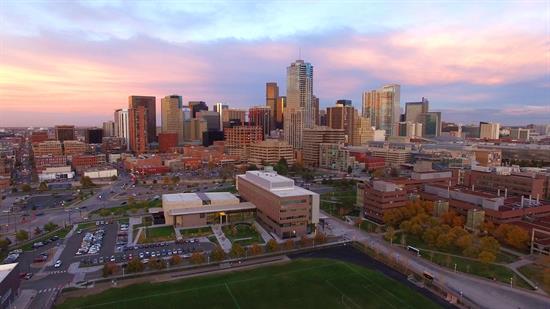
Aurora sits at the intersection of healthcare, defense, and Denver affordability demand, creating a uniquely stable rental market
2026 Economic Outlook
- Anschutz Medical Campus Phase 3 expansion adding 3,000+ jobs by 2027
- Buckley Space Force Base mission expansion driving contractor hiring
- Amazon logistics hub expansion at DIA corridor creating 1,500+ warehouse jobs
- I-225 light rail ridership increasing as Denver core prices force eastward migration
- Gaylord Rockies Resort convention traffic supporting short-term and extended-stay demand near DIA
The Aurora Advantage: Why Investors Choose It Over Denver
Aurora’s investment case rests on a straightforward arbitrage: you get most of the economic upside of Denver’s metro economy at a 20 to 30% entry price discount with meaningfully better cash flow characteristics and a more landlord-friendly regulatory environment.
- Cash flow is achievable: At $475,000 median and $2,100/month typical rent, Aurora’s rent-to-price ratio of roughly 0.44% monthly sits significantly above Denver proper’s 0.32% to 0.38%. This difference is the line between negative and neutral-to-positive monthly carry with conventional financing.
- No just cause ordinance: Aurora follows Colorado state law, not Denver’s stricter municipal code. This gives investors more flexibility in tenant management and lease non-renewal.
- Anschutz demand is recession-resistant: Healthcare employment does not track the broader economy. During the 2020 downturn and the 2023 rate shock, Anschutz-adjacent rentals maintained occupancy above 96% while other Aurora submarkets softened slightly.
- Military BAH as income floor: Buckley Space Force Base BAH rates provide a government-set income floor for the military rental market. As long as Buckley is operational, this demand is essentially guaranteed.
- Light rail leverage: Properties within a 10-minute walk of I-225 light rail stations command rental premiums and vacancy rates comparable to core Denver at a fraction of the entry cost.
Historical Performance
| Period | Market Driver | Avg Annual Appreciation | Key Event |
|---|---|---|---|
| 2010-2014 | Post-recession recovery, Anschutz expansion | 4-7% | Children’s Hospital Colorado relocates to Anschutz campus |
| 2015-2019 | Denver overflow, I-225 light rail opens | 8-12% | I-225 light rail extension completed, connecting Aurora to Denver rail network |
| 2020-2022 | Pandemic migration, inventory collapse | 13-18% | Aurora benefited disproportionately from space-seeking pandemic migration |
| 2023-2024 | Rate normalization | 1-4% | Market moderated but Anschutz corridor held stronger than broader Aurora |
| 2025-2026 | Medical campus expansion, defense growth | 6-10% (projected) | Anschutz Phase 3 and Buckley expansion driving northeast Aurora demand |
📚 New to real estate investing? Master the fundamentals with our professional course Learn more →
2. Neighborhood Hotspots
Aurora Investment Neighborhood Map
Interactive map of Aurora’s investment neighborhoods. Green stars mark top hotspots, blue circles show established markets, and orange circles highlight emerging areas.
Core Investment Neighborhoods
Detailed Submarket Analysis: Aurora Neighborhoods
| Neighborhood | Price Range | Cap Rate | Primary Demand Driver | Best Strategy |
|---|---|---|---|---|
| Fitzsimons / Anschutz | $420K-$750K | 5.0-6.5% | Healthcare workers and medical students | Long-term hold, medical furnished rental |
| Centretech / I-225 | $380K-$600K | 5.5-7.0% | Denver commuters via light rail | Transit-oriented buy-and-hold, condo |
| Buckley / Hoffman Heights | $350K-$575K | 5.5-7.0% | Military BAH income from Buckley SFB | Military rental specialist, BAH-priced units |
| Southlands / SE Aurora | $475K-$750K | 4.5-5.5% | Families seeking Denver schools at lower cost | Newer SFH, family rental, low maintenance |
| Aurora Hills / Central | $340K-$520K | 5.5-7.0% | Working-class renters, affordability migrants | Value-add, BRRRR, cash flow focus |
| Saddle Rock / Tallyn’s Reach | $600K-$950K | 4.0-5.0% | Executive families, Cherry Creek school district | Premium SFH, executive rental, appreciation |
| Green Valley Ranch / NE | $320K-$480K | 6.0-8.0% | DIA and logistics worker housing | Cash flow maximum, affordable hold |
| Gateway / Montebello East | $310K-$470K | 6.5-8.5% | Airport corridor and warehouse employment | Highest yields, long appreciation horizon |
Expert Insight: “The Anschutz corridor is one of the most underappreciated rental demand anchors in Colorado. Investors who focus purely on price-to-rent ratios miss what really matters: tenant quality and tenure. Medical residents and fellows rent for 3 to 7 years, earn $60,000 to $90,000 during training and $200,000 to $400,000 as attending physicians, and treat rental properties with the same professional care they apply to their clinical work. The vacancy rate within one mile of Anschutz has not exceeded 3.5% in any recorded year since the campus consolidated in 2007. You simply cannot buy that kind of stability anywhere else in the Aurora metro.” – Dr. Patricia Howe, Medical Real Estate Investors Network, Colorado Chapter
3. Property Types
| Investment Goal | Best Property Type | Best Areas | Minimum Capital |
|---|---|---|---|
| Stability and Low Vacancy | SFH near Anschutz campus | Fitzsimons corridor, within 1 mile of campus | $110,000+ |
| Maximum Cash Flow | Small multi-family or affordable SFH | Green Valley Ranch, Central Aurora | $85,000+ |
| Premium Income | Medical furnished rental near Anschutz | Fitzsimons, Centretech | $120,000+ |
| Family Market / Low Maintenance | Newer SFH in southeast Aurora | Southlands, Saddle Rock, Tallyn’s Reach | $125,000+ |
Our Complete Renovation and Remodeling Cost Guide covers 400+ pages of project-by-project breakdowns with real contractor pricing ranges applicable to the Denver metro area.
4. Cost Analysis
Acquisition Cost Breakdown (Aurora)
| Expense Item | Typical Cost | Example ($475,000 Property) | Notes |
|---|---|---|---|
| Down Payment | 25% (investment) | $118,750 | Standard for investment properties in Colorado |
| Closing Costs | 2-3% | $9,500-$14,250 | Title, lender fees, recording, transfer taxes |
| Inspection | $400-$650 | $500 | Include sewer scope for pre-1990 Aurora homes |
| Radon Testing | $150-$300 | $200 | Colorado elevated radon zone. Mitigation $800 to $2,500. |
| Hail Assessment | Part of inspection | $0 | Same hail exposure as Denver. Class 4 roof upgrade strongly recommended. |
| Initial Repairs | 0-8% | $0-$38,000 | Older Aurora central homes often need HVAC, flooring, kitchen updates |
| Reserves | 6 months expenses | $10,000-$15,000 | Emergency fund for vacancy and unexpected repairs |
| TOTAL MINIMUM ENTRY | ~28-32% | $138,950-$186,700 | Meaningfully lower barrier than comparable Denver purchase |
Sample Cash Flow Analysis: Fitzsimons Area 3BR SFH
| Item | Monthly | Annual | Notes |
|---|---|---|---|
| Gross Rent | $2,300 | $27,600 | 3BR SFH near Anschutz, renovated |
| Less Vacancy (4%) | -$92 | -$1,104 | Low vacancy near Anschutz; 4% is conservative |
| Property Taxes | -$250 | -$3,000 | ~0.55% of $545K assessed value (purchase + improvements) |
| Insurance | -$175 | -$2,100 | Landlord policy with hail endorsement |
| Property Management (9%) | -$207 | -$2,484 | Aurora management typically 8 to 10% |
| Maintenance and CapEx (8%) | -$184 | -$2,208 | 8% for renovated Aurora home; hail budget included |
| Net Operating Income | $1,392 | $16,704 | Before mortgage |
| Mortgage ($500K purchase, 25% down, 6.75%, 30yr) | -$2,433 | -$29,196 | P and I on $375K financed |
| CASH FLOW | -$1,041 | -$12,492 | Negative but significantly better than comparable Denver property |
| Cap Rate | 3.34% | NOI / total cost; strong for this price range | |
| Total Return (9% appreciation) | ~20% | Including equity, appreciation, and principal paydown |
The Aurora vs Denver math: The equivalent Denver Five Points property from the Denver guide generates negative $1,903/month. This Aurora Anschutz property generates negative $1,041/month, roughly $860/month less negative carry for a property producing similar rents. Over a 10-year hold, that difference compounds to approximately $103,000 in reduced out-of-pocket carrying costs, before accounting for the appreciation differential, which has historically favored Denver proper for the highest-appreciation neighborhoods.
Expert Insight: “I tell investors to think of Aurora as Denver with training wheels. You get 80 to 85% of Denver’s appreciation upside, 60% less negative monthly carry, and a landlord-tenant regulatory environment that is genuinely investor-friendly. For investors building their first portfolio, Aurora is where I always start the conversation. Get two or three Aurora properties with manageable cash flow, build equity through appreciation, then leverage that equity into Denver proper once your portfolio can absorb the carry. That is how serious Denver metro investors scale.” – Roberto Castillo, Colorado Investment Properties Group
5. Legal Framework
✅ Aurora Regulatory Advantage
Unlike Denver, Aurora does not have a just cause eviction ordinance or first-in-time applicant rules. Aurora follows Colorado state landlord-tenant law, which is significantly more landlord-friendly than Denver’s municipal code. This is a meaningful practical difference for investors who want operational flexibility in managing their rental portfolio.
Colorado State Regulations (Aurora)
- Eviction Process: 10-day notice for non-payment of rent (3-day in some cases). After notice period, landlord files with Arapahoe County Court. Uncontested evictions typically complete in 3 to 6 weeks, much faster than Denver’s just cause process.
- No Just Cause Requirement: Unlike Denver, Aurora landlords can non-renew a lease at expiration without providing a qualifying reason. This gives investors meaningful flexibility to transition between tenants without legal exposure.
- Rent Increase Notice: Colorado requires 60 days written notice for rent increases. No Aurora-specific overlay requirements beyond state law.
- Security Deposit: Return within 60 days of lease termination. Landlord must provide itemized accounting for any deductions. Failure triggers double-deposit liability.
- Source of Income: Colorado statewide source of income protection applies in Aurora. Cannot refuse qualified Section 8 voucher holders.
- SCRA Compliance: Military tenants from Buckley are protected by the federal Servicemembers Civil Relief Act. Early termination rights, interest rate caps on pre-service debt, and eviction protections apply. Landlords must understand these before renting to active duty personnel.
- STR Regulations: Aurora requires a Short-Term Rental License and allows STRs in most zones with a valid license. Aurora is less restrictive than Denver on STR primary residence requirements, though regulations are evolving.
Compliance Best Practices for Aurora
- Lease Templates: Use a Colorado state-compliant lease updated annually. Include specific clauses for Buckley military tenants covering SCRA rights and early termination procedures.
- Tenant Screening: While Aurora has no first-in-time rule, Colorado’s fair housing and source of income protections still apply. Screen consistently using objective, written criteria applied to all applicants.
- Military Tenant Protocol: Request deployment orders as part of military tenant screening. Understand SCRA early termination rights before signing with active duty personnel. The income stability usually outweighs the early termination risk.
- Habitability Standards: Colorado’s warranty of habitability applies. Maintain documented maintenance records with timestamps. Response times: 24 hours for heat and hot water failures, 72 hours for appliances, 10 days for general repairs.
- STR License: If operating any unit as a short-term rental, obtain Aurora’s STR License before listing. Aurora’s enforcement has increased since 2023.
- Hail Insurance Endorsement: Not a legal requirement but a practical necessity. Confirm your landlord policy explicitly covers hail damage without excessive deductibles.
Useful Aurora Resources
- Aurora City Clerk (licenses): auroragov.org/clerk
- Arapahoe County Court (evictions): arapahoegov.com/courts
- Colorado Apartment Association: caahq.org
- Colorado Military Legal Assistance: jagcnet.army.mil
| Regulation | Aurora (State Law) | Denver (Municipal Code) | Investor Impact |
|---|---|---|---|
| Eviction Cause | No just cause required; non-renew freely | Just cause required after 12 months | Aurora significantly more flexible for lease transitions |
| Eviction Timeline | 3 to 6 weeks uncontested | 4 to 16 weeks with just cause disputes | Aurora exposure to bad tenants is shorter |
| Tenant Selection | Landlord discretion within fair housing rules | First-in-time rule restricts selection | Aurora landlords can choose among qualified applicants |
| Rent Increase Notice | 60 days statewide | 60 to 81 days for large increases | Minimal difference; plan rent adjustments 3 months ahead in both markets |
| STR Rules | License required; less restrictive than Denver | Primary residence required; highly restrictive | Aurora offers more STR flexibility for secondary investment properties |
6. Step-by-Step Aurora Investment Playbook
Choose Your Aurora Demand Driver
Aurora’s investment thesis is built on four distinct demand pillars. Pick one to specialize in before selecting a property.
Healthcare / Anschutz Strategy
Buy near the medical campus and market exclusively to medical residents, fellows, nurses, and researchers. Lowest vacancy in Aurora, highest-quality tenants, and 2 to 7 year average tenancies.
Military / Buckley BAH Strategy
Target properties near Buckley and price rentals to align with BAH rates by rank. Understand SCRA. Government-backed income with assignment-cycle predictability.
Transit-Oriented Commuter Strategy
Buy within 10 minutes walk of I-225 light rail stations. Market to Denver workers who want to pay Aurora rents while accessing Denver employment via rail. Best cap rates in Aurora for transit-oriented assets.
Cash Flow Maximum Strategy
Target DIA corridor and far northeast Aurora for highest rent-to-price ratios in the entire Denver metro. Accept slower appreciation in exchange for genuine monthly income today.
Build Your Aurora Team
- Arapahoe County Specialist Agent: Must understand Aurora’s distinct submarket dynamics and the Anschutz premium. Ask for their last 5 Aurora investment transactions specifically.
- Colorado Real Estate Attorney: For entity setup and lease compliance. Especially important if planning military rental strategy, as SCRA provisions require legal familiarity.
- Aurora Property Manager: Verify experience managing near Anschutz or with military tenants specifically if those are your target demographics. Generic Denver property managers often underestimate the medical campus market.
- Denver Metro Lender: Most Aurora properties qualify for conventional conforming loans given the $475,000 median. Work with a lender familiar with Colorado investment property requirements.
- Hail-Savvy Contractor: Establish a contractor relationship before you buy. Class 4 roofing upgrades and gutters pay for themselves quickly in the Denver metro hail environment.
Aurora-Specific Due Diligence
Physical Checks
- Hail damage inspection on all exterior surfaces and roof
- Radon test on all properties with basement or slab foundation
- Sewer scope for pre-1990 Aurora homes
- HVAC age and condition critical in Aurora’s climate extremes
- Foundation check for expansive soil movement in east Aurora clay zones
- Window condition for energy efficiency in Colorado winters
Market and Regulatory Checks
- Confirm property is in Aurora jurisdiction vs. unincorporated Arapahoe County (different code enforcement)
- Check HOA rental restrictions for any condo or planned community purchase
- Verify flood zone status for properties near Sand Creek or other drainage channels
- Confirm proximity to Anschutz or Buckley gate if those strategies are planned
- Check current tenant lease terms and any notice requirements for transition
- Verify any open permits or code enforcement actions on the property
Marketing to Your Target Tenant Demographic
Aurora’s tenant demographics are distinct enough that generic Zillow listings underperform targeted outreach. Specific channels by strategy:
- Medical tenants: Post in the CU Anschutz housing Facebook groups, the UCHealth employee intranet housing board, and Children’s Hospital Colorado housing resources. Residents rotate in July and fellows in June or July. List your property in April to capture rotating residents before they find alternatives.
- Military tenants: List on MilitaryByOwner.com and AKO housing boards. Buckley housing office maintains an off-base referral list that active duty families use first. Getting on that list is worth more than any Zillow listing.
- Denver commuters: Focus listings on transit-oriented keywords. “10 minutes to Denver Union Station by light rail” in your listing title dramatically increases inquiries from the Denver commuter segment.
- Family renters: Southlands-area properties rent fastest through school district parent Facebook groups. Parents research schools first and neighborhoods second; lead with Cherry Creek or Aurora Public School district information in listings.
7. Financing Options for Aurora
| Loan Type | Down Payment | Rate Premium | Best For | Aurora Note |
|---|---|---|---|---|
| Conventional Investment | 25% | +0.5-0.75% | Most Aurora purchases under $806,500 | Most Aurora SFH and condo purchases fall within conforming limit; no jumbo required |
| DSCR Loan | 25-30% | +1.5-2.5% | Self-employed or investor income qualifying | Some Aurora properties near Anschutz or in Green Valley Ranch achieve 1.0x DSCR at current rates |
| House Hacking FHA | 3.5% | Standard plus MIP | First-time investors owner-occupying a duplex or triplex | Best entry point for building Aurora portfolio with minimal capital; strong near Anschutz and Buckley |
| VA Loan (Military) | 0% | Below market | Active duty or veteran investors owner-occupying | Buckley-based investors can use VA loan to purchase near base, house hack, then retain as rental on PCS orders |
| Portfolio Loan | 20-30% | +1-1.75% | Investors scaling to 5+ Aurora properties | Several Arapahoe County community banks offer portfolio products for local investor relationships |
| Hard Money Bridge | 15-25% | 9-13% rate | BRRRR acquisitions in Central Aurora value-add corridors | Several Denver-area hard money lenders active in Aurora value-add space |
Aurora Financing Advantage: Because most Aurora investment properties fall well below Denver’s $806,500 conforming limit, the majority of purchases qualify for standard conventional investment loans rather than the higher-rate jumbo products required for many Denver proper purchases. The combination of lower entry prices, conventional financing availability, and higher cap rates means Aurora is one of the few Denver-area markets where DSCR loans can sometimes qualify, giving investors with non-traditional income more financing options than anywhere else in the metro.
8. Frequently Asked Questions

Knowledge Quiz: Aurora Colorado Real Estate
Open Quiz
5 quick questions on what you just learned about Aurora investing
1) What is Aurora’s single most important rental demand anchor?
Answer: B
The Anschutz Medical Campus is Aurora’s crown jewel investment anchor. With 30,000+ employees and students across UCHealth, Children’s Hospital Colorado, and CU School of Medicine, it generates the largest and most stable rental demand of any single employer in Aurora. Medical tenants average 3.2-year stays versus 1.4 years for the metro average.
2) What major regulatory advantage does Aurora have over Denver for landlords?
Answer: C
Unlike Denver which requires just cause for eviction or non-renewal after 12 months of tenancy, Aurora follows Colorado state law and has no just cause ordinance. Landlords can non-renew a lease at expiration without providing a qualifying reason, giving significantly more operational flexibility than Denver.
3) What is BAH and how does it affect the Buckley military rental market?
Answer: D
Basic Allowance for Housing (BAH) is a monthly stipend paid to military personnel to cover off-base housing costs. BAH rates are set by the Department of Defense based on local market data and vary by rank and dependent status. Near Buckley, BAH runs $1,800 to $2,600/month depending on rank. Landlords who price rentals to BAH rates tap into essentially government-backed rental income.
4) Which Aurora submarket offers the highest cap rates in the entire Denver metro area?
Answer: A
Gateway and Montebello East near DIA offer cap rates of 6.5 to 8.5%, the highest in the entire Denver metro area. These areas benefit from DIA logistics and warehouse worker rental demand with entry prices of $310,000 to $470,000. The tradeoff is slower near-term appreciation compared to Anschutz-adjacent or light rail corridor properties.
5) What does SCRA stand for and why must Aurora landlords near Buckley understand it?
Answer: B
The Servicemembers Civil Relief Act (SCRA) is a federal law protecting active duty military members. Key provisions include the right to terminate a lease with 30 days notice when receiving PCS orders or deployment orders, protection from eviction for non-payment during deployment, and interest rate caps on pre-service debt. Landlords near Buckley must include SCRA addenda in leases and cannot contract around these federal protections.
Work With a Local Expert in Aurora
We are building a verified network of real estate professionals across every market we cover.

About Our Expert Network
We are finalizing partnerships with verified real estate professionals across every market on Builds and Buys. Aurora specialists in our network bring specific expertise in Anschutz-adjacent rentals, military tenant management near Buckley, and the I-225 light rail investment corridor.
- Proven experience with Aurora investment and income-producing properties
- Knowledge of Anschutz campus rental premiums and medical tenant dynamics
- Familiarity with military SCRA requirements and Buckley BAH rate strategies
- Access to off-market opportunities in the Fitzsimons and Centretech corridors
- Full transaction support from search through closing and management referrals
Get Connected or Join Our Network
Looking for an Aurora expert? Contact us and we will connect you with the right professional for your market and strategy.
Contact us at support@buildsandbuys.com
Find Specialized Aurora Real Estate Professionals
Ready to Invest in Aurora?
Aurora is where Denver metro investment fundamentals become accessible. Lower entry prices, better cash flow characteristics, a more landlord-friendly regulatory environment, and four distinct non-correlated demand drivers make Aurora one of the most compelling risk-adjusted investment markets in Colorado. Investors who understand the Anschutz anchor, position near light rail, and manage military tenants with SCRA awareness can build portfolios here that outperform on both income and total return with significantly less capital at risk than comparable Denver proper investments.
Continue Your Research
Colorado State Guide
See how Aurora compares to Denver, Colorado Springs, Boulder, and the resort markets.
Denver Guide
Compare Aurora’s fundamentals against Denver proper to decide which market fits your strategy.
144-Lesson Course
University-level real estate education covering financing, law, strategy, and management.
For further guidance, explore our State-by-State Investor guides, browse our expert articles, or follow our Step-by-Step Investment Guide.