
Arlington Real Estate Investment Guide For 2026
A comprehensive resource for investors looking to capitalize on the true commuter hub of the DFW Metroplex, anchored by sports, entertainment, manufacturing, and higher education
Quick answers: Top 5 most searched Arlington investment questions ▼
Migration data: Where people are moving from to Arlington ▼
In This Guide
Click on any section to navigate directly to that content
1. Arlington Market Overview
Market Fundamentals
Arlington occupies a genuinely unique position in the DFW Metroplex: the literal mid-city between Dallas and Fort Worth, roughly 20 minutes from both downtowns, without the premium pricing of either. From the sports and entertainment anchor of AT&T Stadium and Globe Life Field to the steady student demand near UTA, Arlington offers the most accessible entry point among the major DFW cities in this guide series.
Key economic indicators that define Arlington’s investment case:
- Population: 400,000+, the seventh-largest city in Texas
- Major Employers: General Motors (Arlington Assembly, one of GM’s largest plants), Medical City Arlington, Texas Health Resources, University of Texas at Arlington (UTA), and the Dallas Cowboys and Texas Rangers organizations
- Median Household Income: approximately $67,500
- No State Income Tax: standard Texas advantage
- Median Sale Price: approximately $303,000-$320,000, roughly 25% below the national median
- Days on Market: approximately 44-62 days depending on data source, giving buyers genuine evaluation time
Arlington’s economy runs on a genuinely distinctive mix: tourism and sports (Cowboys, Rangers, Six Flags Over Texas), higher education (UTA), manufacturing (one of the largest GM assembly plants in the country), logistics, and healthcare. White-collar workers commonly commute into Dallas or Fort Worth, while Arlington’s own employer base anchors a self-sufficient local economy distinct from either neighboring city.
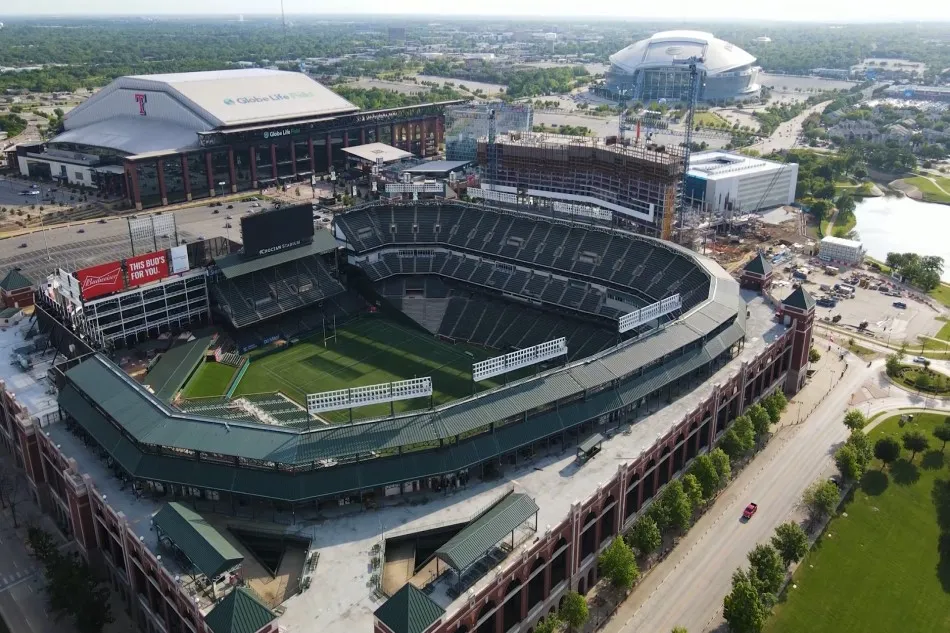
Arlington’s Entertainment District reflects a genuine sports and tourism identity layered onto a stable manufacturing and education economy
2026 Economic Outlook
- Five-year price change of +27.5% remains solid even amid current-year cooling
- 2026 FIFA World Cup events expected to bring sustained visitor traffic to the Entertainment District
- Viridian’s continued expansion adding premium master-planned inventory in the 76005 ZIP code
- DFW’s job base has added 410,000 net new positions since February 2020, sustaining regional rental demand
- City council approved a three-cent property tax rate increase for FY26 to close a $20 million budget shortfall
Investment Climate
Arlington’s investment environment in 2026 is best suited to what one local analysis calls the “stabilization seeker”: an investor prioritizing tenant stability and steady, patient returns over rapid appreciation or speculative flips. Successful Arlington investors tend to share a few characteristics:
- Neighborhood spread awareness since Arlington shows a genuinely wide range between submarkets, from roughly $132,000 list prices in Arlington Oaks to $534,000 in Viridian
- STR zoning discipline given that short-term rentals are permitted only in specific zones (the Entertainment District STR Zone, RM-12, and RMF-22 districts), not citywide
- Property tax awareness given the FY26 rate increase and Arlington’s roughly 2.0-2.4% combined effective rate
- Single-family focus since single-family rentals dominate Arlington’s rental stock to the point where they essentially set the market rate
- Commuter-hub positioning recognizing that Arlington’s core value proposition is genuine proximity to two major job markets without either city’s cost premium
The price-to-rent ratio of 16.9x sits meaningfully below the national average of 18x, indicating that buying remains a financially reasonable path compared to renting even in the current cooling environment. This is precisely the setup that supports Arlington’s “Risk Grade A” designation from local market analysts: not a speculative market, but a fundamentally sound one for patient capital.
Historical Performance
| Period | Market Driver | Avg Annual Change | Key Event |
|---|---|---|---|
| 2015-2019 | Steady manufacturing and education employment | +4-6% | Arlington grows steadily as an affordable DFW mid-city |
| 2020-2022 | Pandemic migration, record-low rates | +10-14% | Genuine appreciation without Austin-style speculative overshoot |
| 2023-2025 | Rate normalization, gradual cooling | -2 to -3% | Cooling described as healthy correction against a strong 5-year gain |
| 2026 (current) | Stabilization, balanced market conditions | -3.0 to -3.4% | Market temperature of 61/100 signals balanced, not distressed conditions |
| 2027-2028 (projected) | Modest appreciation, World Cup event demand | +2-5% (5-year CAGR of 4.9% consensus) | Continued economic diversification beyond entertainment and aerospace anchors |
Arlington’s five-year compound annual growth rate of 4.9% reflects a market of modest, sustainable appreciation, not a boom-bust cycle. The current -3.0 to -3.4% year-over-year cooling is explicitly described by local analysts as a healthy correction given the strong 27.5% five-year gain, positioning Arlington as a genuinely stable hold rather than either an overheated or distressed market.
Demographic Trends Driving Demand
- General Motors Arlington Assembly – one of GM’s largest plants in the country anchors a stable, blue-collar manufacturing employment base
- University of Texas at Arlington – consistent student and staff rental demand near campus and Cooper Street keeps vacancy low even during soft market patches
- Sports and Entertainment Economy – AT&T Stadium (Dallas Cowboys), Globe Life Field (Texas Rangers), and Six Flags Over Texas draw year-round tourism and hospitality employment
- Medical City Arlington and Texas Health Resources – a genuinely established healthcare employer base sustaining medical corridor rental demand
- Commuter Positioning – genuine proximity (roughly 20 minutes) to both downtown Dallas and downtown Fort Worth without either city’s cost premium
- DFW Airport Proximity – North Arlington’s location roughly 12 miles from DFW International Airport supports demand from airport and logistics-adjacent employment
📚 New to real estate investing? Master the fundamentals with our professional course Learn more →
2. Neighborhood Hotspots
Arlington Investment Neighborhood Map
Interactive map of Arlington’s investment neighborhoods. Green stars show top hotspots, blue circles mark established markets, and orange circles highlight emerging areas.
Core Investment Neighborhoods
Detailed Submarket Analysis: All Arlington Neighborhoods
| Neighborhood | Price Range (SFH) | Cap Rate | Growth Drivers | Best Strategy |
|---|---|---|---|---|
| Arlington Oaks | $110K-$180K | 7.5-9.5% | Deepest value entry citywide | Best cash flow in the metro, value-add |
| East Arlington | $150K-$240K | 6.5-8.0% | Revitalization momentum, affordability | Value-add, BRRRR |
| Near UTA / Cooper Street | $180K-$280K | 6.0-7.5% | Consistent student and staff demand | Student rental, buy-and-hold |
| South Arlington | $220K-$320K | 5.5-6.5% | Established character, family demand | Family buy-and-hold |
| Entertainment District | $220K-$400K | 5.0-7.0% | Sports and tourism demand, event traffic | Permitted STR, hybrid strategy |
| Lake Arlington | $240K-$380K | 4.5-5.5% | Waterfront access, recreational amenities | Balanced returns, lifestyle appeal |
| West Arlington | $260K-$400K | 4.5-5.5% | Established character, community appeal | Stable long-term hold |
| North Arlington | $280K-$420K | 4.0-5.0% | DFW Airport proximity, strong schools | Family buy-and-hold, low turnover |
| Viridian | $230K-$1M+ | 3.0-4.0% | Premium master-planned community, wealth metrics | Long-term appreciation, premium rental |
Expert Insight: “Arlington rewards investors who match capital to submarket rather than chasing a single ‘best’ neighborhood across the board. Near UTA and Cooper Street will always have a floor of student and staff demand regardless of the broader market’s temperature, while East Arlington offers genuine forced-appreciation upside if you’re willing to do renovation work. Don’t assume Arlington behaves like one uniform market. The spread between Arlington Oaks and Viridian is enormous, and your return depends on matching your strategy to the specific submarket, not the citywide average.” – Krissy Mireles, Arlington-focused real estate advisor
3. Property Types
| Investment Goal | Best Property Type | Best Neighborhoods | Minimum Capital |
|---|---|---|---|
| Maximum Cash Flow | SFH in value corridors | Arlington Oaks, East Arlington | $28,000+ |
| Consistent Tenant Demand | SFH or small multi-family | Near UTA, Cooper Street | $45,000+ |
| Permitted STR Yield | Licensed property in STR Zone | Entertainment District STR Zone | $65,000+ (plus permit verification) |
| Long-Term Appreciation | New construction or townhome | Viridian | $90,000+ |
Don’t guess the costs. Our Complete Renovation & Remodeling Cost Guide covers 400+ pages of project-by-project breakdowns with real contractor pricing ranges.
4. Cost Analysis
Acquisition Cost Breakdown (Arlington)
| Expense Item | Typical Cost | Example ($310,000 Property) | Notes |
|---|---|---|---|
| Down Payment | 25% (investment) | $77,500 | Standard for investment properties in Texas |
| Closing Costs | 2-3% of price | $6,200-$9,300 | Title, escrow, lender fees, recording. No state transfer tax in Texas. |
| General Inspection | $400-$650 | $525 | Include foundation review given North Texas clay soil movement |
| STR Zoning Verification | Free (city zoning lookup) | N/A | Critical before assuming any short-term rental strategy; only specific zones qualify |
| Initial Repairs | 0-7% of price | $0-$21,700 | Highly variable, especially in older East Arlington and Arlington Oaks stock |
| Reserves (6 months) | 6 months expenses | $9,500-$13,500 | Emergency fund for vacancy and repairs |
| TOTAL MINIMUM ENTRY | ~30-33% of value | $93,200-$104,300 | Lower than Dallas proper, comparable to Fort Worth |
Sample Cash Flow Analysis: Near UTA Single-Family Home
| Item | Monthly | Annual | Notes |
|---|---|---|---|
| Gross Rent | $1,650 | $19,800 | 3BR/2BA, near UTA, renovated kitchen and bath |
| Less Vacancy (5%) | -$83 | -$996 | Conservative estimate given consistent UTA-driven demand |
| Property Taxes | -$427 | -$5,124 | ~2.18% combined effective rate on $235,000 purchase price, no homestead exemption (investment property) |
| Insurance | -$150 | -$1,800 | Landlord policy reflecting Texas’s rising storm-related insurance costs and Arlington’s high wind risk exposure |
| Property Management (9%) | -$149 | -$1,782 | Standard Arlington single-family management fee |
| Maintenance + CapEx | -$116 | -$1,392 | 7% of rent, moderate reserve |
| Net Operating Income | $725 | $8,706 | Before mortgage |
| Mortgage ($235,000, 25% down, 6.5%, 30yr) | -$1,114 | -$13,368 | Principal and interest only |
| CASH FLOW | -$389 | -$4,662 | Modestly negative on 25% down; positive with 35%+ down or an all-cash purchase |
| Cap Rate | 3.70% | NOI / Purchase Price | |
| Total Return (4% appreciation) | ~11% | Including appreciation and principal paydown on leveraged purchase |
This example reflects the genuinely conservative vacancy assumption warranted by the UTA-adjacent tenant base, which tends to renew leases through the academic calendar with predictable turnover timing. Property tax remains the largest single recurring expense, more than double the property management fee, the structural reality every Arlington investor must underwrite precisely rather than estimate.
Expert Insight: “Don’t compare Arlington properties on purchase price alone. A lower price in a rougher pocket of East Arlington might need heavier updates and carry higher ongoing risk than a slightly pricier property near UTA with steady, predictable tenant demand. Model likely rent, expected repair costs, tax burden, and tenant demand type together, not just the sticker price. That is where the real difference between a smart buy and a frustrating one shows up.” – Krissy Mireles, Arlington-focused real estate advisor
5. Legal Framework
⚠️ Compliance Notice
Arlington follows the same statewide landlord-tenant law as the rest of Texas (Property Code Chapters 91-94), which remains broadly landlord friendly. Arlington does layer meaningful additional restrictions on short-term rentals, unlike Dallas or Houston. This guide provides an overview only. Always consult a Texas-licensed real estate attorney before acquiring rental properties, and verify current City of Arlington zoning and Tarrant Appraisal District figures directly.
Arlington-Specific Regulations
Landlord-tenant law itself is governed statewide, but Arlington’s short-term rental zoning is a genuinely important local restriction:
- No Rent Control: The Texas Constitution (Article XI, Section 18) preempts local rent control entirely.
- No Statutory Deposit Cap: Landlords may charge any security deposit amount, subject to the 30-day return and itemization requirement under Tex. Prop. Code § 92.103.
- 3-Day Minimum Eviction Notice: The same statewide standard applies, per Tex. Prop. Code § 24.005.
- Restricted STR Zoning: Arlington permits short-term rentals only within the established STR Zone near the Entertainment District, RM-12 zoning districts, and RMF-22 zoning districts, not citywide.
- Mandatory STR Permit: An active permit is required before advertising or hosting any short-term rental, with rules covering occupancy limits, parking, noise, and event use.
- FY26 Property Tax Rate: The city’s adopted rate is $0.6298 per $100 of assessed value, part of a three-cent increase approved to close a $20 million budget shortfall, combining with Tarrant County, school district, and special district rates for a total effective rate of roughly 2.0-2.4%.
- Homestead Exemptions: $100,000-$140,000 school district exemption and 10% appraisal cap available to owner-occupants; not available to investment properties.
Compliance Best Practices
Systematic compliance protects Arlington investors, especially those considering any STR strategy:
- Verify STR Zoning Before Purchase: Never assume a property qualifies for short-term rental use based on proximity to the Entertainment District alone; confirm the specific zoning designation and permit eligibility directly with the city.
- Written Lease Requirement: Use a written lease specifying entry notice, late fees, and deposit terms explicitly, since Texas law leaves several areas to the lease itself rather than statute.
- Move-In Documentation: Photograph and date every room at move-in. Texas does not require a joint walk-through, so your own documentation is the primary protection in a deposit dispute.
- Annual Property Tax Protest: File with the Tarrant Appraisal District before the annual deadline, especially given Arlington’s recent rate increase.
- Insurance Shopping Discipline: Given Arlington’s severe wind risk exposure (99% of properties at major risk of severe wind events over 30 years, per First Street data), shop multiple carriers and confirm windstorm coverage specifically.
- Professional Management: For any out-of-state investor, professional management with specific Arlington submarket experience is valuable given the genuinely wide price and demand spread across neighborhoods.
Useful Arlington Resources
- City of Arlington Property Tax Rate: arlingtontx.gov
- Tarrant Appraisal District: tad.org
- Texas Attorney General Renter’s Rights: texasattorneygeneral.gov
- City of Arlington STR Permit Portal: arlingtontx.gov
| Regulation | Arlington Requirement | Compare: Fort Worth | Investor Impact |
|---|---|---|---|
| Short-Term Rentals | Restricted to specific zones (STR Zone, RM-12, RMF-22) with mandatory permit | No comparable citywide licensing overhaul | Arlington STR strategies face more upfront zoning verification than Fort Worth or Dallas |
| Property Tax Burden | Combined effective rate ~2.0-2.4%, with FY26 rate increase | Combined effective rate ~2.0-2.5% | Broadly comparable, both similar to other Tarrant County cities |
| Eviction Notice | 3 days minimum (statewide) | Same statewide standard | Identical eviction process and timeline across both cities |
| Rent Control | Constitutionally preempted statewide | Same statewide preemption | No risk of local rent control in either city |
6. Step-by-Step Arlington Investment Playbook
Define Your Arlington Strategy
Arlington’s genuinely wide submarket spread supports several distinct strategies. Before buying, be clear on which of these strategies you are executing:
UTA Steady-Demand Cash Flow
Buy near UTA and Cooper Street for consistent student and staff rental demand that holds up regardless of broader market softening.
East Arlington Value-Add
Buy dated properties in the metro’s most affordable revitalizing corridor. Renovate to increase rents and value while riding genuine infrastructure investment momentum.
Permitted Entertainment District STR
Buy or acquire a property with existing STR permit eligibility within the specific approved zones, targeting sports and event-driven visitor traffic near AT&T Stadium and Globe Life Field.
North Arlington Family Buy-and-Hold
Acquire single-family homes near DFW Airport with strong schools. Lower cap rates but exceptionally low turnover given family-oriented tenants who value the airport commute proximity.
Build Your Arlington Team
Arlington’s genuinely wide submarket spread and STR zoning restrictions make specific local expertise particularly valuable. Non-negotiable team members:
- Arlington-Specialist Real Estate Agent: Must understand the genuinely wide gap between submarkets like Arlington Oaks and Viridian, since the same purchase price can represent very different risk-return profiles.
- City Zoning Specialist (if pursuing STR): Confirm STR Zone, RM-12, or RMF-22 eligibility for the exact address before assuming any short-term rental strategy is viable.
- Insurance Broker with Texas Storm Expertise: Get a real written quote before waiving your inspection contingency, given Arlington’s severe wind risk exposure.
- Arlington-Licensed Property Manager: Verify specific submarket experience given how differently individual neighborhoods perform.
- Real Estate CPA familiar with the Texas market: For depreciation strategy, entity structuring, and Tarrant Appraisal District property tax protest procedures.
Expert Tip: Ask any Arlington agent directly: “Does this specific address fall within a permitted STR zone, RM-12, or RMF-22 district?” Before assuming an Entertainment District-adjacent property can be run as a short-term rental. Many properties near AT&T Stadium fall outside the permitted zones despite the proximity, a costly assumption to get wrong.
Arlington-Specific Due Diligence
Standard due diligence items plus these Arlington-critical checks:
Physical Due Diligence
- Foundation inspection specific to North Texas clay soil movement
- Windstorm and roof inspection given Arlington’s severe wind risk profile (99% of properties at major risk over 30 years)
- HVAC condition and capacity given severe heat exposure (Arlington expected to see a 228% increase in days over 110°F over the next 30 years)
- Flood risk assessment; Arlington carries a moderate 6% flood risk over the next 30 years
Regulatory and Market Due Diligence
- Verify STR zoning eligibility directly with the City of Arlington if any short-term rental strategy is contemplated
- Confirm actual Tarrant Appraisal District appraised value versus purchase price, and evaluate protest potential given the FY26 rate increase
- Check whether the property sits in Viridian or another master-planned community with elevated combined tax rates and HOA fees
- Confirm the specific submarket’s rent comps rather than relying on citywide averages, given Arlington’s genuinely wide neighborhood spread
Negotiating in Arlington’s Balanced Market
With homes averaging 44-62 days on market and a market temperature of 61/100, Arlington in 2026 offers genuine but moderate negotiating room. Strategies that work:
- Target listings past 60+ days on market: Given the market’s balanced temperature, anything meaningfully beyond the average signals a motivated seller.
- Compare neighborhood-specific rent and price data before offering: A lower price alone doesn’t guarantee a better deal once repair costs and tenant demand type are factored in.
- Use the current -3% year-over-year cooling as leverage: Sellers anchored to peak pricing from the 2020-2022 run-up may need education on current comps.
- Request seller-funded rate buydowns: With rates in the 6-7% range, a funded buydown can materially improve first-year cash flow without requiring a price reduction.
- Move decisively near UTA and in the Entertainment District: These submarkets see more consistent demand and may attract competing offers even in a broader balanced market.
Property Management in Arlington
Arlington’s genuinely wide submarket spread and STR zoning restrictions make submarket-specific management particularly important in 2026. Key management focuses:
Managing Different Tenant Profiles by Submarket
Given Arlington’s wide neighborhood spread, tenant management approaches genuinely differ by area:
- Near UTA: anticipate academic-calendar-driven turnover cycles and plan marketing timing accordingly
- Entertainment District (if STR permitted): manage event-driven demand spikes around game days and major events
- North Arlington and family-oriented submarkets: expect longer average tenancy and lower turnover costs
- East Arlington and value corridors: budget more conservative vacancy assumptions during the ongoing revitalization period
Typical Arlington Management Fees
- Single-family management: 8-10% of monthly rent
- Multi-family management: 7-9% of monthly rent
- Leasing fee: 50-100% of one month’s rent
- Lease renewal fee: $150-$300 per renewal
- Licensed STR management: Typically 20-30% of gross booking revenue given the higher operational intensity
7. Financing Options for Arlington
| Loan Type | Down Payment | Rate Premium | Best For | Arlington Note |
|---|---|---|---|---|
| Conventional Investment | 20-25% | +0.5-0.75% | Strong W-2 income, good credit | Most Arlington properties stay comfortably under conforming loan limits |
| DSCR Loan | 20-25% | +1-2% | Investors who want no income verification | Arlington’s 5.5%+ average cap rate generally supports DSCR qualification well, especially in value corridors |
| Portfolio Loan | 20-25% | +1-1.75% | Multiple properties, self-employed | Deep regional bank presence given Arlington’s position within the broader DFW banking market |
| House Hacking (FHA) | 3.5% | Standard + MIP | Owner-occupying one unit of 2-4 unit property | Strong entry point given Arlington’s comparatively lower absolute prices versus Dallas |
| Hard Money (Bridge) | 15-25% | 9-13% rate | BRRRR acquisitions in East Arlington, fast closings | Active hard money lender base given the broader DFW investor community’s reach into Arlington |
Arlington Financing Reality: Arlington’s roughly 5.5% average cap rate, driven by lower entry prices at comparable rent levels to Dallas, makes DSCR financing achievable in most submarkets, similar to Fort Worth’s dynamic. Premium neighborhoods like Viridian carry cap rates too low for most DSCR programs; investors should model the specific property’s actual rent-to-price ratio rather than assuming citywide averages apply universally.
8. Frequently Asked Questions

Knowledge Quiz: Arlington Real Estate Investment
Open Quiz
5 quick questions on what you just learned about Arlington investing
1) Where does Arlington sit geographically within the DFW Metroplex, per the guide?
Answer: B
Arlington sits genuinely between Dallas and Fort Worth, roughly 20 minutes from both downtowns, giving residents access to two major job markets without the cost premium of living in either city.
2) Where can investors legally operate short-term rentals in Arlington, per the guide?
Answer: C
Arlington restricts STRs to specific zones (the STR Zone near the Entertainment District, RM-12, and RMF-22 districts) and requires an active permit before advertising or hosting, unlike Houston’s more permissive citywide approach.
3) What does the guide identify as Arlington’s ideal investor profile, given its 2026 market data?
Answer: A
With a Boomtown Radar score of 42 and Risk Grade A, Arlington fits a “stabilization seeker” profile: a steady, patient hold rather than a speculative flip market, prioritizing tenant stability from the Entertainment District and university employment.
4) Which employer does the guide identify as one of the largest GM plants in the country, anchoring Arlington’s manufacturing base?
Answer: D
General Motors Arlington Assembly is one of GM’s largest plants in the country, anchoring a stable, blue-collar manufacturing employment base distinct from the entertainment and healthcare sectors.
5) Why does the guide caution against comparing Arlington rent data across sources without checking the property type mix?
Answer: B
Since single-family rentals dominate Arlington’s rental stock and essentially set market rates, an apartment-only average understates the true blended rent figure, a distinction investors must check before relying on any single rent data source.
Work With a Local Expert in Arlington
We are building a verified network of real estate professionals across every market we cover.

About Our Expert Network
We are finalizing partnerships with verified real estate professionals across every market featured on Builds and Buys. Each expert in our network is selected for their hands-on investment experience, local market knowledge, and commitment to helping buyers and investors make sound decisions.
Our local specialists offer:
- Proven experience with investment and income-producing properties
- Deep knowledge of local pricing, rental yields, and neighborhood dynamics
- Guidance on financing, legal structure, and due diligence
- Access to off-market and pre-market opportunities
- Full transaction support from search through closing
- Ongoing portfolio and property management referrals
Services Covered
- Property sourcing and acquisition
- Investment analysis and underwriting
- Buyer representation
- Market comparables and valuations
- Short-term and long-term rental strategy
- Value-add and renovation guidance
- Legal and title referrals
- Financing and lender connections
- Property management referrals
- Insurance and inspection referrals
- 1031 exchange coordination
- Exit strategy planning
Get Connected or Join Our Network
Looking for a local expert to help with your investment? Reach out and we will connect you with the right professional for your market and strategy.
Are you a real estate professional with a track record working with investors? We are always expanding our network of verified local experts.
Contact us at support@buildsandbuys.com
Find Specialized Arlington Real Estate Professionals
Ready to Invest in Arlington?
Arlington offers a genuinely distinctive investment case within the DFW Metroplex: a true mid-city commuter position between Dallas and Fort Worth, a diversified economy anchored by GM manufacturing, sports and entertainment, healthcare, and higher education, and a market described by analysts as fitting the “stabilization seeker” rather than the speculative flipper. Investors who understand Arlington’s genuinely wide submarket spread, verify STR zoning carefully before assuming any short-term rental strategy, and underwrite property tax honestly will find a steady, patient hold with a durable long-term case.
Continue Your Research
Texas State Guide
See how Arlington compares to Dallas, Fort Worth, Houston, and other Texas markets.
Step-by-Step Invest
Complete framework for building a real estate investment strategy from scratch.
144-Lesson Course
University-level real estate education covering financing, law, strategy, and management.
For further guidance, explore our State-by-State Investor guides, browse our expert articles, or follow our Step-by-Step Investment Guide.



