Salina Real Estate Investment Guide For 2026
A comprehensive resource for investors looking to capitalize on the most economically diverse market in central Kansas, where two interstates cross, a regional health system anchors a wide service area, and food manufacturing and agricultural equipment production sustain a working population well beyond the city’s size
Quick answers: Top 5 most searched Salina investment questions ▼
Migration data: Where people are moving from to Salina ▼
In This Guide
Click on any section to navigate directly to that content
1. Salina Market Overview
Market Fundamentals
Salina is the seat of Saline County and the largest city in central Kansas, sitting where Interstate 70 crosses Interstate 135 roughly halfway between Kansas City and Denver. That crossroads position is not decoration. It is the reason a city of 46,000 supports a regional hospital, a major food manufacturing plant, an agricultural equipment manufacturer, a university campus, and one of the longest runways in the country. Salina serves a trade area many times its own population, and the investment case rests on that.
Key economic indicators that define the Salina investment case:
- Population: approximately 46,000 in the city, roughly 54,000 across Saline County
- Major Employers: Salina Regional Health Center, Schwan’s Company and its Tony’s Pizza production facility, Great Plains Manufacturing under Kubota, Kansas State University Salina, Salina USD 305, Saline County government, Salina Area Technical College, Kansas Wesleyan University, Blue Beacon International, and the employers of the Salina Airport Industrial Center
- Median Household Income: roughly $58,000
- Median Home Price: approximately $165,000
- Vacancy Rate: approximately 6 to 8 percent
- Housing Stock: heavily weighted toward mid century construction, with a substantial pre 1940 core
Three structural features matter most. The first is Salina Regional Health Center, which functions as the closest full service hospital for a wide stretch of central Kansas and pulls both patients and staff from well outside the county. The second is manufacturing depth that is unusual for a city this size, spanning food production, agricultural equipment, and industrial fabrication. The third is the Salina Regional Airport and its industrial center, built on the former Schilling Air Force Base, where an exceptionally long runway supports aircraft maintenance, flight training, and unmanned aircraft work tied to the Kansas State University Salina campus.
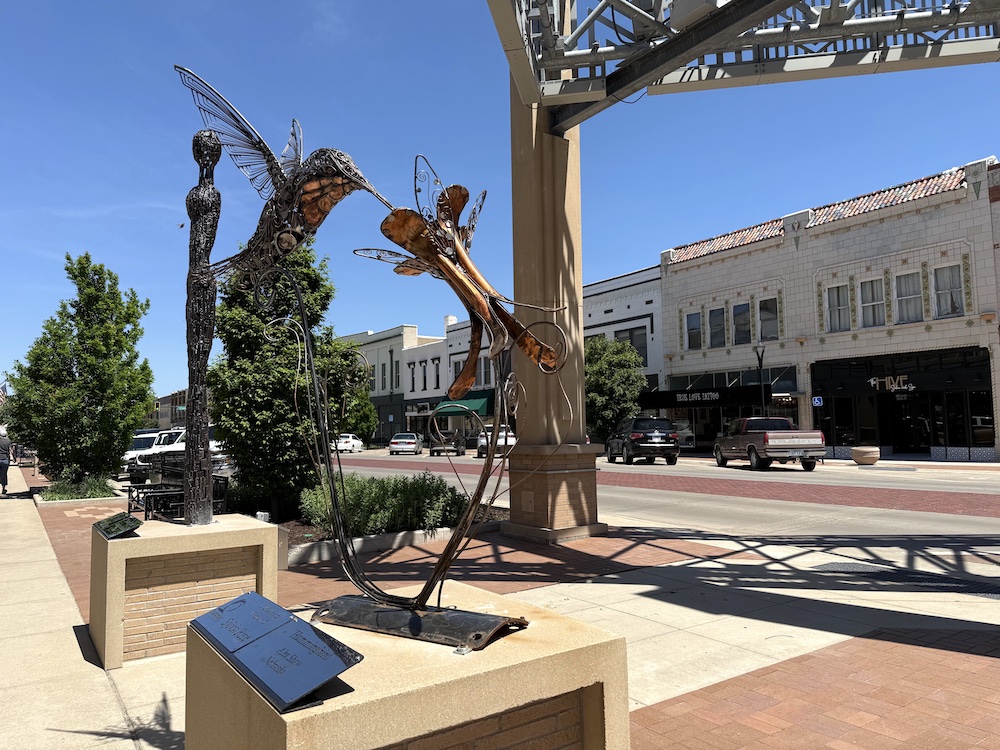
Salina serves a trade area many times its own population from the crossroads of I-70 and I-135
2026 Economic Outlook
- Salina Regional Health Center continuing as the anchor employer and the regional medical draw for central Kansas
- Food manufacturing and agricultural equipment production sustaining a deep skilled working population
- Kansas State University Salina and its aviation and unmanned aircraft programs supporting technical employment
- The Salina Airport Industrial Center leveraging one of the longest runways in the country for maintenance and testing work
- Continued benefit from the completed downtown Santa Fe Avenue streetscape rebuild and associated private investment
- The Smoky Hill River renewal project reshaping the corridor through the older parts of the city
Investment Climate
Salina rewards a patient income investor and frustrates anyone chasing growth. Successful investors here tend to share these characteristics:
- Insurance literacy because central Kansas hail exposure makes the premium, not the tax bill, the variable that decides whether a deal works
- Income orientation since appreciation runs 3 to 5 percent and the monthly number carries the return
- Comfort with mid century housing as the bulk of the workable inventory dates from the 1950s and 1960s
- Realistic exit expectations because above roughly $300,000 the buyer pool in a city this size genuinely thins
- Renovation capability since the highest returns come from bringing tired houses to a modern rental standard in a market with very little renovated competition
- Local relationships with a contractor, an insurance agent, and a community bank, all three of which matter more in a small market than in a metro
The market’s principal strength is diversification. No single employer dominates Salina the way an army post dominates Junction City or a university dominates Pittsburg. Healthcare, food manufacturing, agricultural equipment, aviation, education, retail, and transportation all contribute meaningfully. For a city of 46,000 that is genuinely unusual, and it means a single plant closure or a single bad year in one sector does not empty your rental.
Two weaknesses deserve stating plainly. Salina is not growing, it is holding steady while the surrounding rural counties shrink, which is a durable position but not an appreciating one. And the market is small enough that liquidity is a real consideration. A well priced house under $200,000 sells reasonably. A $350,000 house can sit for a long time, which matters if your strategy assumes a clean exit rather than a long hold.
Historical Performance
| Period | Market Driver | Avg Annual Appreciation | Key Event |
|---|---|---|---|
| 2010-2014 | Flat recovery, manufacturing consolidation | 0-2% | Central Kansas lags the national recovery as industrial employment restructures |
| 2015-2019 | Downtown reinvestment, healthcare and manufacturing stability | 2-4% | Santa Fe Avenue streetscape rebuild and associated private investment reshape the core |
| 2020-2022 | Record low rates, national affordability migration | 9-14% | Even flat population markets repriced sharply as buyers looked outward from the metros |
| 2023-2024 | Rate shock, rising insurance costs | 2-4% | Hail losses across central Kansas push premiums up materially and reshape investor math |
| 2025-2026 | Normalization, steady institutional employment | 3-5% (projected) | Diversified employment base holding rents steady in a flat population market |
Over a 20 year window Salina has produced roughly 3 to 4 percent average annual appreciation, in line with Topeka and Wichita and well behind Johnson County. A $90,000 house purchased in 2006 is worth roughly $160,000 to $180,000 today. As in every central Kansas market, the compounding here comes from rent and principal paydown rather than from price growth. The detail worth noticing in the table above is the 2023 to 2024 row: rising insurance premiums across central Kansas were a genuine drag on investor returns in that period, and any pro forma built on pre 2022 premium assumptions is now materially out of date.
Demographic Trends Driving Demand
- Regional Healthcare Draw – Salina Regional Health Center serving as the closest full service hospital for a wide stretch of central Kansas, drawing both staff and patient related demand
- Food Manufacturing Employment – Large scale production facilities supplying steady shift work for a substantial working household population
- Agricultural Equipment Manufacturing – Skilled fabrication and assembly employment that pays well above the local service sector median
- Aviation and Technical Education – Kansas State University Salina and its aviation and unmanned aircraft programs creating a technical student and graduate population
- Rural Consolidation – Households leaving smaller central and western Kansas towns for the nearest city with a hospital, a college, and career employment
- Transportation and Logistics – The I-70 and I-135 junction sustaining trucking, warehousing, and distribution employment
📚 New to real estate investing? Master the fundamentals with our professional course Learn more →
2. Neighborhood Hotspots
Salina Investment Neighborhood Map
Interactive map of Salina’s investment areas. Green stars show top hotspots, blue circles mark established markets, and orange circles highlight emerging areas across the city.
Core Investment Neighborhoods
Detailed Submarket Analysis: All Salina Areas
| Area | Price Range | Cap Rate | Housing Era | Best Strategy |
|---|---|---|---|---|
| North Salina | $70K-$130K | 8.5-10.5% | Pre war-1960s | Highest yields, workforce housing, hands on management |
| Old Town / River District | $75K-$150K | 8-10% | Pre war-1950s | Value add, river renewal upside, verify flood zone first |
| Airport Industrial Corridor | $85K-$155K | 8-10% | 1950s-1970s | Shift worker rentals, aviation and industrial demand, strong cash flow |
| Downtown / Santa Fe and Hospital | $85K-$180K | 7-9% | Pre war-1940s | Historic renovation, hospital staff rentals, walkable niche |
| Midtown / Kansas Wesleyan | $95K-$165K | 7.5-9% | Pre war-1960s | Value add, BRRRR, best available Salina cash flow |
| South Salina / Schilling Area | $105K-$180K | 7.5-9% | 1950s-1970s | Workforce rentals, verify environmental status before purchase |
| West Salina / Ninth Street | $115K-$195K | 6.5-8% | 1950s-1990s | Workforce and family rentals, retail convenience, mixed stock |
| Northeast Salina / Indian Rock | $120K-$200K | 6.5-8% | 1950s-2000s | Selective buying, park access, moderate value add |
| Southwest Salina / Ohio Street | $130K-$210K | 6.5-8% | 1950s-1970s | Balanced buy and hold, predictable scopes, low complexity |
| Georgetown / East Salina | $175K-$275K | 6-7% | 1970s-1990s | Family buy and hold, low turnover, predictable operations |
| Country Club / East Salina | $190K-$300K | 5.5-6.5% | 1950s-1980s | Premium hold, professional tenants, strongest resale |
| Southeast Salina / Magnolia | $215K-$340K | 5.5-6.5% | 1990s-2020s | Turnkey family hold, longest tenancies, out of state friendly |
| Far Southeast Growth Edge | $250K-$400K | 5-6% | New construction | Appreciation runway, newest inventory, watch exit liquidity |
Expert Insight: “In Salina I tell every investor the same thing before we look at a single house: call an insurance agent first. In Kansas City people obsess over the mill levy, and here that is not the number that gets you. A landlord policy in central Kansas can run two thousand dollars on a house you paid a hundred and forty for, and the wind and hail deductible is a percentage of replacement cost, not a flat five hundred. I have seen a single storm produce a three thousand dollar out of pocket on a property that only clears twelve hundred a year in cash flow. Quote the coverage on the actual address before you release your contingency, because a twenty year old roof and a hundred year old wiring panel will change that premium more than anything else in the deal.” – Corinne Bexley, Investment Broker, Smoky Hill Property Group
3. Property Types
| Investment Goal | Best Property Type | Best Neighborhoods | Minimum Capital |
|---|---|---|---|
| Maximum Cash Flow | Small multi-family or renovated workforce single family | North Salina, midtown, airport corridor | $40,000+ |
| Best Total Return | Value add mid century with full systems and roof update | Midtown, southwest Salina, Old Town | $55,000+ |
| Maximum Appreciation | Southeast Salina family home or downtown historic | Magnolia corridor, Country Club, downtown | $65,000+ |
| Lowest Entry Cost | Workforce single family, or FHA owner occupied entry | North Salina, Old Town, airport corridor | $25,000+ |
| Lowest Management Burden | Newer family single family with a recent roof | Southeast Salina, Georgetown, Country Club | $60,000+ |
Don’t guess the costs. Our Complete Renovation & Remodeling Cost Guide covers 400+ pages of project-by-project breakdowns with real contractor pricing ranges.
4. Cost Analysis
Acquisition Cost Breakdown (Salina)
| Expense Item | Typical Cost | Example ($165,000 Property) | Notes |
|---|---|---|---|
| Down Payment | 20-25% standard | $33,000-$41,250 | 25% down produces positive carry on a well bought Salina property |
| Insurance Quote on the Actual Address | $0 | $0 | Free, and the single most important step in Salina. Do it before you release contingencies, not after. |
| Closing Costs | 2-3% of price | $3,300-$4,950 | Title, escrow, lender fees, recording. Kansas closings handled by title companies. |
| General Inspection | $400-$600 | $450 | Non negotiable given how much of the Salina housing stock predates 1970 |
| Roof and Hail Damage Assessment | $0-$300 | $200 | The most important physical item in central Kansas. Roof age drives your premium more than anything else. |
| Sewer Lateral Scope | $200-$350 | $275 | Original clay laterals are common in the older core. Replacement runs $4,000-$11,000. |
| Radon Test | $125-$200 | $150 | Kansas records high radon readings statewide. Mitigation runs $900-$2,000. |
| Foundation Evaluation | $0-$500 | $300 | Expansive clay soils are the norm. Get a structural opinion whenever movement is flagged. |
| Electrical and Plumbing Assessment | Included or $200-$400 | $250 | Knob and tube and galvanized lines are common pre 1940 and both directly affect insurability |
| Flood Zone Determination | $0-$50 | $25 | Essential along the Smoky Hill River corridor and the older river district neighborhoods |
| Environmental Verification (South Salina) | $0-$500 | $0-$500 | Specific to the former Schilling Air Force Base area. Verify current status with the city and state before buying nearby. |
| Initial Repairs | 0-30% of price | $0-$49,500 | Near zero on southeast Salina inventory, substantial on core and historic stock |
| Reserves (6 months) | 6 months plus a full hail deductible | $8,000-$13,000 | Size this to cover a 2% wind and hail deductible on replacement cost, which is roughly $3,200 on this property |
| TOTAL MINIMUM ENTRY | ~28-67% of value | $46,000-$111,000 | The high end reflects a full value add renovation including a roof replacement. |
The insurance note, which in Salina matters more than the tax note: Kansas property taxes here are actually gentler than in the eastern markets. Saline County’s combined mill levy produces an effective rate around 1.5 to 1.7 percent of market value, against roughly 1.7 to 1.9 percent in Topeka and 1.9 to 2.3 percent in Wyandotte County. The line item that decides a Salina deal is insurance. Central Kansas sits deeper into hail alley than the Kansas City metro, carriers price on replacement cost rather than on purchase price, and wind and hail deductibles are typically percentage based rather than flat. A landlord policy on a modest Salina house can run $1,700 to $2,300 annually, which is 12 to 15 percent of gross rent, roughly double the ratio you would model in a coastal or midwestern metro. Worse, a 2 percent deductible on a $160,000 replacement cost is $3,200 out of pocket per event, and central Kansas produces hail events regularly. Roof age is the largest single variable in that premium, followed by the age of the wiring and plumbing, which is precisely why a value add scope that includes the roof frequently pays for itself twice.
Sample Cash Flow Analysis: Midtown Salina Mid Century Value Add
Deal structure: $110,000 purchase, $27,000 renovation (kitchen, bath, flooring, paint, roof replacement, electrical service upgrade, partial repipe from galvanized, furnace and central air replacement, radon mitigation), $3,500 closing. Total basis $140,500. After repair value approximately $158,000. Rented at $1,250 per month. Salina USD 305.
| Item | Monthly | Annual | Notes |
|---|---|---|---|
| Gross Rent | $1,250 | $15,000 | 3BR fully renovated, well above typical midtown Salina rental condition |
| Less Vacancy (7%) | -$88 | -$1,050 | Renovated stock leases quickly in a market with almost no renovated competition |
| Insurance | -$160 | -$1,920 | The defining Salina line item at 13% of gross rent. The new roof and updated systems are why it is not higher. |
| Property Taxes | -$211 | -$2,528 | ~1.6% effective on the post renovation value. 17% of gross rent, gentler than Topeka or Wyandotte. |
| Maintenance + CapEx (10%) | -$125 | -$1,500 | Appropriate for mid century stock even with systems and roof already replaced |
| Net Operating Income (self managed) | $666 | $8,002 | Before mortgage |
| Property Management (8%) | -$100 | -$1,200 | Drops NOI to $566/month or $6,802/year |
| Mortgage ($82,500 at 7.0%, 30yr, 25% down) | -$549 | -$6,588 | Principal and interest only, financed on the purchase price with renovation paid in cash |
| CASH FLOW (self managed, 25% down) | +$117 | +$1,404 | Positive at conventional leverage on the smallest capital base in this series |
| CASH FLOW (professionally managed, 25% down) | +$17 | +$204 | Effectively breakeven. Management fees consume nearly the entire margin at Salina rent levels. |
| Cap Rate | 5.7% self managed / 4.8% managed | NOI divided by total basis of $140,500 | |
| Total Return Year One (25% down, self managed) | ~14.8% | $1,404 cash flow plus $835 principal paydown plus 4.0% appreciation on $158,000, on $58,000 invested | |
| Immediate Forced Equity | $17,500 | $158,000 ARV less $140,500 total basis, realized at refinance |
Set beside the rest of this series, Salina lands where a diversified small market should. Olathe required $106,250 and ran $135 negative for roughly 21 percent total return. Kansas City, Kansas required $64,750 and ran $77 positive for 17.2 percent. Topeka required $59,750 and ran $98 positive for 13.7 percent. Salina requires $58,000, the smallest capital base of the four, runs $117 positive, the strongest monthly number of the four, and returns 14.8 percent. Notice what drives the difference between Salina and Topeka: the tax bill here is lower, but insurance is $500 a year higher, and those two largely cancel. What actually separates them is that Salina’s diversified employment base supports a slightly better rent to price ratio than a government town does. That is the whole argument for central Kansas over eastern Kansas at this price point.
Expert Insight: “Investors carry a mental model that says taxes are the big expense and insurance is a rounding error, and that model is built on markets that are not Kansas. Move a hundred and fifty miles west from Kansas City and the two line items nearly swap places. In Salina I underwrite insurance before I underwrite the mill levy, because the levy is knowable to the dollar from the county site and the premium can vary by eight hundred dollars a year on two identical houses depending on roof age and whether the wiring has been updated. Get the quote on the actual address, ask specifically what the wind and hail deductible is as a percentage, and then decide whether the roof goes in your renovation scope. Nine times out of ten it should.” – Reid Callahan, CPA, Kansas Real Estate Advisory
5. Legal Framework
⚠️ Salina Compliance Notice
Kansas state landlord law is moderately favorable and applies uniformly statewide. Salina is a comparatively simple market on the regulatory side: one school district serves the city, homeowners associations are far less prevalent than in Johnson County, and the Saline County District Court sits in Salina itself. The obligations that do bind here are the age of the housing stock, federal lead paint rules on the majority of it, and two location specific verifications: flood plain status along the Smoky Hill River, and environmental status in south Salina near the former Schilling Air Force Base. This guide provides an overview as of 2026 only. Always confirm current requirements with a licensed Kansas real estate attorney and with the City of Salina before acquiring rental property.
Kansas and Salina Regulations
The governing statute is the Kansas Residential Landlord and Tenant Act, codified at K.S.A. 58-2540 and following:
- Nonpayment of Rent: 3 day written notice to pay or vacate, among the shortest notice periods in the country.
- Lease Violations: 14 day written notice to cure, with termination effective 30 days from notice if the breach is not remedied.
- Month to Month Termination: 30 days written notice by either party.
- Security Deposits: Capped at one month’s rent unfurnished, one and a half months furnished, plus an additional half month permitted for pets. Return due within 30 days with an itemized statement.
- Landlord Entry: Reasonable notice required, generally interpreted as 24 hours, at reasonable times except in emergency.
- No Rent Control: Kansas law preempts municipal rent control.
- Self Help Eviction Prohibited: Changing locks, removing doors, or shutting off utilities exposes you to damages and attorney fees.
- No Source of Income Protection: Kansas does not require landlords to accept housing choice vouchers.
- Court Venue: Saline County District Court sits in Salina. Filings, hearings, and writs all happen inside the city.
- Federal Lead Paint Rules: Disclosure is mandatory on all pre 1978 housing, which is the majority of Salina. Renovation disturbing painted surfaces triggers EPA certified contractor requirements.
- City Codes: Salina enforces property maintenance, occupancy, and nuisance codes, and applies occupancy limits relevant to by-the-room leasing near the colleges. Confirm current registration, inspection, and occupancy requirements directly with the city.
Compliance Best Practices
Salina operating risk sits in housing age and in two location specific verifications rather than in complex local regulation:
- Quote Insurance Before Removing Contingencies. Not a legal requirement, but the single most valuable habit in this market. Get the premium and the wind and hail deductible in writing on the actual address.
- Handle Lead Paint Correctly. Disclose on every pre 1978 property, provide the federal pamphlet, and use EPA certified contractors for work disturbing paint. In a market this old this is a real cost line, not a formality.
- Verify Flood Plain Status anywhere along the Smoky Hill River corridor and in the older river district neighborhoods. This affects insurance, financing, and resale.
- Verify Environmental Status in South Salina. The former Schilling Air Force Base area has a documented groundwater contamination history and an ongoing remediation effort. Confirm current status and any restrictions with the City of Salina and the Kansas Department of Health and Environment before purchasing nearby.
- Confirm Occupancy Limits Before Leasing By the Room near Kansas Wesleyan or the technical college. Verify the unrelated occupant limit and the zoning for that parcel in writing.
- Scope the Sewer Lateral. Original clay laterals are common in the older core and a failure is a five figure event.
- Respect the Deposit Cap. One month unfurnished. Use a co signer for higher risk applicants rather than a larger deposit, which Kansas law does not permit.
- Never Attempt Self Help. The formal process is fast and the courthouse is in town.
Useful Salina and Saline County Resources
- City of Salina: salina-ks.gov
- Saline County Appraiser for parcel and valuation data
- Saline County District Court in Salina for eviction filings
- Saline County Register of Deeds for deeds, liens, and easements
- Kansas Department of Health and Environment for radon, lead, and environmental site information
- Kansas Statutes K.S.A. 58-2540 for the Residential Landlord and Tenant Act
| Regulation | Salina / Kansas | Typical Tenant Protective State | Investor Impact |
|---|---|---|---|
| Eviction for Nonpayment | 3 day notice, filed and heard in Salina | 14-30 day notice, 2-6 month court timeline | Short notice period plus a courthouse inside city limits |
| Rental Restrictions | Minimal HOA presence, city occupancy codes apply | Public permit caps and registration schemes | Far fewer private restrictions than Johnson County. Verify occupancy limits for room rentals. |
| School District Complexity | One district, Salina USD 305, serving essentially the whole city | Varies | Genuinely simpler than Topeka with five districts or Wyandotte County with four |
| Security Deposit Cap | Capped at 1 month unfurnished, 1.5 furnished, plus 0.5 for pets | Often capped at 1 month, 14-21 day return | Cannot size the deposit to risk. Screen harder instead. |
| Insurance Environment | Severe hail exposure, percentage based wind and hail deductibles | Flat deductibles, lower catastrophe loading | The defining Salina expense at 12-15% of gross rent. Quote before removing contingencies. |
| Property Tax Burden | ~1.5-1.7% effective, resets on sale | Varies widely, often capped or assessed below market | Meaningful at 17% of gross rent, but gentler than Topeka or Wyandotte County |
6. Step-by-Step Salina Investment Playbook
Define Your Salina Strategy
Salina’s low price points make several strategies workable that would be impossible in a metro market. Be clear which one you are running:
Midtown Value Add
Buy an untouched mid century or pre war house at $85,000 to $135,000, complete a full systems and finish renovation including the roof, and lease well above the unrenovated competition. The highest return strategy in the city.
Hospital and Downtown District Hold
Acquire near Salina Regional Health Center and the rebuilt Santa Fe Avenue district. Healthcare employment does not have a slow season, and this is the only walkable part of the city, which draws a tenant choosing the location deliberately.
Southeast Salina Family Hold
Acquire newer construction along the Magnolia corridor for long tenancies, a newer roof that prices better on insurance, and the lowest management burden in the city. The one Salina segment genuinely suited to remote ownership.
Small Multi-Family Income
Acquire a duplex through fourplex near downtown or the university. The strongest monthly income per dollar deployed in central Kansas, provided you resolve the metering and permit history before closing.
Build Your Salina Team
The professional bench in a city of 46,000 is small, which means the right people are fewer but far easier to identify. Get the insurance agent first:
- Independent Insurance Agent, Hired First: This is the reverse of the usual order and it is deliberate. In central Kansas the premium is the variable that decides deals, so you want someone who can quote an address in a day before you write an offer. Shop at least four carriers and ask specifically about percentage based wind and hail deductibles.
- Contractor Experienced With Roofs and Old Systems: Roof replacement, knob and tube rewires, galvanized repipes, and sewer laterals. Ask for two completed jobs on pre 1970 properties and call the references.
- EPA Lead Certified Renovator: Not optional in a city where most of the stock predates 1978.
- Investor Focused Agent: In a market this size the good ones are known. Ask what share of their volume is investment property rather than owner occupied.
- Community Bank Lender: More useful here than any national lender, because they will write loans on the sub $100,000 properties that produce the best yields.
- Local Property Manager or a Decision to Self Manage: At Salina rents an 8 percent fee is roughly $100 a month, which is most of the cash flow on a financed deal. Decide this explicitly.
- Real Estate CPA: For depreciation, entity structure, and Saline County valuation appeals.
Expert Tip: Ask your insurance agent to run the same property two ways: as it sits today, and as it will be after a roof replacement and an electrical service upgrade. The difference is often $500 to $900 a year, and knowing that number before you write your renovation scope changes what belongs in it. A roof you were treating as a maybe becomes an obvious yes when it pays back a meaningful share of its cost through the premium alone, every year, forever. Almost no investor runs this comparison and it is free.
Salina Specific Due Diligence
Standard due diligence items plus these Salina critical checks:
Physical Due Diligence
- Roof age, layer count, and hail claim history. The most important physical item in central Kansas, because it drives both your renovation budget and your insurance premium for as long as you own the property.
- Sewer lateral scope. Original clay laterals are common in the older core and replacement runs $4,000 to $11,000.
- Electrical service and branch wiring. Knob and tube in pre 1940 stock, undersized panels in mid century houses. Some carriers decline knob and tube outright.
- Supply plumbing material. Galvanized steel corrodes closed from the inside, producing pressure complaints no fixture work solves.
- Foundation movement in expansive clay soils. Get a structural opinion whenever the inspector flags it.
- Radon testing on every property.
- Heating and cooling age. Original equipment in a 1950s house is decades past end of life.
- Asbestos in floor tile, pipe wrap, and siding on pre 1980 properties.
Insurance, Location, and Regulatory
- Written insurance quote on the address. Premium, wind and hail deductible as a percentage, and any conditions attached to wiring, plumbing, or roof age. Do this before removing contingencies.
- Flood zone determination along the Smoky Hill River corridor and the older river district neighborhoods.
- Environmental status in south Salina. The former Schilling Air Force Base area carries a documented groundwater contamination history and ongoing remediation. Verify current status and restrictions with the city and the state before purchasing nearby.
- Occupancy and zoning limits if you intend to lease by the room near the colleges. Confirm the unrelated occupant limit in writing.
- Permit history for multi-family conversions, which are common in the older core and create financing and insurance problems when unpermitted.
- Current valuation and appeal history, since your tax basis resets on sale.
- Saline County Register of Deeds search for liens, judgments, and easements.
- Open code enforcement cases with the City of Salina.
Sourcing Deals in Salina
Salina sees very little out of state investor competition, which means patience and local relationships both pay disproportionately. Channels that work:
- Target unrenovated houses in midtown and the older core. Owner occupants want move in ready. An original kitchen and a twenty year old roof remove most of your competition and are exactly what you are looking for.
- Estate sales and long tenured owner turnover. Salina’s core neighborhoods have a large cohort of original and second owners aging out. In a market this size, relationships with estate and probate counsel produce real deal flow.
- Properties that failed to close on insurance. Genuinely specific to central Kansas. Houses with knob and tube or an old roof sometimes fall out of contract because a buyer could not get coverage. Those sellers are motivated and the fix is knowable.
- Direct mail to long tenured owners. Pull the Saline County Appraiser list for owners of 25 plus years in the midtown and north Salina neighborhoods.
- Small multi-family that failed conventional financing. Unpermitted conversions trade at a discount to buyers who understand how to resolve the issue.
- Community bank relationships. In a market this size the local lenders know which properties are coming available before they list. Build the relationship before you need it.
Property Management in Salina
At Salina rent levels an 8 percent management fee is roughly $85 to $130 a month, which consumes nearly the entire cash flow on a financed deal. The offsetting factor is that the tenant base here is stable and the properties are close together:
Tenant Screening Protocol
Kansas caps your deposit at one month, so screening is your protection. Salina’s diversified employment base means applicants come from many different employers, which is a strength. Apply consistently to every applicant:
- Verifiable gross income of at least 3 times monthly rent, which at typical Salina rents means roughly $45,000 or more annually
- Direct employer verification, noting whether the household is employed by the hospital, the manufacturers, the school district, or county government, all of which are stable
- Two prior landlord references, contacting the landlord before the current one
- Full credit and eviction records search including Saline County and the surrounding central Kansas counties, since applicants frequently relocate from nearby towns
- Written, posted criteria applied identically to every applicant under federal fair housing law
- For higher risk applicants use a co signer rather than a larger deposit, which Kansas law does not permit
Typical Salina Management Fees
- Single family management: 8-10% of monthly rent
- Small multi-family management: 6-9% of monthly rent, better economics at scale
- Leasing fee: 50-100% of one month’s rent
- Lease renewal fee: $100-$225 per renewal
- Flat fee management: $80-$130 per door per month, frequently better economics at Salina rent levels
- Maintenance coordination markup: typically 10% on vendor invoices
- Note that the manager pool in a city this size is small, so vet carefully and ask how many doors they currently handle
7. Financing Options for Salina
| Loan Type | Down Payment | Rate Premium | Best For | Salina Note |
|---|---|---|---|---|
| Local Portfolio / Community Bank | 20-30% | +0.5-1.5% | Cheap properties, multiple doors, self employed borrowers | The most useful tool in this market by a wide margin. Salina banks lend on $90,000 houses that national lenders decline outright. |
| Conventional Investment | 25% | +0.5-0.75% | Strong W-2 income, good credit | Produces genuine positive carry here. Watch minimum loan amounts, which exclude a lot of good Salina inventory. |
| DSCR Loan | 20-25% | +1.5-2.5% | Investors avoiding income documentation | Rent to price clears coverage comfortably, but the insurance line tightens the test more than lenders expect. Mind loan minimums. |
| FHA 203(k) Renovation | 3.5% | Standard + MIP | Owner occupants buying dated core homes | Exceptionally well matched. Rolls the roof, wiring, plumbing, and mechanicals into the loan on exactly the inventory that makes this market work. |
| Cash Purchase | 100% | None | Buyers of sub $100,000 properties | Very realistic in Salina. Many lenders will not write a $70,000 loan at all, and cash also solves the insurance conditioned closing problem. |
| House Hacking (FHA) | 3.5% | Standard + MIP | Owner occupying a 2 to 4 unit building | Available because real small multi-family inventory exists downtown and near the university. Verify the conversion was permitted. |
| USDA Rural Development | 0% | Standard + guarantee fee | Owner occupants in eligible areas outside the city | Worth checking eligibility maps for the smaller Saline County communities. Income limits apply and it is owner occupied only. |
| HELOC on Existing Equity | N/A | Variable | Funding renovations or cash purchases | A common route for investors deploying metro equity into central Kansas cash flow |
Salina Financing Reality: Two constraints shape financing here, and neither is credit. The first is loan size: many national lenders will not write investment mortgages below $75,000 to $100,000, which excludes a large share of the inventory producing the best yields in this city. A community bank relationship solves that and should be your first call after the insurance agent. The second is genuinely specific to central Kansas: lenders require insurance to close, and a property with knob and tube wiring or a twenty five year old roof can be difficult or expensive to insure, which means a financing failure that looks like a lender problem is actually a coverage problem. This is exactly why the insurance quote belongs at the start of your process rather than the end. For owner occupants, the FHA 203(k) is unusually well matched to Salina’s housing stock and rolls the roof and systems work into the loan at 3.5 percent down. For everyone else, expect conventional at 25 percent down, with cash purchase a realistic option at the lower end.
8. Frequently Asked Questions

Knowledge Quiz: Salina Real Estate Investment
Open Quiz
5 quick questions on what you just learned about Salina investing
1) Which expense decides whether a Salina deal works, and why?
Answer: C
Salina property taxes at roughly 1.5 to 1.7 percent effective are actually gentler than Topeka or Wyandotte County. Insurance is the line item that decides deals here, running $1,700 to $2,300 a year on a modest house because carriers price on replacement cost and central Kansas sits deep in hail alley. Wind and hail deductibles are percentage based, so 2 percent on a $160,000 replacement cost is $3,200 out of pocket per event.
2) What is genuinely simpler about Salina than Topeka or Kansas City, Kansas?
Answer: A
Topeka has five districts serving Shawnee County and Wyandotte County has four, and in both markets the district is the single largest variable in a rent assumption. In Salina you are almost always in USD 305, which frees you to underwrite on housing condition, neighborhood, and insurance instead of attendance boundaries.
3) Why does a city of 46,000 support a hospital system, a university campus, and major manufacturing?
Answer: D
Salina functions as the medical, retail, and employment center for a trade area many times its own population, and the crossroads of two interstates plus one of the longest runways in the country give it logistics and aviation capacity unrelated to its size. The city holds roughly flat in population while the surrounding rural counties decline, meaning it quietly gains regional share.
4) Which physical item does the guide say costs you twice in Salina?
Answer: B
Roof age is the largest single variable in a central Kansas insurance premium, followed by wiring and plumbing age. Two otherwise identical Salina houses can differ by $800 a year on premium based on those three items. That is why running the property a second way with a new roof and updated electrical often makes the roof an obvious inclusion in the renovation scope rather than a maybe.
5) What is the real constraint on Salina as an investment market?
Answer: C
Under $200,000 a well presented Salina house sells reasonably. Above $300,000 the buyer pool in a city this size is genuinely thin and a property can sit for months. That makes Salina a strong market for a buy and hold income investor working in the $85,000 to $250,000 range and a poor one for anyone whose plan depends on a quick resale. Note that employer concentration is not the issue here, since Salina is unusually diversified for its size.
Work With a Local Expert in Salina
We are building a verified network of real estate professionals across every market we cover.

About Our Expert Network
We are finalizing partnerships with verified real estate professionals across every market featured on Builds and Buys. Each expert in our network is selected for their hands-on investment experience, local market knowledge, and commitment to helping buyers and investors make sound decisions.
Our local specialists offer:
- Proven experience with investment and income-producing properties
- Deep knowledge of local pricing, rental yields, and neighborhood dynamics
- Guidance on financing, legal structure, and due diligence
- Access to off-market and pre-market opportunities
- Full transaction support from search through closing
- Ongoing portfolio and property management referrals
Services Covered
- Property sourcing and acquisition
- Investment analysis and underwriting
- Buyer representation
- Market comparables and valuations
- Short-term and long-term rental strategy
- Value-add and renovation guidance
- Legal and title referrals
- Financing and lender connections
- Property management referrals
- Insurance and inspection referrals
- 1031 exchange coordination
- Exit strategy planning
Get Connected or Join Our Network
Looking for a local expert to help with your investment? Reach out and we will connect you with the right professional for your market and strategy.
Are you a real estate professional with a track record working with investors? We are always expanding our network of verified local experts.
Contact us at support@buildsandbuys.com
Find Specialized Salina Real Estate Professionals
Ready to Invest in Salina?
Salina is the most diversified small market in Kansas and one of the least worked by outside capital. Healthcare, food manufacturing, agricultural equipment, aviation, and education all contribute meaningfully, which means no single employer can empty your rental. It cash flows at conventional leverage on the smallest capital base of any market in this series, and the older core holds a deep stock of houses nobody has renovated to a modern rental standard. The one thing you must get right is insurance. Quote the actual address before you release contingencies, ask what the wind and hail deductible is as a percentage, size your reserves to cover a full deductible, and run the property a second way with a new roof to see what the premium becomes. Do that, verify the flood plain and the environmental status where they apply, and Salina will pay you steadily for a very long time.
Continue Your Research
Kansas State Guide
See how Salina compares to Wichita, Topeka, Manhattan, and other Kansas markets.
Step-by-Step Invest
Complete framework for building a real estate investment strategy from scratch.
144-Lesson Course
University-level real estate education covering financing, law, strategy, and management.
For further guidance, explore our State-by-State Investor guides, browse our expert articles, or follow our Step-by-Step Investment Guide.