Prairie Village Real Estate Investment Guide For 2026
A comprehensive resource for investors looking at one of America’s landmark planned suburbs, where a fully built out 1940s and 1950s housing stock, a single elite school district, and land values that make teardowns viable create a market unlike anything else in Kansas
Quick answers: Top 5 most searched Prairie Village investment questions ▼
Migration data: Where people are moving from to Prairie Village ▼
In This Guide
Click on any section to navigate directly to that content
1. Prairie Village Market Overview
Market Fundamentals
Prairie Village occupies the northeastern corner of Johnson County, wedged between State Line Road to the east and Overland Park to the south and west. It is small, roughly six square miles and 22,000 people, and it is one of the most historically significant planned suburbs in the United States. Development began in the early 1940s under the J.C. Nichols Company, and the design won national recognition for its curving street layout, integrated parks, and neighborhood shopping built within walking distance of homes. That plan is still the reason people move here.
Key economic indicators that define the Prairie Village investment case:
- Population: approximately 22,000 across roughly six square miles
- Employment Base: almost entirely residential, with neighborhood retail at Prairie Village Shops and Corinth Square. Residents work across the metro, with the Country Club Plaza and Johnson County corporate corridors both minutes away
- Median Household Income: roughly $115,000
- Median Home Price: approximately $525,000
- Housing Stock: overwhelmingly 1940s through 1960s, essentially fully built out by the end of that decade
- School District: Shawnee Mission USD 512 across the entire city, anchored by Shawnee Mission East
Two features make this market unlike anything else in Kansas. The first is that the whole city sits in one school district, which after five Johnson County guides insisting on parcel level verification is a genuine simplification. The second is that Prairie Village has no room to grow. Supply only changes when someone expands or replaces an existing house, and that single fact shapes every part of the investment case here.
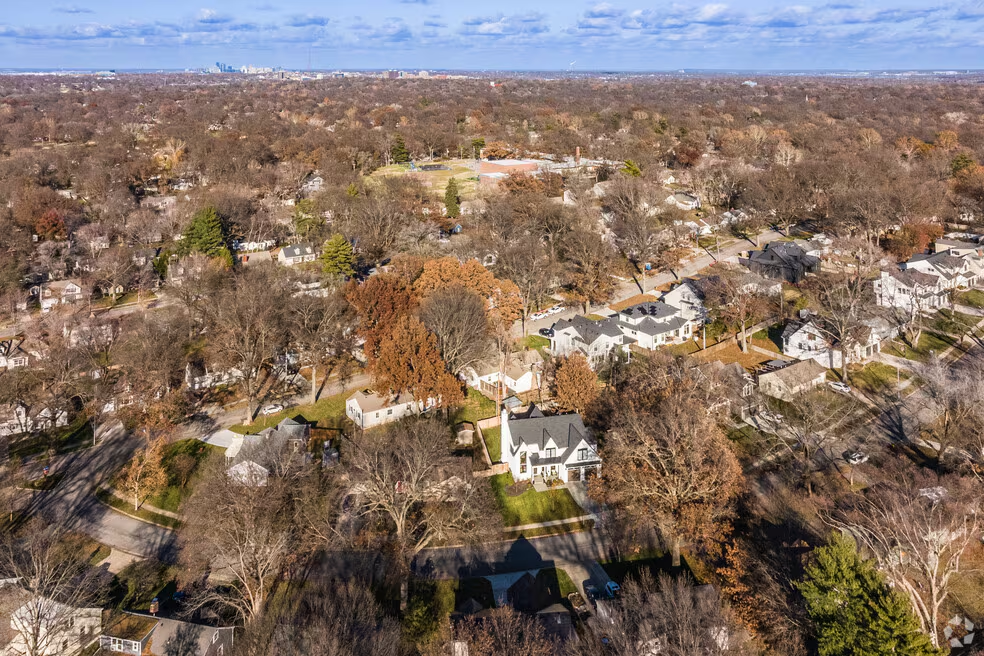
Prairie Village is one of America’s landmark planned post war suburbs, and it has essentially no room left to grow
2026 Economic Outlook
- Continued expansion and replacement of original small ranches, the only mechanism for supply change in a built out city
- Prairie Village Shops and Corinth Square anchoring neighborhood retail and the walkable design premium
- Meadowbrook continuing to mature as the city’s only meaningful newer residential district
- Ongoing community discussion about housing density and zoning policy, which is worth monitoring as it develops
- Sustained demand from Missouri side households crossing State Line Road for Shawnee Mission East
- Land scarcity across the entire city structurally supporting values
Investment Climate
Prairie Village is a tight, competitive, land constrained market where the competition is not who you expect. Successful investors here tend to share these characteristics:
- Understanding of teardown economics because you frequently bid against builders who value the lot rather than the house and will not be outnegotiated on condition
- Comfort with 1940s and 1950s construction including undersized panels, cast iron drain lines, galvanized supply, asbestos, and lead paint obligations
- Substantial capital since a typical value add requires roughly $165,000 and reaching positive carry takes about 42 percent down
- Appreciation orientation accepting roughly $400 per month of negative carry in exchange for reliable equity growth
- Patience on acquisition because inventory in a six square mile city is genuinely thin and the right property does not appear every week
- Appreciation for the design premium since walkability, mature trees, and neighborhood retail are what tenants and buyers are actually paying for
The market’s principal advantage is scarcity. There is no developable land, the school district is elite and uniform, and the location is minutes from both the Country Club Plaza and the Johnson County employment corridors. Those conditions have produced remarkably consistent appreciation and they are not going to change, because the constraint is physical rather than cyclical.
The principal challenge is the builder competition. In most markets a tired original kitchen is your advantage, because it deters owner occupants and lets you buy at a discount. In Prairie Village that same house may be worth more to a builder as a lot than it is to you as a renovation, and the builder does not need to be talked into the condition. That compresses the value add spread and it is the honest reason this city is harder to work than its housing age suggests.
Historical Performance
| Period | Market Driver | Avg Annual Appreciation | Key Event |
|---|---|---|---|
| 2010-2014 | Post recession recovery, urban adjacent demand emerges | 3-5% | Walkable inner suburbs begin outperforming outer ring development |
| 2015-2019 | Teardown and expansion activity accelerates, Meadowbrook redevelopment | 6-8% | The former country club site is redeveloped into parkland and new residential |
| 2020-2022 | Record low inventory in an already supply constrained city | 13-19% | Land scarcity plus surge demand produces some of the sharpest gains in the metro |
| 2023-2024 | Rate shock, inventory lock in, zoning debate | 4-6% | Community discussion about density and zoning policy becomes a prominent local issue |
| 2025-2026 | Normalization, continued expansion and replacement activity | 6-7% (projected) | Renovated and expanded homes leading, original unimproved ranches lagging |
Over a 20 year window Prairie Village has produced roughly 5.5 to 7 percent average annual appreciation, tracking closely with Overland Park and slightly behind Leawood. A $265,000 house purchased in 2006 is worth roughly $600,000 to $690,000 today. The distinctive feature of the record is how consistent it is. A city that cannot add supply and holds one uniformly strong school district does not experience the boom and bust of markets where builders can flood the pipeline. That predictability is the core of the Prairie Village case.
Demographic Trends Driving Demand
- Shawnee Mission East Demand – The single largest relocation driver, and it applies uniformly across the entire city rather than to selected neighborhoods
- Cross State Line Movement – Households leaving the Missouri side for Johnson County schools while staying minutes from Plaza and downtown employment
- Walkability Seekers – Buyers and tenants specifically choosing the original planned design over newer suburban square footage, a genuine and growing preference
- Young Professional Families – Households graduating from urban apartments into a first house with a yard, without giving up proximity to the core
- Expansion and Replacement Activity – Owners and builders adding second stories or rebuilding entirely, which steadily upgrades the housing stock and pulls values with it
- Absolute Land Scarcity – No developable land anywhere in the city, which places a structural floor under values that no policy change can quickly alter
📚 New to real estate investing? Master the fundamentals with our professional course Learn more →
2. Neighborhood Hotspots
Prairie Village Investment Neighborhood Map
Interactive map of Prairie Village’s investment areas. Green stars show top hotspots, blue circles mark established markets, and orange circles highlight the more attainable corridors across this compact six square mile city.
Core Investment Neighborhoods
Detailed Submarket Analysis: All Prairie Village Areas
| Area | Price Range | Cap Rate | Housing Era | Best Strategy |
|---|---|---|---|---|
| Lamar Corridor / West Edge | $400K-$575K | 4.6-5.3% | 1950s-1960s | Best city yields, value add, lowest entry price |
| Southwest / 87th and Roe | $415K-$600K | 4.6-5.3% | 1950s-1960s | Value add, attainable entry, renovation candidates |
| Southern PV / 91st to 95th | $425K-$625K | 4.5-5.2% | 1950s-1960s | Value add, best realistic entry position |
| Delmar and 75th | $440K-$680K | 4.4-5.1% | 1940s-1950s | Renovation, civic core proximity, walkability |
| Windsor / 79th Street | $425K-$650K | 4.4-5.1% | 1950s | Selective buying, mixed condition, family rental |
| Harmon Park / 77th and Delmar | $450K-$725K | 4.3-5.0% | 1950s | Value add with park adjacency, central location |
| Tomahawk Road Corridor | $450K-$700K | 4.3-5.0% | 1950s | Renovation, planned core, balanced returns |
| Somerset / 85th | $475K-$775K | 4.2-4.9% | 1950s-1960s | Established family rental, stable tenancy |
| Prairie Village Shops | $475K-$800K | 4.2-4.9% | 1940s-1950s | Renovation and hold, walkability premium |
| Mission Road Corridor / North | $500K-$850K | 4.0-4.7% | 1940s-1950s | Premium adjacency, character homes, appreciation |
| Corinth / 83rd and Mission | $500K-$900K | 4.0-4.7% | 1950s-1960s | Premium family rental, larger homes, strong resale |
| Belinder / State Line | $525K-$950K | 4.0-4.7% | 1940s-1960s | Appreciation hold, expansion play, Plaza proximity |
| Meadowbrook / 95th and Nall | $525K-$1M | 3.9-4.6% | 2010s-2020s | Newest inventory, park amenity, low maintenance hold |
Expert Insight: “The thing investors underestimate in Prairie Village is who else is at the table. You find a 1954 ranch that has never been updated, you think you have found a bargain because nobody wants a pink bathroom, and then you lose it to a builder who is going to scrape it. He does not care about the bathroom. He is buying the lot, the street, and the school district, and he will pay more than your renovation math supports. So you have to work the west and south edges where land values do not quite justify a teardown yet, or you have to find the house that is too good to scrape but too tired to sell, which is a narrow window. That window is where the money is here.” – Ellis Vaughn, Investment Broker, Nichols Corridor Realty
3. Property Types
| Investment Goal | Best Property Type | Best Neighborhoods | Minimum Capital |
|---|---|---|---|
| Best Available Yield | Renovated original 1950s ranch | Lamar corridor, southwest, southern Prairie Village | $130,000+ |
| Best Total Return | Value add or expansion on an original ranch | Southern PV, Harmon Park, Tomahawk, Windsor | $165,000+ |
| Maximum Appreciation | Larger original or expanded home | Belinder, Corinth, Mission Road corridor | $185,000+ |
| Lowest Maintenance Burden | Meadowbrook newer construction | Meadowbrook and surrounding blocks | $170,000+ |
| Closest to Breakeven | Small multi family, or FHA owner occupied entry | Older corridors, city boundary areas | $160,000+ |
Don’t guess the costs. Our Complete Renovation & Remodeling Cost Guide covers 400+ pages of project-by-project breakdowns with real contractor pricing ranges.
4. Cost Analysis
Acquisition Cost Breakdown (Prairie Village)
| Expense Item | Typical Cost | Example ($525,000 Property) | Notes |
|---|---|---|---|
| Down Payment | 25% standard, ~42% for positive carry | $131,250-$220,500 | 42% is the Prairie Village threshold, between Overland Park at 40% and Leawood at 45%. |
| Closing Costs | 2-3% of price | $10,500-$15,750 | Title, escrow, lender fees, recording. Kansas closings handled by title companies. |
| General Inspection | $500-$800 | $625 | Budget the upper range. 1940s and 1950s houses take longer to inspect properly. |
| Electrical Evaluation | $0-$400 | $0-$400 | Important here. Undersized panels and cloth insulated wiring are common, and knob and tube appears in the earliest homes. |
| Sewer Scope | $250-$400 | $300 | Non negotiable across the whole city. Cast iron and clay laterals are the norm in this housing era. |
| Radon Test | $125-$225 | $160 | Johnson County has among the highest radon readings in the country. Mitigation runs $1,000-$2,200. |
| Basement and Structural Evaluation | $250-$700 | $300 | Seventy year old foundations have had a long time to develop problems. Worth doing properly. |
| Permit and Zoning Research | $0 | $0 | Free but essential if you plan an expansion. Setbacks, lot coverage, and height limits determine whether your plan is even possible. |
| Roof and Hail Damage Assessment | $0-$250 | $150 | The Kansas City metro takes regular hail. Roof age drives your premium. |
| Initial Repairs | 0-20% of price | $0-$105,000 | Near zero at Meadowbrook, substantial on original unimproved ranches |
| Reserves (6 months) | 6 months expenses plus negative carry | $17,000-$26,000 | Must cover a percentage based hail deductible and the ongoing negative carry |
| TOTAL MINIMUM ENTRY | ~31-66% of value | $160,600-$348,600 | Between the Overland Park and Leawood requirements, as with most things here |
Property tax note, and here is where Prairie Village is genuinely simpler: the entire city sits in Shawnee Mission USD 512, so unlike Lenexa, Shawnee, Olathe, Overland Park, and Leawood, there is only one school district levy in play. Kansas assesses residential property at 11.5 percent of appraised value and the combined Johnson County levy puts the effective rate at roughly 1.3 to 1.4 percent. On a $525,000 home that is $6,800 to $7,400 per year. The valuation still resets to your purchase price on sale, and the county appeal process is still worth using, but you do not have to hunt for a parcel specific district levy the way you do everywhere else in this county.
Sample Cash Flow Analysis: Prairie Village 1950s Ranch Value Add
Deal structure: $435,000 purchase, $45,000 renovation (kitchen, two baths, flooring, paint, 200 amp panel and partial rewire, heating and cooling replacement, sewer lateral repair, radon mitigation), $11,000 closing. Total basis $491,000. After repair value approximately $555,000. Rented at $3,100 per month.
| Item | Monthly | Annual | Notes |
|---|---|---|---|
| Gross Rent | $3,100 | $37,200 | 3BR fully renovated in the Shawnee Mission district |
| Less Vacancy (5%) | -$155 | -$1,860 | Small city, small rental pool, but very little competing renovated inventory |
| Property Taxes | -$624 | -$7,488 | ~1.35% effective on the post renovation value. 20% of gross rent. One district levy citywide. |
| Insurance | -$292 | -$3,504 | Landlord policy on ~$570,000 replacement cost with a 2% wind and hail deductible and a new panel credit |
| Maintenance + CapEx (9%) | -$279 | -$3,348 | Appropriate only because the panel, systems, and sewer lateral were all addressed |
| Net Operating Income (self managed) | $1,750 | $21,000 | Before mortgage |
| Property Management (8%) | -$248 | -$2,976 | Optional. Drops NOI to $1,502/month or $18,024/year. |
| Mortgage ($326,250 at 7.0%, 30yr, 25% down) | -$2,171 | -$26,052 | Principal and interest only |
| CASH FLOW (self managed, 25% down) | -$421 | -$5,052 | Between the Overland Park and Leawood equivalents |
| CASH FLOW (self managed, 42% down) | +$72 | +$864 | $252,300 loan at 7.0% is $1,678/month. 42% is the Prairie Village threshold. |
| Cap Rate | 4.3% self managed / 3.7% managed | NOI divided by total basis of $491,000 | |
| Total Return Year One (25% down, self managed) | ~21% | Negative $5,052 cash flow plus $3,312 principal paydown plus 6.5% appreciation on $555,000, on $164,750 invested | |
| Immediate Forced Equity | $64,000 | $555,000 ARV less $491,000 total basis, realized at refinance |
Prairie Village completes the Johnson County picture and lands exactly where its price point predicts. Shawnee requires $101,500 and carries $83 negative. Olathe $106,000 and $135. Lenexa $110,500 and $152. Overland Park $115,500 and $179. Prairie Village $164,750 and $421. Leawood $199,250 and $622. Six cities, one county, the same roughly 21 percent total return in every case, and a clean progression in capital required and monthly carry from one end to the other. The choice between them is a question of how much capital you have and how much negative carry you can comfortably absorb, not which one is a better investment.
Expert Insight: “Prairie Village is the one Johnson County city where I do not have to start every client conversation by explaining school district boundaries. One district, whole city, done. That sounds small and it is not. In Lenexa I have watched people underwrite the wrong rent and the wrong tax bill simultaneously because they assumed the district. Here you get the answer for free. What replaces that complexity is the teardown question, which is harder. You need to know, before you write an offer, whether the house you are bidding on is worth more to a builder as dirt than it is to you as a renovation. Get that wrong and you either lose the deal or you overpay to win it.” – Reid Callahan, CPA, Kansas Real Estate Advisory
5. Legal Framework
⚠️ Prairie Village Compliance Notice
Kansas state landlord law is moderately favorable and applies uniformly statewide. Prairie Village’s specific considerations are the age of the housing, which brings lead paint obligations across nearly the entire city, and the zoning and permitting framework, which matters enormously if you intend to expand rather than simply renovate. Community discussion about housing density and zoning policy has been an active local issue, so confirm current standards directly with the city rather than relying on any published summary. This guide provides an overview as of 2026 only. Always confirm current requirements with a licensed Kansas real estate attorney and with the City of Prairie Village before acquiring rental property.
Kansas and Prairie Village Regulations
The governing statute is the Kansas Residential Landlord and Tenant Act, codified at K.S.A. 58-2540 and following:
- Nonpayment of Rent: 3 day written notice to pay or vacate, among the shortest notice periods in the country.
- Lease Violations: 14 day written notice to cure, with termination effective 30 days from notice if the breach is not remedied.
- Month to Month Termination: 30 days written notice by either party.
- Security Deposits: Capped at one month’s rent unfurnished, one and a half months furnished, plus an additional half month permitted for pets. Return due within 30 days with an itemized statement.
- Landlord Entry: Reasonable notice required, generally interpreted as 24 hours, at reasonable times except in emergency.
- No Rent Control: Kansas law preempts municipal rent control.
- Self Help Eviction Prohibited: Changing locks, removing doors, or shutting off utilities exposes you to damages and attorney fees.
- No Source of Income Protection: Kansas does not require landlords to accept housing choice vouchers.
- Lead Paint Disclosure, unusually broad here: Federal disclosure and the EPA renovation rule apply to dwellings built before 1978, which covers almost the entire Prairie Village housing stock. A certified renovation firm is required for work disturbing painted surfaces.
- Zoning and Setbacks: Critically important if you plan an expansion. Setbacks, lot coverage limits, and height restrictions determine whether a pop top or addition is possible at all.
- City Codes: Prairie Village enforces property maintenance and nuisance codes. Confirm current registration and inspection requirements directly with the city.
Compliance Best Practices
Prairie Village compliance is shaped almost entirely by the age of the housing and by what you intend to build:
- Confirm Zoning Before You Buy, Not After. If your plan depends on adding square footage, verify setbacks, lot coverage, and height limits with the city before removing contingencies. An expansion the code will not permit turns your entire underwriting into a straight renovation at a purchase price you paid for expansion potential.
- Handle Lead Paint Properly. Nearly every house in this city predates 1978. Federal disclosure applies, and the EPA renovation rule requires a certified firm for work disturbing painted surfaces. This is not optional and the penalties are real.
- Scope the Sewer Lateral Every Time. Cast iron and clay are the norm in this housing era across the whole city. A $300 scope prevents a five figure discovery.
- Check Permit History Carefully. Seventy years of accumulated work means additions, basement finishes, and electrical changes that may have no record. Unpermitted expansions are a genuine issue in a city with this much renovation activity.
- Respect the Deposit Cap. One month unfurnished. Use a co signer for higher risk applicants rather than a larger deposit.
- Never Attempt Self Help. The formal process is fast and the penalties for shortcuts are real.
- Use a Kansas Specific Lease reviewed once by Johnson County counsel, then reused.
- Monitor Local Policy. Zoning and density are live topics in this city. Changes could affect what you are permitted to build.
Useful Prairie Village and Johnson County Resources
- City of Prairie Village: pvkansas.com
- City of Prairie Village planning and codes department for zoning, setbacks, and permit history
- Johnson County Appraiser for parcel and valuation data
- Johnson County District Court in Olathe for eviction filings
- Johnson County Register of Deeds for deeds, liens, and easements
- EPA Lead Renovation, Repair and Painting rule for pre 1978 properties
| Regulation | Prairie Village / Kansas | Typical Tenant Protective State | Investor Impact |
|---|---|---|---|
| Zoning and Expansion | Setbacks, lot coverage, and height limits govern all additions | Varies widely | The most consequential regulatory item here if your plan involves adding square footage |
| Lead Paint Obligations | Federal rules apply to nearly the entire housing stock | Same federal baseline, sometimes with state additions | Broader relevance here than any other city in this series |
| School District Verification | One district citywide, Shawnee Mission USD 512 | Varies | The only Johnson County city in this series where the district question is settled |
| Eviction for Nonpayment | 3 day notice, filed in Johnson County District Court | 14-30 day notice, 2-6 month court timeline | Among the shortest notice periods in the United States |
| Rent Control | Prohibited statewide by preemption | Permitted or mandated locally | Rents adjust to market with only standard notice |
| Property Tax Burden | ~1.3-1.4% effective, with one uniform school district levy | Varies widely, often capped or assessed below market | 20% of gross rent, but simpler to calculate than anywhere else in the county |
6. Step-by-Step Prairie Village Investment Playbook
Define Your Prairie Village Strategy
In a fully built out city with one district, strategy comes down to what you do with the house rather than where you buy:
Straight Renovation Hold
Buy an original 1950s ranch on the western or southern edges at $400,000 to $560,000, renovate without changing the footprint, and hold. The most straightforward strategy here and the one least likely to run into a builder bidding against you.
Expansion Play
Buy an original ranch and add the square footage the market actually wants, whether a second story or a rear addition. Creates more value than a renovation but requires more capital, more time, and city approval before you start.
Eastern Corridor Appreciation Hold
Acquire a larger original or already expanded home in Belinder, Corinth, or along Mission Road. Accept $500 to $800 monthly negative carry in exchange for the strongest appreciation and the deepest buyer pool at exit.
Meadowbrook Low Maintenance Hold
Acquire newer construction at Meadowbrook. The only inventory in the city with modern systems, so near term capital expenditure is minimal, and a major park amenity is attached. Lowest yields, lowest hassle.
Build Your Prairie Village Team
The bench here needs to be able to work on genuinely old houses and navigate a city where expansion is a normal part of the market:
- Contractor Experienced With 1940s and 1950s Houses. Panel upgrades, partial rewires, cast iron drain replacement, plaster repair, and lead safe work practices are all routine here and unfamiliar to a contractor who only works on newer builds.
- EPA Lead Certified Renovation Firm. Legally required for work disturbing painted surfaces in pre 1978 housing, which is nearly every house in this city. Confirm certification before work begins.
- Architect or Designer Who Knows the City Code. Essential if you plan an expansion. Setbacks, lot coverage, and height limits are the difference between a viable plan and a wasted purchase.
- Agent Who Understands Teardown Economics. You need someone who can tell you whether a given property will attract builder interest, because that determines both your bidding strategy and your walk away price.
- Inspector Experienced With Older Homes. Budget the upper fee range. A thorough inspection on a 1952 house takes longer and finds more.
- Real Estate CPA for depreciation, entity structure, and Johnson County valuation appeals.
Expert Tip: Before you make an offer, ask your agent one question about the property: would a builder scrape this? If the answer is yes, you are bidding against land value rather than renovation value and you will probably lose or overpay. If the answer is no, because the house is too large or too solid or the lot is awkward, you are in the window where an investor can actually win. That single question does more to protect your capital in Prairie Village than any amount of spreadsheet work.
Prairie Village Specific Due Diligence
Standard due diligence items plus these Prairie Village critical checks:
Physical Due Diligence
- Sewer lateral scope. Non negotiable citywide. Cast iron and clay are the norm in 1940s and 1950s construction, and a lateral replacement runs $6,000 to $18,000.
- Electrical panel and wiring type. Undersized panels and cloth insulated wiring are common, and knob and tube appears in the earliest homes. Affects insurability, not just convenience.
- Supply plumbing material. Galvanized is common in this housing era and will need full replacement.
- Radon testing. Johnson County records among the highest levels in the country and basements are nearly universal.
- Asbestos awareness in flooring, duct wrap, and popcorn ceilings, which changes demolition method and cost.
- Basement condition, wall movement, and water management in seventy year old foundations.
- Roof age, layer count, and hail claim history.
- Quality and water management of any prior expansion, particularly at roof transitions.
Zoning, Permits, and Title
- Zoning, setbacks, lot coverage, and height limits. The most consequential item if you plan to expand. Verify with the city planning department before removing contingencies, not after.
- Permit history and the gaps in it. Seventy years of accumulated work in a city with heavy renovation activity means unpermitted additions and basement finishes are a genuine possibility.
- Lead paint obligations for any pre 1978 dwelling, which is nearly the entire city.
- Teardown comparables. Understand what builders have recently paid for lots on that street. It sets the floor under your acquisition price.
- Current valuation and appeal history, since your tax basis resets on sale.
- Johnson County Register of Deeds search for liens, judgments, and easements.
- Open code enforcement cases with the City of Prairie Village.
- Any HOA covenants where they exist, which is less common in the original planned neighborhoods than at Meadowbrook.
Competing Against Builders
This is the defining challenge of investing in Prairie Village, and there are workable ways around it:
- Work the western and southern edges. Land values along the Lamar corridor and the southern band do not yet fully justify a teardown, which means you are competing against other investors and owner occupants rather than builders.
- Target houses too good to scrape but too tired to sell. A larger original home with solid bones and a dated interior is unattractive to a builder, who wants a small house on a good lot, and unattractive to most owner occupants, who want move in ready. That is your window.
- Consider awkward lots. Irregular shapes, difficult topography, or challenging setbacks reduce builder interest without necessarily reducing rental appeal.
- Move quickly and cleanly. Builders often offer cash and short timelines. If you cannot match the price, matching the terms sometimes wins.
- Estate sales and long tenured owners. The original owner cohort in a city built out in the 1950s is now well into generational transfer. Build relationships with estate attorneys and senior move managers.
- Know your walk away number and hold it. Losing a deal to a builder is not a failure. Winning one by paying land value for a renovation play is.
Property Management in Prairie Village
Management fees run $220 to $340 per month at these rent levels, which is a meaningful share of the negative carry. The offsetting factor is that older houses generate more work orders than newer ones:
Tenant Screening Protocol
Kansas caps your deposit at one month, so screening carries the weight. Prairie Village’s applicant pool is small but high quality:
- Verifiable gross income of at least 3 times monthly rent, which at these levels means $112,000 or more annually
- Direct employer verification, noting that many households here work on the Missouri side of the metro
- Two prior landlord references, contacting the landlord before the current one
- Full credit and eviction records search across both Kansas and Missouri, which matters given the cross state line movement into this city
- Written, posted criteria applied identically to every applicant under federal fair housing law
- For higher risk applicants use a co signer rather than a larger deposit, which Kansas law does not permit
Typical Prairie Village Management Fees
- Single family management: 7-10% of monthly rent
- Leasing fee: 50-100% of one month’s rent
- Lease renewal fee: $200-$400 per renewal
- Flat fee management: $175-$275 per door per month, often better economics at these rent levels
- Maintenance coordination markup: typically 10% on vendor invoices, and it matters here because older houses generate more work orders
- Ask specifically about their vendor bench for older home systems, since that is where Prairie Village properties differ from newer stock
- Ask how they market a property whose selling point is walkability and district rather than square footage
7. Financing Options for Prairie Village
| Loan Type | Down Payment | Rate Premium | Best For | Prairie Village Note |
|---|---|---|---|---|
| Conventional Investment | 25% | +0.5-0.75% | Strong W-2 income, good credit | Produces roughly $420 per month negative on typical deals. Expect it and plan for it. |
| Conventional at 42% Down | 42-45% | +0.25-0.5% | Investors who require positive carry | 42% is the Prairie Village threshold, sitting between Overland Park at 40% and Leawood at 45%. |
| FHA 203(k) Renovation | 3.5% | Standard + MIP | Owner occupants buying original Prairie Village ranches | An exceptional fit here. Rolls the panel, systems, sewer, kitchen, and baths into the loan on exactly the inventory that needs them, and it can fund an expansion. |
| Renovation and Construction Loans | 20-30% | Varies | Expansion and pop top projects | Genuinely relevant in a city where adding square footage is a normal strategy. Requires approved plans before funding. |
| DSCR Loan | 25-40% | +1.5-2.5% | Investors avoiding income documentation | Marginal at 25% down given the tax burden. May work at 35-40% down on the higher yielding western and southern properties. |
| Portfolio / Community Bank | 25-30% | +0.5-1.5% | Multiple properties, self employed, properties needing work | Useful when a house has condition issues that trouble a conventional appraiser, which is common in this stock |
| HELOC on Existing Equity | N/A | Variable | Funding renovations, expansions, or larger down payments | Common here given the substantial equity accumulated across Johnson County since 2019 |
| Hard Money (Bridge) | 20-30% | 10-13% rate | Competing with cash builder offers | Genuinely useful here. When you cannot match a builder on price, matching them on speed and certainty sometimes wins the property. |
Prairie Village Financing Reality: Two financing tools matter more here than in any other city in this series. The FHA 203(k) is an exceptional fit, because Prairie Village’s defining inventory is a structurally sound original ranch that needs a panel, systems, a sewer lateral, a kitchen, and baths, and that is precisely what a 203(k) funds. For an owner occupant willing to live in the property, it is the single most capital efficient way into this market. The second is renovation and construction financing for expansion projects, which is a normal strategy in a city with no land left. If your plan involves adding square footage, line up that financing and your approved plans before you make an offer, because sellers here have seen enough failed expansion projects to prefer a buyer who has done the homework.
8. Frequently Asked Questions

Knowledge Quiz: Prairie Village Real Estate Investment
Open Quiz
5 quick questions on what you just learned about Prairie Village investing
1) Who does the guide say you are most often competing against when buying in Prairie Village?
Answer: B
Prairie Village is fully built out, so the only way to add housing is to replace or expand what exists, and land values support doing exactly that. The dated kitchen that would be your discount in Shawnee is irrelevant to a builder buying the lot. That puts a floor under acquisition prices that renovation math cannot always clear, and it is why the guide steers investors to the western and southern edges where teardowns are not yet justified.
2) What is genuinely simpler about Prairie Village than every other Johnson County city in this series?
Answer: A
Shawnee Mission USD 512 covers all of Prairie Village. Overland Park, Lenexa, Shawnee, Olathe, and Leawood all have district splits where getting it wrong means getting both your rent assumption and your mill levy wrong simultaneously. Here that error category is off the table. Elementary attendance areas still vary and are worth checking, but the complexity moves to zoning and teardown economics instead.
3) What does the guide identify as the most expensive avoidable error in Prairie Village?
Answer: C
If your purchase price reflects expansion potential and the code will not permit the expansion, your deal collapses into a straight renovation at a price you paid for something else. Zoning governs absolutely, so verify with the city planning department before removing contingencies rather than after closing.
4) Why is Prairie Village roughly $160,000 more expensive than Shawnee despite similar housing age?
Answer: D
These two cities are the closest thing to a controlled experiment in Johnson County: similar housing age, same county, largely the same district. The gap comes from location, the nationally recognized original plan with its walkable retail and curving streets, the Shawnee Mission East assignment, and land values high enough that a builder will pay to remove a house, which puts a hard floor under prices that Shawnee does not have.
5) Which financing tool does the guide call an exceptional fit for Prairie Village’s core inventory?
Answer: B
Prairie Village’s defining inventory is a structurally sound original ranch needing a panel, systems, a sewer lateral, a kitchen, and baths, and that is precisely what a 203(k) funds. For an owner occupant willing to live in the property it is the most capital efficient way into this market. Renovation and construction loans matter too, for anyone pursuing an expansion in a city with no land left.
Work With a Local Expert in Prairie Village
We are building a verified network of real estate professionals across every market we cover.

About Our Expert Network
We are finalizing partnerships with verified real estate professionals across every market featured on Builds and Buys. Each expert in our network is selected for their hands-on investment experience, local market knowledge, and commitment to helping buyers and investors make sound decisions.
Our local specialists offer:
- Proven experience with investment and income-producing properties
- Deep knowledge of local pricing, rental yields, and neighborhood dynamics
- Guidance on financing, legal structure, and due diligence
- Access to off-market and pre-market opportunities
- Full transaction support from search through closing
- Ongoing portfolio and property management referrals
Services Covered
- Property sourcing and acquisition
- Investment analysis and underwriting
- Buyer representation
- Market comparables and valuations
- Short-term and long-term rental strategy
- Value-add and renovation guidance
- Legal and title referrals
- Financing and lender connections
- Property management referrals
- Insurance and inspection referrals
- 1031 exchange coordination
- Exit strategy planning
Get Connected or Join Our Network
Looking for a local expert to help with your investment? Reach out and we will connect you with the right professional for your market and strategy.
Are you a real estate professional with a track record working with investors? We are always expanding our network of verified local experts.
Contact us at support@buildsandbuys.com
Find Specialized Prairie Village Real Estate Professionals
Ready to Invest in Prairie Village?
Prairie Village is a landmark planned suburb with one elite school district, no developable land, and a housing stock that is almost entirely seventy years old. That combination produces the most predictable appreciation in Kansas and a market where the competition is builders rather than other investors. Buy where land values do not yet justify a teardown, along the western and southern edges. Scope the sewer, quote the panel, respect the lead paint rules, and if your plan involves adding square footage, confirm the zoning with the city before you remove a single contingency. Do that and you own a piece of one of the most durable residential markets in the state, in a city that physically cannot build its way out of scarcity.
Continue Your Research
Kansas State Guide
See how Prairie Village compares to Leawood, Overland Park, Shawnee, and the rest of Kansas.
Step-by-Step Invest
Complete framework for building a real estate investment strategy from scratch.
144-Lesson Course
University-level real estate education covering financing, law, strategy, and management.
For further guidance, explore our State-by-State Investor guides, browse our expert articles, or follow our Step-by-Step Investment Guide.