
Louisville Colorado Real Estate Investment Guide For 2026
A comprehensive resource for investors targeting one of America’s most consistently top-ranked small cities, where an authentic coal-mining-era downtown, direct Boulder access, and one of the Front Range’s most fully built-out growth boundaries create a genuinely scarcity-driven investment market in 2026
Quick answers: Top 5 most searched Louisville investment questions ▼
Migration data: Where people are moving from to Louisville ▼
In This Guide
Click on any section to navigate directly to that content
1. Louisville Market Overview
Market Fundamentals
Louisville is a Boulder County city of approximately 21,000 residents that has repeatedly earned national recognition as one of the best places to live in the United States, anchored by an authentic late 19th and early 20th century coal-mining-era downtown, direct US-36 access to Boulder, and a genuinely local employment base that distinguishes it from a pure bedroom community. Perhaps most structurally significant for investors, Louisville is among the most fully built-out municipalities on the Front Range, with very limited remaining land available for new residential development within current city boundaries.
Key economic indicators:
- Population: 21,000+ and essentially stable, reflecting build-out constraints rather than declining demand
- Major Employers: Avista Adventist Hospital, Colorado Technology Center business park tenants, Boulder tech and biotech employers via US-36 (10-15 min)
- Median Household Income: $130,000+, among the highest of any city in this Colorado series
- Median Home Price: $815,000, reflecting premium Boulder County positioning and genuine supply scarcity
- Boulder Valley School District (BVSD): Consistently rated among Colorado’s top districts
- US-36 Access: Boulder in 10-15 minutes, downtown Denver in 30-35 minutes
Louisville’s economy benefits from a structural advantage that distinguishes it from most Front Range bedroom communities: genuine local employment depth. The Colorado Technology Center business park hosts a range of companies with significant Louisville-based operations, while Avista Adventist Hospital provides substantial healthcare sector employment directly within city limits. This means Louisville’s rental market draws demand from local employees alongside the broader Boulder and Denver commuter population, providing more structural depth than a town that depends entirely on a neighboring city’s job market.
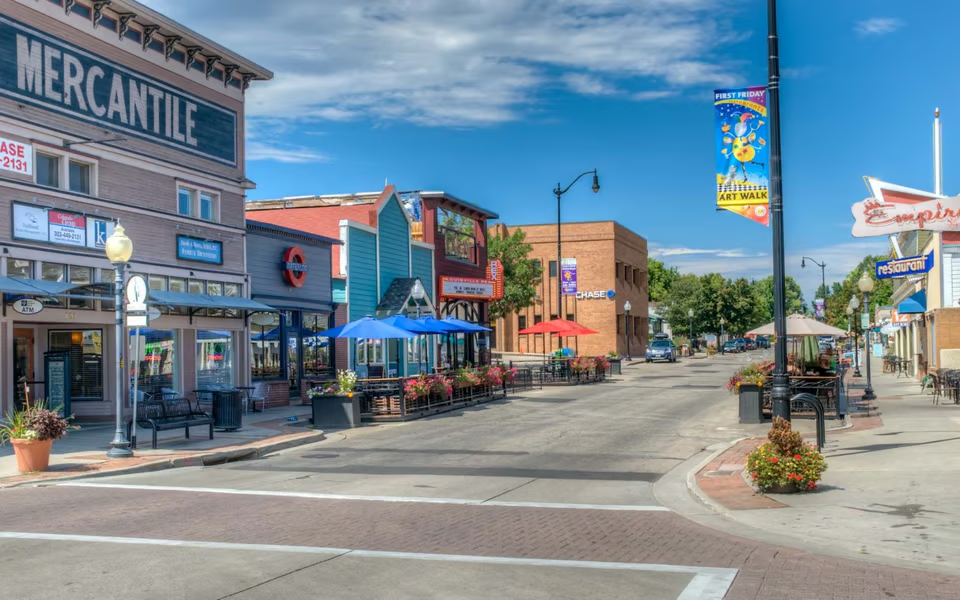
Louisville’s authentic coal-mining-era Old Town anchors a community identity that has repeatedly earned national “best place to live” recognition
2026 Economic Outlook
- Colorado Technology Center continuing to attract and retain established business tenants
- Avista Adventist Hospital ongoing healthcare employment stability
- Old Town Louisville downtown continuing incremental retail and dining investment
- Minimal new residential construction given build-out status, supporting structural price stability
- Continued Boulder tech corridor demand sustaining commuter-driven housing interest
The Build-Out Scarcity Thesis: Louisville’s Most Durable Structural Advantage
Among every city covered in this Colorado series, Louisville offers the clearest and most durable structural supply constraint argument. Unlike growth corridors in Parker, Castle Rock, Windsor, or Brighton where investors must actively monitor and avoid new construction competition, Louisville’s build-out status means this risk is largely already resolved at the city level:
- Minimal remaining developable land: Louisville’s municipal boundaries encompass very little undeveloped land suitable for significant new residential construction, a direct result of decades of deliberate growth management policy combined with the simple geographic reality of being surrounded by neighboring municipalities and protected open space.
- No meaningful “growth corridor” risk: Where Parker investors must specifically avoid the Anthology corridor and Windsor investors must monitor Severance, Louisville investors face essentially no equivalent risk, because there is no large-scale new construction corridor within city limits to avoid.
- Demand growth without supply growth: As the broader Boulder-Denver corridor population and economy continue to grow, Louisville’s effectively fixed housing stock means continued demand pressure translates more directly into price appreciation than in markets where supply can expand to meet demand.
- The tradeoff: This scarcity comes at the cost of entry price. Louisville’s $815,000 median is among the highest in this series, and the structural scarcity that supports long-term appreciation also means there is little opportunity for the kind of below-market value-add acquisition common in newer or less constrained markets.
Louisville vs. Superior: A Direct Comparison
Given their adjacency and similar fundamental positioning, investors frequently compare Louisville and Superior directly. Understanding the key distinctions is essential:
| Factor | Louisville | Superior |
|---|---|---|
| Disaster History | Not directly affected by the Marshall Fire | Several hundred structures destroyed (Dec 2021) |
| Due Diligence Complexity | Standard premium-market due diligence | Requires fire/rebuild-specific verification |
| Insurance Market | Standard Boulder County rates | Post-fire elevated premiums, shop carefully |
| Housing Stock Age | Mix of historic Old Town and established build-out era | Mix of unaffected established and newer post-2021 rebuild |
| Identity Anchor | Authentic coal-mining-era historic downtown | Recovery and resilience narrative, McCaslin corridor |
| Local Employment | Colorado Technology Center, Avista Hospital | Primarily commuter-dependent |
For investors specifically seeking the lowest-friction path to premium Boulder County exposure, Louisville’s lack of fire-related complexity is a genuine, meaningful advantage. For investors comfortable navigating Superior’s specific due diligence requirements, that market may offer slightly more relative value given the ongoing, if narrowing, recovery-period pricing dynamics. Many sophisticated Boulder County investors hold positions in both.
Historical Performance
| Period | Market Driver | Avg Annual Appreciation | Key Event |
|---|---|---|---|
| 2014-2019 | National recognition, Boulder tech corridor growth | 7-10% | Repeated national “best place to live” rankings build durable demand |
| 2020-2022 | Remote work, statewide migration boom | 12-17% | Louisville median crosses $700K; build-out scarcity amplifies price growth |
| 2023-2024 | Rate normalization | 2-4% | Limited inventory kept price declines modest relative to less constrained markets |
| 2025-2026 | Rate stabilization, continued scarcity-driven demand | 5-8% (projected) | Build-out status continuing to support price stability and appreciation |
Demographic Trends Driving Demand
- National Livability Brand Recognition — Repeated rankings in major national publications create durable, quantifiable demand from buyers and renters who specifically search for Louisville by name
- Boulder Affordability Overflow — Tech, biotech, and academic professionals priced out of Boulder proper, comparable to Superior’s draw but without the fire-related considerations
- Local Healthcare and Business Park Employment — Avista Adventist Hospital and Colorado Technology Center tenants provide genuine local employment independent of Boulder or Denver commuting
- Boulder Valley School District — Anchors durable family rental demand identical in character to Superior’s BVSD draw
- Historic Downtown Lifestyle Seekers — Buyers and renters specifically seeking authentic, walkable, historic community character that few Front Range communities can genuinely offer
- Long-Term Wealth Preservation Buyers — Investors and homeowners specifically targeting Louisville’s build-out scarcity as a long-horizon wealth preservation and appreciation vehicle
📚 New to real estate investing? Master the fundamentals with our professional course Learn more →
2. Neighborhood Hotspots
Louisville Investment Neighborhood Map
Interactive map of Louisville’s investment neighborhoods. Green stars show top hotspots, blue circles mark established markets, and orange circles highlight emerging areas.
Core Investment Neighborhoods
Detailed Submarket Analysis
| Neighborhood | Price Range | Cap Rate | Growth Drivers | Best Strategy |
|---|---|---|---|---|
| Old Town Louisville | $700K-$1.1M | 4.0-5.0% | Irreplaceable historic core, maximum scarcity | Long-hold, scarcity play |
| Downtown Adjacent / North | $680K-$900K | 4.2-5.0% | Walkability, BVSD schools, established community | Long-hold family SFH |
| CTC Adjacent | $650K-$850K | 4.3-5.2% | Local employment proximity | Local employment tenant targeting |
| South Louisville | $700K-$900K | 4.0-4.8% | Established, BVSD, US-36 access | Long-hold family SFH |
| Steel Ranch | $750K-$950K | 4.0-4.8% | Newer construction, family amenities | Lower-maintenance newer stock |
Expert Insight: “There is no new Old Town Louisville coming. That is the entire investment case in one sentence. You can build a thousand new subdivisions in Severance or Anthology, but you cannot manufacture 130 years of coal-mining history and an organically grown downtown commercial district. We have clients who specifically waited two years for the right Old Town listing rather than settle for a newer-construction Louisville property, because they understood that scarcity premium only grows over time.” — Patricia Nguyen, Principal Broker, Front Range Heritage Properties
3. Property Types
| Investment Goal | Best Property Type | Best Neighborhoods | Minimum Capital |
|---|---|---|---|
| Maximum Scarcity Value | Historic Old Town SFH | Old Town Louisville core | $185,000+ |
| Balanced Premium Entry | Established build-out era SFH | Downtown Adjacent/North, South Louisville | $175,000+ |
| Local Employment Targeting | CTC/hospital proximity SFH | CTC Adjacent | $170,000+ |
| Lowest Maintenance | Newer construction (where available) | Steel Ranch | $190,000+ |
Our Complete Renovation and Remodeling Cost Guide covers 400+ pages of project-by-project cost breakdowns with real contractor pricing ranges.
4. Cost Analysis
Acquisition Cost Breakdown (Louisville)
| Expense Item | Typical Cost | Example ($815,000 Property) | Notes |
|---|---|---|---|
| Down Payment | 25% (investment) | $203,750 | Among the highest capital requirements in this Colorado series |
| Closing Costs | 2-3% of price | $16,300-$24,450 | Boulder County title rates; standard Colorado closing structure |
| Inspection + Radon | $600-$900 | $750 | Radon mandatory; Boulder County carries moderate to elevated risk |
| Historic District Verification | Free-$200 | $100 | Relevant for Old Town properties if renovation is planned |
| Initial Repairs | 0-10% of price | $0-$81,500 | Older Old Town stock may require updates; budget accordingly |
| Reserves (6 months) | 6 months expenses | $20,000-$26,000 | Higher Louisville rents and costs require proportional reserve sizing |
| TOTAL MINIMUM ENTRY | ~28-33% of value | $240,750-$336,400 | Reflects Louisville’s premium, scarcity-driven market position |
Sample Cash Flow Analysis: Downtown Adjacent 3BR SFH
| Item | Monthly | Annual | Notes |
|---|---|---|---|
| Gross Rent | $3,000 | $36,000 | 3BR SFH, Downtown Adjacent, established BVSD zone |
| Less Vacancy (3%) | -$90 | -$1,080 | Strong, durable BVSD and brand-driven family demand |
| Property Taxes | -$432 | -$5,184 | ~0.64% of $810K assessed value (Boulder County rate) |
| Insurance | -$170 | -$2,040 | Standard Boulder County rates; no fire-related premium adjustment needed |
| Property Management (9%) | -$261 | -$3,132 | Boulder County PM rates |
| Maintenance + CapEx | -$180 | -$2,160 | Standard reserve for established stock |
| Net Operating Income | $1,867 | $22,404 | Before mortgage |
| Mortgage ($790K, 25% down, 6.75%, 30yr) | -$3,843 | -$46,116 | $592,500 loan, principal and interest |
| CASH FLOW | -$1,976 | -$23,712 | Significant negative carry, reflecting Louisville’s premium scarcity positioning |
| Cap Rate | 2.84% | NOI / Purchase Price | |
| Total Return (6.5% appreciation) | ~17% | Appreciation + principal paydown – negative carry |
Notice that Louisville’s insurance line item is meaningfully lower than the comparable Superior example, reflecting the absence of Marshall Fire-related insurance market disruption. This is the clearest quantifiable advantage of Louisville’s lack of fire history relative to its neighbor, even though both markets otherwise show similar cap rate and negative carry profiles given their shared premium Boulder County positioning.
The Scarcity Appreciation Argument: Louisville’s build-out status means that, unlike growth corridor markets where supply can expand to meet rising demand, continued population and economic growth across the broader Boulder-Denver corridor translates more directly into Louisville price appreciation. Investors should view Louisville’s negative cash flow not as a deficiency to be solved, but as the structural cost of holding a genuinely scarce, demand-inelastic asset in one of Colorado’s most economically significant corridors — a different return profile than cash-flow-oriented markets, evaluated on its own appreciation-driven terms.
5. Legal Framework
✅ Louisville Landlord Environment: Colorado State Law
Louisville operates under Colorado state landlord-tenant law. No rent control, no mandatory source-of-income acceptance at the state level. Boulder County courts process evictions in line with standard Colorado timelines. The primary Louisville-specific legal consideration relates to historic district renovation requirements for Old Town properties rather than landlord-tenant law specifically.
Colorado State Law Essentials
- No Rent Control: Colorado preempts local rent control. Louisville rents are entirely market-driven.
- Eviction Notices: 10-day pay-or-quit for non-payment, 3-day cure for violations, 21-day no-cause at lease end.
- Eviction Timeline: 30 to 45 days uncontested. Boulder County courts process in line with standard Colorado timelines.
- Security Deposit: No statutory cap. Return within 60 days (72 hours with written request).
- Boulder County Considerations: Verify current Louisville-specific town ordinances given Boulder County’s relatively active regulatory environment compared to less progressive Front Range jurisdictions.
Louisville-Specific Considerations
- Historic District Renovation Review: Properties within Old Town’s historic district may require architectural review for exterior renovations, additions, or significant alterations. Verify specific requirements with the city before purchasing with renovation plans.
- No City Rental License (Verify Annually): Confirm current requirements, as municipal rental licensing programs are periodically introduced or updated across Boulder County jurisdictions.
- Short-Term Rentals: Louisville regulates short-term rentals with permit requirements; verify current ordinance specifics before pursuing any STR strategy.
- Boulder County Property Tax Appeal: File with the Boulder County Assessor during the standard biennial Colorado appeal window.
- Environmental Due Diligence (Coal Mining Legacy): Given Louisville’s coal-mining history, standard environmental and soil due diligence for any property, particularly in or near historically mined areas, is good practice as part of comprehensive purchase due diligence.
- HOA Considerations: Newer Louisville communities like Steel Ranch may have HOA governance; review CC&Rs before purchase as with any HOA-governed property.
| Issue | Louisville Requirement | Investor Action |
|---|---|---|
| Historic district renovation | Architectural review required in Old Town historic district | Verify district status and review requirements before purchase if renovation planned |
| Coal mining legacy | No specific mandate; good practice for due diligence | Standard environmental and soil checks as part of comprehensive due diligence |
| Radon | No ordinance but Colorado law requires disclosure | Test every property; Boulder County has moderate to elevated risk |
| STR permitting | Permit required; verify current ordinance | Confirm with Louisville city offices before pursuing STR strategy |
| Property tax appeal | Biennial window; Boulder County Assessor | File appeal given Louisville’s appreciation trajectory and scarcity premium |
6. Step-by-Step Louisville Investment Playbook
Choose Your Louisville Strategy
Old Town Maximum Scarcity
Buy a historic property in Old Town Louisville. Accept the highest entry price and negative carry of the Louisville range for the most durable scarcity-driven appreciation thesis available in this entire Colorado series.
Balanced Premium Family Hold
Buy in Downtown Adjacent/North or South Louisville. Target BVSD-seeking families for 4-6 year tenancies at a somewhat more accessible entry than Old Town while retaining strong walkability access.
Local Employment Targeting
Buy near the Colorado Technology Center or Avista Adventist Hospital. Target locally-employed tenants for genuine community integration and tenant stability beyond pure regional commuter dependency.
Premium Executive Furnished Rental
Furnish a premium Louisville property for extended-stay corporate relocation tenants who specifically value Louisville’s identity and walkability over generic corporate housing alternatives.
Build Your Louisville Team
- Boulder County / Louisville-Experienced Agent: Must understand Old Town’s historic district nuances, the city’s build-out status and its implications for available inventory, and the specific distinctions between Louisville and Superior submarkets.
- Colorado Real Estate Attorney: For LLC setup, lease drafting, and historic district compliance guidance if pursuing Old Town renovation strategies.
- Boulder County Property Manager: With specific experience managing premium, low-turnover family rentals in a scarcity-driven market context.
- Appraiser Familiar with Louisville’s Premium Positioning: Important for accurate valuation given the city’s unique combination of historic and build-out era housing stock.
- Historic Preservation-Experienced Contractor: For any Old Town renovation work, a contractor with specific experience navigating historic district architectural review processes will significantly streamline any improvement project.
Louisville-Specific Due Diligence
Physical Checks
- Radon test — mandatory; Boulder County has moderate to elevated risk
- Standard environmental and soil checks, particularly relevant given Louisville’s coal-mining history
- Sewer scope for pre-1980 homes, common in Old Town’s historic stock
- HVAC and electrical system age assessment for older historic properties
- Roof age and hail claim history (CLUE report)
- Foundation check for any settlement issues, particularly relevant for older historic construction
Market and Regulatory Checks
- Verify BVSD attendance zone directly with the district
- Confirm historic district status for any Old Town property if renovation is planned
- Review HOA documents if applicable for newer Louisville communities like Steel Ranch
- Confirm US-36 commute times to both Boulder and Denver from the specific property
- Pull Boulder County Assessor record and compare to purchase price for appeal opportunity
- Verify distance and access to Colorado Technology Center and Avista Adventist Hospital if targeting local employment tenants
Marketing Louisville Properties: Identity-Driven Strategy
National Brand and Historic Identity Marketing
- Reference Louisville’s national “best place to live” recognition directly in listings — this is a genuine, quantifiable selling point that resonates with relocating families researching Colorado options
- Emphasize Old Town’s authentic historic character for properties in or near the downtown core, distinguishing the listing from generic suburban housing
- Lead with BVSD school district affiliation for family-targeted listings
- Highlight walkability to Old Town’s restaurants, breweries, and community events as a genuine lifestyle differentiator
Local Employment Targeting
- For CTC Adjacent and hospital-proximate properties, market directly to Avista Adventist Hospital staff and Colorado Technology Center business park employees through relevant community channels
- Emphasize short, local commute times as a specific differentiator from properties requiring regional Boulder or Denver commuting
7. Financing Options for Louisville
| Loan Type | Down Payment | Rate Premium | Best For | Louisville Note |
|---|---|---|---|---|
| Conventional Investment | 25% | +0.5-0.75% | W-2 income, first Louisville investment | Many Louisville properties approach or exceed the conventional loan limit of $806,500, requiring jumbo financing |
| Jumbo Investment | 25-30% | +0.75-1.25% | Properties above $806,500 | Standard for most Old Town and premium Louisville purchases |
| DSCR Loan | 30-40% | +1.5-2.5% | Self-employed, portfolio investors | Louisville’s low cap rates (4.0-5.0%) make standard DSCR qualification difficult; expect to need 35-40%+ down |
| Historic Renovation Loan Products | Varies | Varies by lender | Investors purchasing and renovating Old Town historic properties | Some lenders offer specialized products for historic property renovation; explore options with lenders experienced in this niche |
| Owner Move-Out to Rental | Original owner equity | Locked-in rate from purchase | Existing Louisville homeowners relocating | Similar opportunity to other premium markets for homeowners with sub-4% locked-in rates considering conversion to rental |
Financing Reality for Scarcity-Driven Markets: Louisville, like Superior, generally does not support standard DSCR qualification at conventional down payment levels given its low cap rates. Investors pursuing Louisville should plan for either substantial down payments (35-40%+), full income documentation conventional or jumbo financing, or the owner move-out rate-lock strategy as the most financially efficient paths into this market. This is consistent with the broader pattern across this Colorado series: premium, scarcity-driven appreciation markets require different financing approaches than cash-flow-oriented workforce markets like Fountain or Greeley.
8. Frequently Asked Questions

Knowledge Quiz: Louisville Colorado Real Estate Investment
Open Quiz
5 quick questions on what you just learned about Louisville investing
1) What does the guide identify as Louisville’s most durable structural advantage relative to growth-corridor markets like Parker or Windsor?
Answer: C
Louisville’s build-out status, with minimal remaining developable land, means investors face essentially no equivalent to the growth-corridor competitive supply risk that applies in Parker’s Anthology corridor or Windsor’s Severance corridor. This is a structural, durable scarcity argument rather than a temporary supply-demand imbalance.
2) How does Louisville’s investment profile differ from neighboring Superior’s, according to the guide’s direct comparison?
Answer: B
The key distinguishing factor is that Louisville was not directly affected by the December 2021 Marshall Fire, meaning Louisville investors avoid the fire/rebuild-specific due diligence requirements and elevated insurance market considerations that apply specifically to Superior properties. Both cities share BVSD access and similar cap rate ranges, both are in Boulder County.
3) Why does the guide highlight the Colorado Technology Center and Avista Adventist Hospital as structurally significant for Louisville investors?
Answer: D
Unlike most Front Range bedroom communities that depend almost entirely on residents commuting to jobs in a neighboring larger city, Louisville’s Colorado Technology Center business park and Avista Adventist Hospital provide genuine local employment within city limits. This means some share of Louisville’s tenant base works locally rather than commuting, adding structural depth and diversification to the rental market.
4) What specific renovation consideration applies to properties within Old Town Louisville’s historic district that does not apply to standard, non-historic properties?
Answer: A
Properties within Old Town Louisville’s historic district may require architectural review for exterior renovations, additions, or significant alterations. This protects the authentic character that drives Old Town’s scarcity value, but investors planning renovation work should verify specific district requirements and budget for potentially different timelines than a standard, non-historic property renovation.
5) According to the guide, why is Louisville’s negative cash flow not necessarily a deficiency that needs to be solved?
Answer: C
The guide frames Louisville’s negative cash flow as the structural cost of holding a scarce, demand-inelastic asset in a build-out-constrained market, rather than a problem to solve. Because supply cannot expand to meet demand the way it can in growth-corridor markets, continued regional population and economic growth translates more directly into Louisville price appreciation, supporting an appreciation-focused rather than cash-flow-focused investment evaluation.
Work With a Local Expert in Louisville
We are building a verified network of real estate professionals across every market we cover.

About Our Expert Network
We are finalizing partnerships with verified real estate professionals across every market featured on Builds and Buys. Each expert is selected for hands-on investment experience, local market knowledge, and commitment to helping investors make sound decisions.
- Proven experience with investment and income-producing properties
- Deep knowledge of Old Town historic district requirements and build-out dynamics
- Guidance on financing, legal structure, and due diligence
- Access to off-market and pre-market opportunities
- Full transaction support from search through closing
Services Covered
- Property sourcing and acquisition
- Historic district guidance
- Investment analysis and underwriting
- Buyer representation
- Value-add and renovation guidance
- Local employment tenant placement
- Title and disclosure review
- Financing and lender connections
- Property management referrals
- Insurance and inspection referrals
- 1031 exchange coordination
- Exit strategy planning
Get Connected or Join Our Network
Looking for a local expert to help with your Louisville investment? We will connect you with the right professional for your strategy.
Contact us at support@buildsandbuys.com
Find Specialized Louisville Real Estate Professionals
Ready to Invest in Louisville?
Louisville offers a genuinely rare combination among Front Range investment markets: a nationally recognized, durable brand identity, an authentic historic downtown that no amount of new construction anywhere could ever replicate, real local employment depth beyond pure commuter dependency, Boulder Valley School District access, and one of Colorado’s most structurally constrained growth boundaries. Investors who approach Louisville with appropriate capital, a long-term appreciation-focused mindset, and an understanding of its specific historic district and build-out dynamics will find access to one of the most durable scarcity-driven investment theses available anywhere in this Colorado series.
Continue Your Research
Colorado State Guide
See how Louisville compares to Superior, Boulder, and other Colorado markets.
Step-by-Step Invest
Complete framework for building a real estate investment strategy from scratch.
144-Lesson Course
University-level real estate education covering financing, law, strategy, and management.
For further guidance, explore our State-by-State Investor guides, browse our expert articles, or follow our Step-by-Step Investment Guide.



