
Evanston Wyoming Real Estate Investment Guide For 2026
A comprehensive guide for investors targeting Wyoming’s western gateway, where Salt Lake City proximity 80 miles east, Union Pacific Railroad heritage, Bear River fly fishing, and a structural Wyoming tax advantage over Utah’s 4.85% income tax combine to create a demand story unlike any other Wyoming market
Quick answers: Top 5 most searched Evanston investment questions ▼
Migration data: Where people are moving from to Evanston ▼
1. Evanston Market Overview
Market Fundamentals
Evanston occupies a unique position in Wyoming’s investment landscape: it is the most accessible Wyoming community from Utah’s Wasatch Front, sitting at the intersection of two dramatically different tax and cost-of-living environments. Where every other Wyoming market competes within Wyoming for residents, Evanston competes for the enormous pool of Salt Lake City metro residents for whom Wyoming residency is a rational financial decision.
- Population: 12,000 city, 20,000 Uinta County
- Salt Lake City Distance: 80 miles via I-80; approximately 80 minutes
- Union Pacific Railroad: Continuous presence since 1869; stable high-wage employment
- Natural Gas: Uinta County production; supplemental energy employment
- Bear River: Quality fly fishing through the city; outdoor recreation asset
- No State Income Tax: Wyoming’s most powerful advantage versus Utah’s 4.85%
Evanston is not primarily a Wyoming market. It is a Salt Lake City metro market that happens to be in Wyoming. This distinction changes the analysis entirely: the relevant comparables are Tooele and Heber City, Utah, not Casper or Cheyenne.
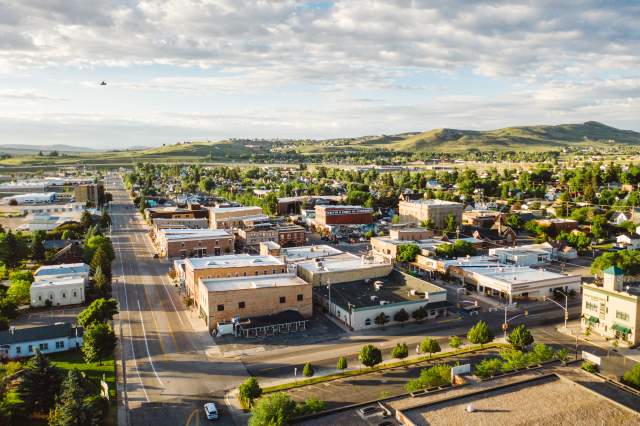
Evanston’s Bear River flows through the city while I-80 provides 80-minute access to Salt Lake City, creating a demand story unique in Wyoming
2026 Economic Outlook
- Salt Lake City tech sector growth driving Utah out-migration to Wyoming
- Union Pacific Railroad operations stable; freight demand consistent
- Remote work from Utah employers normalizing Wyoming residency
- Bear River corridor outdoor investment growing
- Natural gas market recovery adding Uinta County employment
The Evanston Investment Thesis: Wyoming’s Utah Arbitrage
- The tax savings calculation. A Utah resident earning $100,000 annually pays $4,850 in state income tax. Moving to Evanston eliminates this entirely. For a household earning $150,000, the savings reach $7,275 per year. For dual-income households earning $200,000 combined, the annual savings approach $9,700, effectively covering most of an Evanston mortgage payment.
- The housing price differential. Evanston homes average $345,000. Comparable Salt Lake City homes average $550,000 to $650,000. Even Tooele, Utah’s most affordable Wasatch Front suburb, averages $400,000 to $480,000. The Evanston discount of $100,000 to $300,000 is permanent as long as Wyoming maintains its tax advantage, which requires no legislative action since Wyoming has no income tax to abolish.
- The remote work catalyst. Remote work has made the 80-minute Salt Lake City commute a partial rather than daily experience. An Evanston resident who commutes two or three days per week can save $7,000 to $15,000 annually in combined tax and housing costs while maintaining full professional integration with Utah employers.
- The Union Pacific stability floor. Evanston has a railroad employment anchor that has operated continuously since 1869, independent of energy prices and Utah economic conditions. Railroad workers earn $80,000 to $120,000 and represent the most stable tenant profile in any Wyoming small city.
Historical Performance
| Period | Driver | Avg Appreciation | Key Event |
|---|---|---|---|
| 2010-2018 | Railroad and energy stability | 2-4% | Steady; Evanston not yet identified as Utah alternative |
| 2019-2021 | Salt Lake City appreciation spillover | 5-8% | Utah buyers begin crossing into Wyoming for affordability |
| 2022-2023 | Remote work explosion, Utah exodus | 10-15% | Median jumped from $255K to $325K; Utah buyers dominate new purchases |
| 2024-2025 | Sustained Utah demand, railroad stability | 6-9% | Market normalizing at elevated levels; Utah buyer share remains high |
| 2026 | Salt Lake City growth, permanent Wyoming advantage | 7-10% projected | As Salt Lake City grows, Evanston gap widens; structural demand continues |
📚 New to real estate investing? Master the fundamentals with our professional course Learn more →
2. Neighborhood Hotspots
| Neighborhood | Price Range | Cap Rate | Key Driver | Best Strategy |
|---|---|---|---|---|
| Downtown / Railroad | $295K to $430K | 6 to 7.5% | Utah demand, heritage character, Bear River | Appreciation play, quality Utah tenants |
| West Side Residential | $310K to $420K | 6 to 7% | UP employees, Utah commuters, stability | Quality buy-and-hold, stable professional tenants |
| Bear River Corridor | $330K to $500K | 5.5 to 7% | Fly fishing premium, outdoor enthusiasts | Premium appreciation, outdoor targeting |
| East Side New Development | $340K to $480K | 5.5 to 6.5% | Utah commuter families, new construction | Remote investor preferred, low maintenance |
| Hospital Area | $305K to $400K | 6 to 7% | Healthcare workers, stable employment | Low turnover, healthcare worker focus |
| Bear Lake Corridor (Rural) | $250K to $500K | 5 to 9% mixed | Bear Lake recreation, Utah visitor STR | STR / vacation rental, seasonal management |
Expert Insight: “Evanston is the most interesting market I work in because it plays by different rules than every other Wyoming town. A meaningful share of my rentals go to Utahns who made a deliberate financial decision to cross the border. They have done the math. They know they are saving $8,000 a year in taxes and $200 a month in housing costs. That makes them motivated, stable tenants who have a specific financial reason to stay. That dynamic fundamentally changes the risk profile of an Evanston investment compared to anywhere else in Wyoming.” – Sarah McNulty, Uinta County Real Estate Partners
3. Property Types
Utah Commuter Target Home
The primary Evanston strategy. Quality home with reliable broadband. Market to Utah residents working partially or fully remote who are motivated by Wyoming tax savings. Typically sign 1 to 2 year leases and renew consistently. The most creditworthy tenant profile in any Wyoming small city.
Union Pacific Employee Housing
Target railroad workers earning $80K to $120K annually. UP has a local HR presence; registering as an approved landlord can connect you directly to incoming employees. These tenants stay 3 to 7 years and are among Wyoming’s most reliable payers.
Railroad Heritage Value-Add
Victorian and craftsman homes in the historic district that have not been updated since the 1970s or 1980s. Utah buyers pay a premium for renovated heritage homes. Renovation honoring original character captures forced equity plus above-market rental premium.
Bear Lake / Bear River Recreation STR
Properties positioned for Bear Lake State Park or Bear River fishing visitors. Nightly rates of $120 to $280 during May through September peak season. Best as a hybrid: long-term tenant through winter, STR during peak recreation season.
Utah Tax Arbitrage Premium Tier
A higher-end Evanston property targeting high-earning Utah tech or financial professionals earning $150K to $250K annually who save $7K to $12K per year in Wyoming. These tenants pay $2,000 to $2,500 for a well-appointed 4-bedroom and are the most creditworthy segment in Evanston.
Energy Sector Workforce
Uinta County natural gas production creates workforce demand supplementing Utah and railroad demand. Natural gas workers are well-paid but cyclical, typically on 12 to 24 month assignments. Higher gross yield during active periods; higher vacancy risk during energy downturns.
Our Complete Renovation & Remodeling Cost Guide covers 400+ pages of real contractor pricing ranges.
4. Cost Analysis
Acquisition Cost Breakdown ($345,000 Property)
| Item | Typical Cost | Example | Notes |
|---|---|---|---|
| Down Payment (25%) | 25% | $86,250 | Standard investment; 20% possible with strong credit |
| Closing Costs | 2 to 3% | $6,900 to $10,350 | Wyoming lean closing structure; Uinta County title fees modest |
| Inspection + Radon | $550 to $800 | $650 | Full inspection plus radon test; Wyoming elevated radon levels |
| Initial Repairs | 0 to 8% | $0 to $27,600 | Older downtown homes may need HVAC, roofing, electrical updates |
| Reserves (6 months) | 6 months | $9,000 to $13,000 | Evanston’s Utah connection provides better liquidity than most Wyoming small cities |
| TOTAL MINIMUM ENTRY | ~30 to 35% | $102,800 to $137,850 | Justified by Utah demand quality and appreciation trajectory |
Sample Cash Flow: West Side 3BR SFH (Utah Commuter Tenant)
| Item | Monthly | Annual | Notes |
|---|---|---|---|
| Gross Rent | $1,700 | $20,400 | 3BR, west side, quality condition, Utah commuter |
| Less Vacancy (7%) | -$119 | -$1,428 | Conservative; Utah commuters motivated to stay |
| Property Taxes | -$173 | -$2,070 | ~0.6% of $345,000; Wyoming’s low effective rate |
| Insurance | -$118 | -$1,416 | Landlord policy; Wyoming wind and snow coverage |
| Property Management (10%) | -$170 | -$2,040 | Local manager; Utah tenant quality reduces complexity |
| Maintenance + CapEx (7%) | -$119 | -$1,428 | HVAC and roof reserves; quality west side home |
| Net Operating Income | $1,001 | $12,018 | Before mortgage; cap rate 3.48% on $345K price |
| Mortgage ($258,750 at 7%, 30yr) | -$1,723 | -$20,676 | 25% down conventional investment loan |
| Cash Flow (managed) | -$722 | -$8,658 | Negative with professional management at current rates |
| Cash Flow (self-managed, 5% vacancy) | -$263 | -$3,156 | Near-neutral with quality tenant and self-management |
| Annual Appreciation (8%) | +$27,600 | Within recent Evanston trajectory | |
| Total Return on $86K Down (8% apprec.) | ~28% | Leveraged return; compelling for managed appreciation play |
Evanston’s cash flow math sits between Lander and the cash flow markets like Worland. With professional management the monthly deficit is real. With self-management and a quality Utah commuter tenant, the deficit nearly disappears. The leverage story at 8% appreciation is compelling: approximately 28% total return on equity in year one. The key differentiator is that Evanston’s appreciation driver, Salt Lake City metro growth, is structural and Washington-independent rather than commodity-price-dependent.
5. Legal Framework
Wyoming’s Full Landlord Advantage, No Local Overlays
Evanston and Uinta County operate under Wyoming’s straightforward landlord-tenant framework with no local overlays of any kind. No rent control, no just cause eviction requirement, no rental registration, and no STR ordinance. Utah residents who become Evanston tenants are subject to Wyoming law, not Utah’s more tenant-protective framework, which is a meaningful additional landlord advantage.
Wyoming Landlord-Tenant Essentials
- No Rent Control: Wyoming prohibits rent control statewide. Evanston landlords raise rents freely as Utah demand grows market rates.
- Eviction: 3-day notice to pay or quit. File unlawful detainer after 3 days. Uinta County courts process efficiently. Full eviction in 3 to 6 weeks.
- No Just Cause Requirement: Month-to-month tenancies ended with 30-day notice, no cause required.
- Security Deposits: Maximum 1.5 months rent. Return within 30 days with itemized deductions.
- Tenant Screening: Full landlord discretion subject to federal Fair Housing.
Evanston-Specific Considerations
- No Rental Registration: City of Evanston does not require landlord registration or operating licenses.
- No STR Ordinance: No specific short-term rental regulations as of 2026. Wyoming lodging tax (4%) applies to stays under 30 days. Register with Wyoming Department of Revenue before any STR operation.
- Railroad Noise Easements: Properties near the Union Pacific line may have railroad noise and vibration as a disclosure item. Not a legal encumbrance but a tenant disclosure best practice.
- Property Taxes: Uinta County effective rate approximately 0.6% of assessed value; Wyoming’s standard low rate.
Useful Resources
- City of Evanston: evanstonwy.org
- Uinta County Assessor: uintacounty.com
- Wyoming DOR (STR Tax): revenue.wyo.gov
- Wyoming AG Landlord Guide: ag.wyo.gov
6. Step-by-Step Evanston Investment Playbook
Choose Your Evanston Strategy
Utah Commuter Anchor Rental
Acquire a quality west side or downtown home with confirmed fiber internet. Market specifically to Utah remote workers and commuters through Utah-facing channels. Lock in a 1 to 2 year lease with renewal priority. Accept negative carry as the cost of holding Evanston’s Utah-driven appreciation.
Union Pacific Employee Targeting
Contact UP’s Evanston HR directly. Register as an approved landlord. The railroad’s HR team actively places incoming employees in approved housing. These workers are Wyoming’s most stable tenants. Zero marketing effort once enrolled in the UP housing program.
Railroad Heritage Value-Add BRRRR
Buy a dated downtown Victorian or craftsman at discount. Renovate to honor heritage character while modernizing systems. Refinance at improved ARV. Rent to Utah buyer or remote worker at a premium for the authentic railroad town character. Repeat with recycled capital in Evanston or elsewhere.
Bear Lake STR + Long-Term Hybrid
Acquire a property near Bear Lake State Park. Place a long-term winter tenant (October through April) for stable baseline income. Convert to STR during peak Bear Lake season (May through September) at $120 to $280 per night from Utah water recreation visitors. Combined annual income typically exceeds pure long-term strategy.
Build Your Evanston Team
- Union Pacific HR Contact: Before hiring any other team member, contact UP’s Evanston facility HR. The corporate housing relationship is Evanston’s most underutilized investment tool and costs nothing to pursue.
- Local Agent: Find an Evanston agent who specifically has Utah buyer experience. This agent understands the cross-border dynamic and can identify which properties will appeal to Utah tenants and buyers at resale.
- Property Manager: Essential for remote investors. Evanston’s property management market is growing with the Utah-driven investment interest. Interview managers specifically about their Utah tenant placement experience.
- Utah-Focused Marketing Channels: Standard Wyoming rental platforms miss Utah buyers. The best marketing channels are Utah-facing Facebook groups for Wyoming relocation, Utah Realtor referral networks (offer a tenant placement fee), and LinkedIn targeting Salt Lake City tech workers.
Evanston-Specific Due Diligence
Physical Due Diligence
- Radon test: Wyoming elevated; test every property
- Confirm fiber internet at specific address; critical for Utah remote worker tenants
- Railroad noise: properties near the UP mainline have noise; disclose and price accordingly
- Heating: Evanston winters are cold; inspect furnace and insulation
- Roof: Wyoming wind and snow load; inspect for condition
- For Bear Lake rural properties: well and septic condition critical
Market Due Diligence
- Research current Utah commuter rental demand through local property managers
- Verify comparable rentals; Evanston’s Utah-influenced market may not appear on standard Wyoming rental databases
- Confirm distance to I-80 interchange; Utah commuters prioritize highway access
- Check broadband provider coverage map at specific address
- Model base case at 7% vacancy; stress case at 12% for energy downturn scenario
Marketing to Utah Tenants
- Lead with the Wyoming tax savings narrative: “Live in Wyoming, work in Utah, save $7,000 to $12,000 per year in state income tax” is the most powerful sentence in Evanston marketing. Calculate the specific savings for a tenant at median Salt Lake City professional income and include it prominently in your listing.
- Confirm and prominently advertise fiber internet: Utah remote workers will not consider a rental without confirming high-speed internet. State the provider and confirmed speed in the first line of your listing.
- Utah-facing Facebook groups and LinkedIn: “Moving to Wyoming from Utah,” “Wyoming tax arbitrage,” and Salt Lake City tech worker LinkedIn groups are where your tenants self-identify. Standard Wyoming rental platforms are largely invisible to this audience.
- Partner with Salt Lake City Realtors: Salt Lake City agents whose clients are pricing out of Utah will refer tenants to Wyoming if there is a referral fee arrangement. A modest tenant placement fee to a Salt Lake agent generates pre-screened, creditworthy applicants who have already decided to cross the border.
7. Financing Options for Evanston
| Loan Type | Down Payment | Rate Premium | Best For | Evanston Note |
|---|---|---|---|---|
| Conventional Investment | 25% | +0.5 to 0.75% | W-2 income, strong credit | All Evanston residential properties within conforming limits; most common approach |
| DSCR Loan | 25 to 30% | +1.5 to 2.5% | Self-employed, portfolio builders | 6 to 7.5% cap rates may be borderline for DSCR at current rates; verify with lender; some national lenders comfortable with Evanston’s size of 12,000 |
| Portfolio Loan | 20 to 25% | +0.75 to 1.5% | Multiple properties, relationship banking | Uinta County community banks understand Utah demand dynamic; preferred for first-time Evanston investors |
| Hard Money (Bridge) | 15 to 25% | 9 to 12% rate | Value-add heritage renovation | Wyoming and Utah hard money lenders serve Evanston; Utah lenders often more familiar with this cross-border market |
| Utah-Based Lender | 20 to 25% | Standard + market | Investors with Utah banking relationships | Utah lenders familiar with cross-border Wyoming purchases; some have Evanston-specific experience |
Evanston Financing Note: Unlike the very small Wyoming markets where DSCR lenders hesitate over population size, Evanston at 12,000 residents passes the minimum threshold for most national DSCR programs. However, cap rates of 6 to 7.5% are borderline for DSCR qualification at current interest rates. Verify with your specific lender before going under contract. Uinta County community banks and Utah-based lenders are often the best source for Evanston financing, as they understand the cross-border Utah demand dynamic that drives Evanston’s market in ways that out-of-state institutional lenders typically do not.
8. Frequently Asked Questions

Knowledge Quiz: Evanston, Wyoming Real Estate Investment
Open Quiz
5 quick questions on what you just learned about investing in Evanston
1) What makes Evanston fundamentally different from every other Wyoming investment market?
Answer: C
No other Wyoming city has a comparable metro adjacency to a major, growing metro area. Salt Lake City is 80 miles east on I-80, and Wyoming’s permanent zero income tax versus Utah’s 4.85% creates a structural financial incentive for Utah workers and remote professionals to live in Evanston. This demand driver is independent of Wyoming’s energy sector and grows as Salt Lake City’s economy expands.
2) For a Utah household earning $200,000 combined, what is the approximate annual state income tax savings from living in Evanston versus Utah?
Answer: B
Utah charges 4.85% state income tax on all income. On a $200,000 combined household income, this equals $9,700 per year. Wyoming charges 0%. For a family making $200,000, moving to Evanston saves $9,700 annually in state income tax, plus additional savings from lower housing costs. Over five years that is $48,500 in state income tax alone, a genuinely compelling financial case.
3) Why is Union Pacific Railroad Evanston’s most important economic stability anchor?
Answer: A
Union Pacific’s 157-year continuous presence in Evanston makes it the most durable employment anchor of any Wyoming small city. Railroad workers earn $80K to $120K, stay 3 to 7 years, and pay consistently. This baseline is entirely independent of natural gas prices, Utah economic conditions, or remote work policy changes. It is Evanston’s insurance policy against the demand risks that affect other segments of the market.
4) What is the most important property feature to confirm before purchasing an Evanston home for Utah remote worker tenants?
Answer: D
Utah remote workers working for Salt Lake City tech and professional services employers have a non-negotiable requirement for reliable high-speed internet. Coverage gaps exist in parts of Evanston. Always confirm the specific address’s fiber or high-speed cable availability before purchasing with remote worker marketing in mind, and advertise the confirmed provider and speed prominently in your listing. This is a dealbreaker feature, not an amenity.
5) What is Evanston’s primary risk that is unique compared to other Wyoming investment markets?
Answer: C
Remote work policy reversal is Evanston’s unique vulnerability. Unlike Rock Springs (trona stability), Lander (NOLS and outdoor community), or Wheatland (agricultural base), Evanston’s premium appreciation driver depends partly on Utah remote workers being able to work from Wyoming. If major Utah employers require full in-office attendance, the commuter and remote worker segments would shrink. Union Pacific and natural gas employment would maintain a demand floor, but the Utah premium would diminish. Option D is incorrect: Wyoming cannot reintroduce an income tax through normal legislation; it has never had the infrastructure.
Work With a Local Expert in Evanston
We are building a verified network of real estate professionals across every market we cover.

About Our Expert Network
We are finalizing partnerships with verified real estate professionals across every market on Builds and Buys. Each expert is selected for their hands-on investment experience, local knowledge, and commitment to sound investment decisions.
- Proven experience with investment and income-producing properties
- Deep knowledge of local pricing, rental yields, and neighborhood dynamics
- Understanding of the Utah-Wyoming cross-border demand dynamic
- Full transaction support from search through closing
Get Connected or Join Our Network
Looking for a local expert in Evanston or the Uinta County cross-border market? We will connect you with the right professional.
Contact us at support@buildsandbuys.com
Find Specialized Wyoming Real Estate Professionals
Ready to Invest in Evanston?
Evanston is Wyoming’s most Utah-connected market and its most structurally differentiated investment story. The Salt Lake City metro will continue to grow. Utah’s income tax will remain at 4.85% or higher. Wyoming will remain at 0%. The housing price differential will persist as long as these structural conditions hold, and nothing on the horizon suggests they will not. Union Pacific has been in Evanston since 1869 and is not leaving. The Bear River still flows through town. The investors who buy Evanston today are positioned to benefit from the same compounding dynamic that has driven 35% appreciation since 2020, with more runway ahead as the Utah migration narrative matures into mainstream awareness.
Continue Your Research
Wyoming State Guide
See how Evanston compares to other Wyoming markets across the state.
Step-by-Step Invest Guide
Complete framework for building a real estate investment strategy from scratch.
144-Lesson Course
University-level real estate education covering financing, law, strategy, and management.
For further guidance, explore our State-by-State Investor guides, browse our expert articles, or follow our Step-by-Step Investment Guide.



