
Jackson Real Estate Investment Guide For 2026
A comprehensive resource for investors looking to navigate one of the most supply constrained and tax advantaged real estate markets in the country, gateway to Grand Teton and Yellowstone National Parks
Quick answers: Top 5 most searched Jackson investment questions ▼
Migration data: Where people are moving from to Jackson ▼
Complete Investment Guide
Click on any section to navigate directly to that content
1. Jackson Market Overview
Market Fundamentals
Jackson is the county seat of Teton County and the largest incorporated town in Wyoming, sitting in the Jackson Hole valley at the base of the Teton Range. It is the gateway to both Grand Teton National Park and Yellowstone National Park, and the defining fact of this market is land scarcity: roughly 97% of Teton County is owned by the federal government as national park or national forest, leaving a small sliver of private land to absorb demand from one of the most desirable resort communities in North America.
Key economic indicators that define Jackson’s investment case:
- Population: about 10,500 to 10,760 in the town proper, with Teton County’s broader population considerably larger across Wilson, Teton Village, South Park, and other unincorporated areas
- Major Employers: Jackson Hole Mountain Resort and the broader tourism and hospitality sector, the National Park Service across Grand Teton and Yellowstone, St. John’s Health (the regional hospital), and a growing wealth management and family office sector tied to Wyoming’s tax advantaged residency
- Median Sale Price (Town of Jackson): approximately $2.3 million for a single family home
- Largest Employment Sectors: tourism and hospitality, government and national park services, healthcare, professional and financial services
- No State Income Tax: Wyoming has no personal or corporate income tax and no estate tax
- Rental Vacancy: under 2% countywide, among the tightest rental markets in the country
Unlike every other city in our Wyoming coverage, Jackson’s price level is driven primarily by structural land scarcity and wealth migration rather than local population or wage growth. The town’s median sale price runs more than five times Wyoming’s statewide median, and Teton County as a whole, including Wilson and Teton Village, runs considerably higher still.
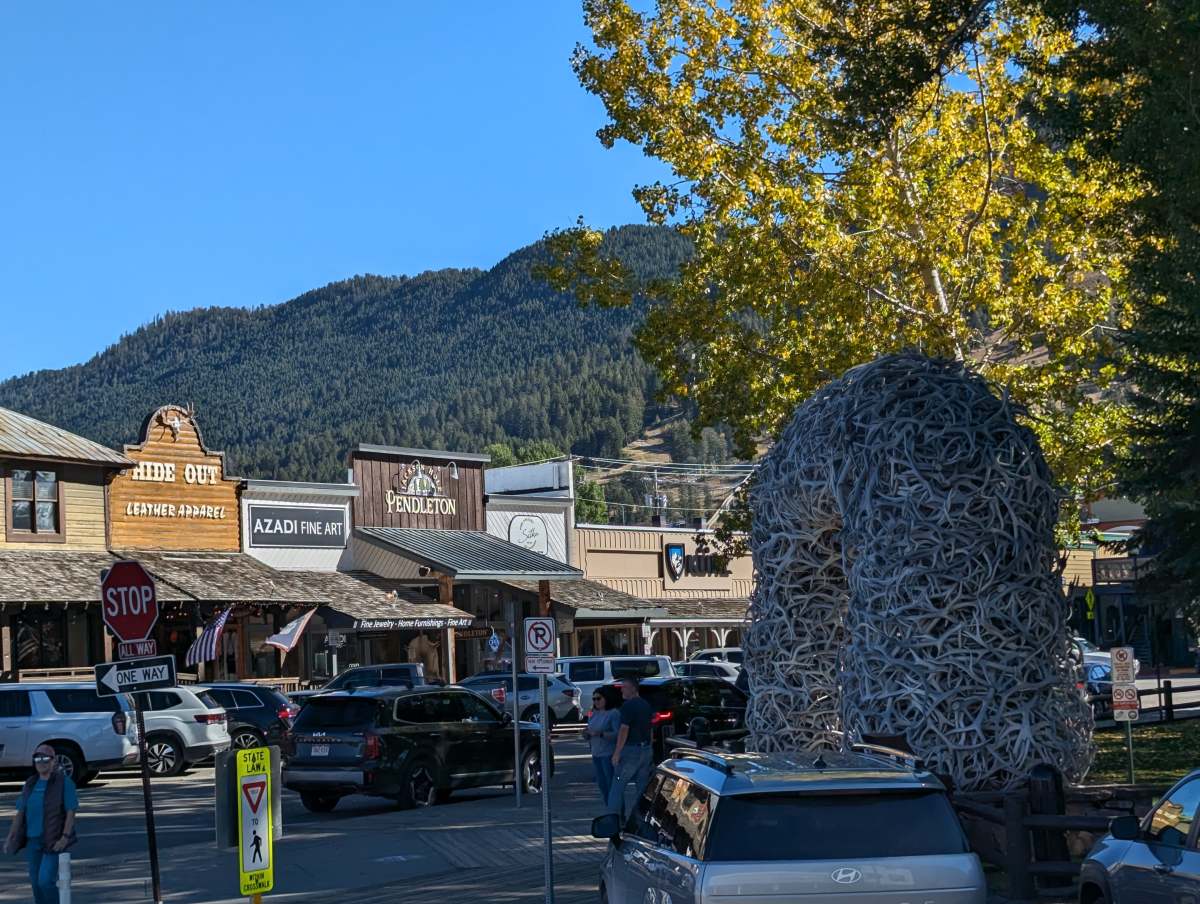
Jackson’s economy blends tourism, national park services, healthcare, and a growing wealth management sector tied to Wyoming’s tax advantaged residency
2026 Economic Outlook
- The luxury segment of the market is normalizing after a sharp run up, with median single family prices in Teton County down roughly 23% from recent peaks, while the Town of Jackson’s own median has continued to edge higher
- Condo inventory remains exceptionally tight, with the median condo price sitting at $1.1 million to $1.2 million, a relative entry point for this market
- Fannie Mae forecasts 30 year mortgage rates dipping below 6.0% by late 2026, though the ultra luxury segment here is dominated by cash buyers largely insulated from rate movements
- Continued growth in deed restricted workforce housing production, with roughly 35 to 41% of all new units built in recent years carrying a permanent affordability restriction
Investment Climate
Jackson is not a market for an investor looking for a $200,000 duplex and a clean cap rate. It is a market defined by extreme land scarcity, a deeply bifurcated economy, and a genuine tax driven demand pool that does not exist anywhere else in our Wyoming coverage. Successful Jackson investors tend to share a few characteristics:
- Realistic expectations about yield – traditional rental cap rates here are structurally lower than almost anywhere else in the state, with the real return often coming from appreciation, tax residency value, or personal use rather than monthly cash flow
- A clear understanding of where short term rental is actually legal – Teton County’s regulatory default is prohibition outside specific zones, the opposite assumption an investor coming from a typical resort town would make
- Genuine interest in the deed restricted workforce housing system as a distinct, government supported investment lane rather than viewing it as a constraint to avoid
- Comfort with condos as the practical entry point rather than single family homes, given the gap between condo and single family pricing
- An appreciation for Wyoming’s tax structure as a standalone reason for ownership, separate from rental income
Wyoming’s statewide landlord tenant law is genuinely favorable to property owners, with fast eviction timelines and minimal tenant protections relative to most states. But in Jackson specifically, that statewide advantage is layered underneath some of the strictest local land use and short term rental regulation in the country, a combination investors elsewhere in Wyoming will not encounter.
Historical Performance (2020 to 2026)
| Year | Median Single Family Price (Town) | YoY Change | Notable Context |
|---|---|---|---|
| 2020 | $1,350,000 | +8.0% | Pre pandemic baseline, already one of the most expensive small markets in the country |
| 2022 | $2,100,000 | +25.0% | Pandemic era remote wealth migration and low Wyoming tax exposure drive a sharp run up |
| 2024 | $2,250,000 | +3.0% | Growth moderates sharply as the broader luxury market normalizes |
| 2025 | $2,280,000 | +1.3% | Inventory increases modestly, days on market lengthen |
| 2026 | $2,300,000 | +0.6% | Town of Jackson holds steady even as the broader county luxury segment shows a sharper correction |
Figures blend Redfin and Zillow data for the Town of Jackson specifically. Teton County wide figures, which include Wilson and Teton Village, run considerably higher and have shown a sharper recent correction at the very top of the market.
Demographic Trends Driving Demand
- Structural Land Scarcity – with 97% of Teton County under federal protection, new supply is fundamentally capped regardless of demand strength
- 183 Day Tax Residency Migration – high net worth buyers from California, Texas, and other high tax states establishing Wyoming residency to access no income tax, no estate tax treatment
- Tourism Driven Service Workforce – Jackson Hole Mountain Resort, the National Park Service presence, and the broader hospitality sector require a substantial year round and seasonal workforce that increasingly cannot afford market rate housing
- Deed Restricted Housing Expansion – 35 to 41% of all new residential units built in recent years carry a permanent workforce or affordable housing restriction, a structural and growing share of the local market
- Renter Occupied Share Declining – down from roughly 59% in older data to approximately 43 to 45% today, as housing increasingly converts to seasonal second home use
- Extremely Low Vacancy – under 2% countywide, meaning available rental units, when they exist, receive intense demand almost immediately
📚 New to real estate investing? Master the fundamentals with our professional course Learn more →
2. Neighborhood Hotspots
Where Smart Money Is Moving in 2026
Top Hotspots
Teton Village (the primary zone where short term rental is legal), the Town of Jackson core (year round walkable rental demand), and the Indian Springs and Skyline Ranch corridor along Highway 22 (relatively more accessible pricing) lead for 2026. South Park and Wilson appeal to buyers wanting a more local, year round community feel, while East Jackson and the Gros Ventre Butte area sit at the very top of the market.
Typical Cap Rates
1.5 to 3.5% across most Jackson properties, structurally lower than anywhere else in our Wyoming coverage, reflecting price levels that have outpaced what local rents alone can support. Teton Village condos legally operating as short term rentals generally land at the top of that range given nightly rate potential, while long term rental condos and homes elsewhere in the valley trade more on appreciation and tax residency value than on yield.
Jackson Investment Neighborhood Map
Interactive map of Jackson Hole’s investment neighborhoods. Green stars show top hotspots, blue circles mark established markets, and orange circles highlight emerging pockets.
Core Investment Neighborhoods
Detailed Submarket Analysis: All Jackson Neighborhoods
| Submarket | Price Range | Cap Rate | Character | Best Strategy |
|---|---|---|---|---|
| Teton Village | $1,500,000 to $8,000,000+ | 2.5 to 3.5% | Short term rental legal, ski resort base | Short term rental income |
| Town of Jackson Core | $1,100,000 to $3,000,000 | 2.0 to 3.0% | Walkable, strongest long term rental demand | Long term rental, tax residency |
| Indian Springs and Skyline Ranch Corridor | $1,000,000 to $4,000,000 | 2.0 to 3.0% | Relatively accessible, Snake River proximity | Long term rental, appreciation |
| Highway 22 Buttes | $1,800,000 to $4,000,000 | 2.0 to 2.5% | Relatively lower pricing for comparable quality | Appreciation, long term hold |
| South Jackson and Rafter J | $1,500,000 to $3,500,000 | 2.0 to 2.5% | Family friendly, year round community | Long term rental, appreciation |
| South Park | $1,800,000 to $5,000,000 | 2.0 to 2.5% | Rural, ranch like, local community | Appreciation, personal use |
| Fall Creek Road | $2,500,000 to $7,000,000 | 1.5 to 2.0% | Larger lots, mountain views, semi rural | Appreciation, personal use |
| Wilson | $3,000,000 to $8,000,000 | 1.5 to 2.5% | Village character, Teton Pass access | Appreciation, personal use |
| East Jackson and Gros Ventre Butte | $1,500,000 to $18,000,000 | 1.5 to 2.0% | Ultra luxury, sweeping views | Appreciation, tax residency |
| North of Town | $2,500,000 to $10,000,000+ | 1.5 to 2.0% | Golf club access, Snake River frontage | Appreciation, personal use |
| West Bank North | $5,000,000 to $20,000,000+ | 1.0 to 2.0% | Ultra luxury, golf course access | Appreciation, tax residency |
Expert Insight: “The first thing I tell every out of state client is to forget the cap rate math they learned somewhere else. Jackson is not a cash flow market. It is a scarcity market and a tax strategy market that happens to also produce rent. If someone wants real income property potential, I point them to Teton Village, because it is genuinely one of the only places in the valley where short term rental is legal outright. If someone wants long term appreciation and the tax residency benefit, the town core or a Highway 22 corridor condo gets them in at the lowest realistic price point in the valley.” – Whitney Sorensen, Broker, Teton Peaks Realty Group
Don’t guess the costs. Our Complete Renovation & Remodeling Cost Guide covers 600+ pages of project by project breakdowns with real contractor pricing ranges.
3. Property Types
📋 2026 Reality Check: Jackson’s Zoning Runs the Opposite Direction From Most of Wyoming
Wyoming has no statewide law mandating ADUs, duplexes, or upzoning, and zoning authority sits entirely with local governments. In most of the state this means a light, permissive local touch. In Jackson and Teton County, it means the opposite: some of the strictest local land use and short term rental regulation anywhere in the country, layered on top of Wyoming’s otherwise landlord friendly statewide law. Before purchasing anything in Jackson with a rental strategy in mind, confirm the property’s specific zoning district and whether it falls inside or outside the Lodging Overlay and Planned Resort Zone, since this single fact determines what is and is not legally possible.
| Investment Goal | Best Property Type | Best Neighborhoods | Minimum Capital |
|---|---|---|---|
| Strongest Realistic Yield | Short term rental eligible condo | Teton Village | $450,000 to $2,400,000 (down payment) |
| Lowest Entry Price | Long term rental condo | Indian Springs and Skyline Ranch Corridor | $300,000 to $400,000 (down payment) |
| Subsidized Entry With Below Market Rent | Workforce Rental Deed Restriction | Valley wide, subject to qualification | Purchase price minus up to $100,000 subsidy |
| Tax Residency and Long Term Appreciation | Condo or single family home | Town of Jackson Core, East Jackson | $330,000 to $1,000,000+ (down payment) |
| Ultra Luxury Wealth Preservation | Single family estate | Wilson, West Bank North, Gros Ventre Butte | $1,000,000+ (down payment) |
4. Cost Analysis
Acquisition Cost Breakdown (Jackson)
| Expense Item | Typical Cost | Example ($1,150,000 Condo) | Notes |
|---|---|---|---|
| Down Payment | 30% (typical jumbo investment) | $345,000 | Jumbo and luxury lenders commonly require 25 to 40% down on investment property here |
| Closing Costs | 1.5 to 2.5% of price | $17,250 to $28,750 | Title, escrow, lender fees, recording; no Wyoming real estate transfer tax |
| General Inspection | $600 to $900 | $750 | Roof snow load capacity and HOA reserve health are key items in a Jackson condo inspection |
| Initial Repairs and Furnishing | 0 to 5% of price | $0 to $57,500 | Highly variable, furnished units command a premium for both long term and short term rental |
| Reserves (6 months) | 6 months expenses | $25,000 to $32,000 | Emergency fund for vacancy, HOA assessments, and repairs |
| TOTAL CASH TO CLOSE | ~35 to 40% of value | $387,750 to $463,250 | By far the highest dollar cash to close requirement of any city in our Wyoming coverage |
Wyoming’s Tax Structure and the 183 Day Residency Calculation
Unlike Montana’s HB 231, Wyoming applies a single flat property tax structure statewide. Residential property, including rentals, is assessed at 9.5% of fair market value regardless of whether it is owner occupied, a long term rental, or a second home. There is no separate, higher rate for rental or second home status the way Montana now has, which is a meaningful structural difference for any investor comparing the two states.
| Item | Calculation | Annual Tax on $1,150,000 Property |
|---|---|---|
| Assessed Value | 9.5% of fair market value | $109,250 |
| Mill Levy (Teton County, typical) | Approximately 70 mills | 7.0% of assessed value |
| Total Annual Property Tax | Assessed Value x Mill Levy | $7,648 (effective rate of about 0.66%) |
On a percentage basis, this is one of the lowest property tax burdens in the country relative to home value, even in Teton County, which carries the highest average annual property tax bill in Wyoming in raw dollar terms simply because home values are so high. Combined with no state income tax and no estate tax, many high net worth buyers find that owning a Jackson property and establishing Wyoming residency, generally understood to require at least 183 days a year in the state, produces meaningful tax savings that have little to do with rental income at all. This calculation, not a rental cap rate, is the primary financial driver for a large share of Jackson buyers.
Sample Cash Flow Analysis: Town of Jackson Core Condo (Long Term Rental)
| Item | Monthly | Annual | Notes |
|---|---|---|---|
| Gross Rent (2BR, Long Term) | $4,800 | $57,600 | Midpoint of the $4,600 to $5,000 market range for a 2BR in town |
| Less Vacancy (3%) | -$144 | -$1,728 | Conservative given countywide vacancy under 2% |
| Property Taxes | -$637 | -$7,648 | 9.5% assessment, approximately 70 mill levy |
| HOA Dues | -$600 | -$7,200 | Typical for a full amenity condo building in town |
| Insurance | -$200 | -$2,400 | Reflects elevated wildfire exposure across Teton County |
| Property Management (10%) | -$480 | -$5,760 | Local long term residential management rate |
| Maintenance and CapEx (5%) | -$240 | -$2,880 | Lower share given HOA covers most exterior and building system costs |
| Net Operating Income | $2,499 | $29,984 | Before mortgage, equal to a 2.61% cap rate |
| Mortgage ($1,150,000 price, 30% down, 6.75%, 30yr) | -$5,223 | -$62,680 | Principal and interest only, on an $805,000 loan |
| CASH FLOW (30% down) | -$2,724 | -$32,696 | Negative at standard financing, the honest reality of this market |
This is, deliberately, not a flattering cash flow table, and that is the point. At standard financing, a Jackson condo runs meaningfully negative every month. An all cash purchase produces the full $29,984 in annual NOI, a 2.61% cash on cash return, which is the realistic ceiling for a long term rental strategy here without leverage. Investors specifically seeking positive monthly cash flow should look toward Teton Village’s short term rental eligible condos, or toward the considerably higher cap rate markets covered elsewhere in our Wyoming series, such as Casper or Gillette.
Expert Insight: “I show clients this exact math constantly, and I would rather they see it honestly than get surprised after closing. Nobody is buying a long term rental condo in downtown Jackson for the monthly cash flow. They are buying it because the appreciation has been strong, because establishing Wyoming residency saves them real money every single year regardless of what the property earns in rent, and because owning here is genuinely different from owning a normal income property anywhere else. If someone tells me they need positive cash flow on day one, Teton Village or somewhere outside the valley entirely is usually the better conversation.” – Whitney Sorensen, Broker, Teton Peaks Realty Group
5. Legal Framework
✅ Wyoming State Law Is Landlord Friendly, But Jackson Layers On Some of the Strictest Local Zoning in the Country
This is the single most important legal distinction in this entire guide. Wyoming’s statewide landlord tenant law genuinely favors property owners. But in Jackson and Teton County, that statewide advantage sits underneath a local zoning and short term rental framework that is, by design, restrictive rather than permissive. Always confirm a specific property’s zoning district and short term rental eligibility with the Town of Jackson Planning Department or Teton County Planning and Development before purchasing with any rental strategy in mind.
Wyoming Statewide Landlord Tenant Law
Wyoming Statutes Title 1, Chapter 21 (eviction) and Title 34, Chapter 2 (general landlord tenant relations) govern every residential lease in the state, including Jackson:
- Non Payment Notice: A 3 day pay or vacate notice is required before a non payment eviction can proceed.
- Lease Violation Notice: A 3 day notice to cure or vacate applies for most lease violations, faster than the multi week cure periods common in many other states.
- No Rent Control: Wyoming has no statewide or local rent control or rent stabilization law.
- Security Deposits: No statutory dollar cap, though 1 to 2 months rent is common market practice. Deposits must be returned within 30 days, or up to 60 days if deductions are taken, with an itemized statement.
- Entry Notice: Landlords must give at least 24 hours notice before entering an occupied unit for non emergency purposes.
- Self Help Evictions Are Illegal: A landlord who changes locks, shuts off utilities, or removes a tenant’s property without a court order is acting unlawfully.
- No Anti Retaliation Statute: Unlike most states, Wyoming has no specific law prohibiting a landlord from retaliating against a tenant who reports a code violation, a notable difference from more tenant protective states.
Jackson and Teton County Specifics
Unlike most cities in our Wyoming coverage, Jackson and Teton County have adopted extensive local land use regulation that directly governs rental strategy:
- 31 Day Minimum Rental Outside Approved Zones: Teton County’s Land Development Regulations prohibit rentals under 31 days everywhere except specifically approved areas like the Lodging Overlay and Planned Resort Zone.
- Short Term Rental Permitting Inside Approved Zones: Even within the Lodging Overlay, operating an STR requires both a Town of Jackson Business License and a Basic Use Permit, plus neighbor notification within 200 to 300 feet depending on location.
- Steep Penalties for Violations: Wyoming Statutes authorize the County to fine STR violators up to $750 per offense, with each day of continued violation treated as a separate offense.
- ARU Rental Restrictions: Accessory Residential Units may only be rented to persons employed within Teton County, for a minimum 90 day term, never as a short term stay.
- Family Definition Limits: Most homes in Teton County were approved as single family residences, meaning long term occupancy is legally limited to related individuals or no more than six unrelated individuals living as a single household.
- No Statewide ADU or Duplex Mandate: Unlike states that have passed statewide upzoning laws, Wyoming leaves all of this entirely to local control, and Jackson has chosen a restrictive approach.
| Regulation | Jackson / Teton County | A More Typical Wyoming City | Investor Impact |
|---|---|---|---|
| Eviction Process | Wyoming statewide process applies | Wyoming statewide process applies | No difference, same fast 3 day notice statewide |
| Short Term Rental | Prohibited outside approved zones, permit required inside them | Generally allowed with a business license or registration | Dramatically more restrictive in Jackson, the most important difference in this guide |
| ADU / ARU Rights | Allowed, but rental restricted to local workforce, 90 day minimum | Allowed, generally fewer rental restrictions | Jackson’s ARU income potential is meaningfully more limited |
| Property Tax Structure | Same flat 9.5% assessment, no rental vs owner distinction | Same flat 9.5% assessment, no rental vs owner distinction | Identical statewide structure, only home values differ dramatically |
| Land Use Planning | Extensive, detailed Land Development Regulations | Generally simpler local zoning codes | Confirm zoning before any purchase, far more consequential here than elsewhere in the state |
| Building Permits | Town of Jackson Planning Department or Teton County Planning and Development | Local city or county planning office | Generally a more involved, longer review process in Jackson |
6. Step by Step Jackson Investment Playbook
Define Your Jackson Strategy
Jackson is the one market in our coverage where the very first decision is not which neighborhood, but which of four genuinely different investment theses actually fits the goal. Before buying, decide which of these strategies fits your goals:
Short Term Rental Income
Purchase a condo within Teton Village’s Lodging Overlay, the primary submarket in the valley where short term rental is legally permitted, capturing peak ski and summer season demand.
Tax Residency and Appreciation
Purchase a condo or home primarily to establish 183 day Wyoming residency and capture the state’s no income tax, no estate tax treatment, with long term rental income as a secondary benefit.
Workforce Rental Subsidy
Purchase a qualifying market rate unit and enroll it in the Preservation Program’s Workforce Rental deed restriction track, receiving up to $100,000 toward the purchase in exchange for renting to a qualified local employee.
Ultra Luxury Wealth Preservation
Purchase a single family estate in Wilson, the West Bank, or East Jackson primarily for long term wealth preservation, lifestyle use, and Wyoming’s favorable estate tax treatment, with minimal expectation of rental income.
Build Your Jackson Team
Jackson’s complexity means the right team matters more here than almost anywhere else in our coverage:
- Jackson Hole Specialist Agent: Essential given how much zoning and STR eligibility varies parcel by parcel, not just neighborhood by neighborhood.
- Wyoming Residency Focused CPA or Tax Attorney: Critical for any buyer considering the 183 day residency strategy, since the rules require genuine documentation of time spent in the state.
- Teton County Land Use Attorney or Consultant: Worth the cost before closing on any property where rental income, short term or long term, is part of the plan.
- Local Property Manager Experienced With HOA Heavy Buildings: Most Jackson condos sit inside active HOAs with their own rental rules layered on top of county regulation.
- Jumbo or Private Banking Lender: Conventional conforming loan limits are essentially irrelevant here, since nearly every Jackson property requires jumbo or portfolio financing.
Expert Tip: Before writing an offer on anything you intend to rent, ask your agent for a Zoning Compliance Verification from Teton County Planning, confirming in writing whether the specific parcel sits inside or outside an approved short term rental zone. Relying on a neighbor’s or a listing agent’s assumption about this is one of the most common and costly mistakes outside investors make here.
Jackson Specific Due Diligence
Physical Due Diligence
- Wildfire risk assessment, since Redfin data shows 99% of Teton County properties carry some wildfire exposure over a 30 year horizon
- Roof snow load capacity given the valley’s significant winter snowfall
- HOA reserve fund health for condo purchases, particularly in older Teton Village buildings
- Well water rights and quality for properties outside municipal water service, especially in South Park and Wilson
- Flood risk near the Snake River corridor, with roughly 30% of Teton County properties carrying some flood exposure
Regulatory Due Diligence
- Confirm the exact zoning district and whether the parcel sits inside or outside the Lodging Overlay or Planned Resort Zone
- Obtain a Zoning Compliance Verification from Teton County Planning before assuming any rental strategy is legal
- Review HOA bylaws for any building specific rental restrictions, which can be more restrictive than county law
- If considering the ARU or Workforce Rental Deed Restriction program, confirm current eligibility requirements directly with the Jackson/Teton County Housing Department
- Verify whether the property carries any existing deed restriction from a prior owner’s participation in an affordable or workforce program
Competing in Jackson’s Market
Jackson’s market has normalized somewhat from its pandemic era peak, with days on market in the Town of Jackson rising from 52 to 84 days year over year, and the broader Teton County luxury segment showing a sharper correction. Still, structural scarcity means this is not a market where prices are likely to become broadly affordable.
- Move quickly on Teton Village condos: With short term rental legality genuinely scarce, properties that are clearly compliant tend to draw faster, more competitive interest than comparable units elsewhere in the valley.
- Expect an all cash or heavily capitalized buyer pool: The $10 million plus segment is dominated entirely by cash buyers and asset backed credit lines, largely insulated from mortgage rate movements.
- Watch the condo segment specifically: With inventory still roughly 36% below pre-2024 levels in the broader valley, well priced condos at the $1.1 to $1.2 million entry point can move faster than the headline luxury slowdown might suggest.
- Budget time for zoning verification: Build at least several weeks into any purchase timeline for confirming rental eligibility before closing, rather than assuming it after the fact.
Property Management in Jackson
Jackson carries Wyoming’s statewide landlord friendly framework, but property management here is considerably more specialized than in a typical market given the dual long term and short term rental landscape. Key focuses for Jackson landlords:
Typical Jackson Management Fees
- Long term rental management: 8 to 12% of monthly rent, on the higher end of our coverage given the specialized local market
- Short term rental management (Teton Village, where legal): 25 to 35% of gross revenue, reflecting the much higher operational complexity of turnover, cleaning, and guest services
- Leasing fee (long term): 50 to 100% of one month’s rent
- HOA coordination: many Jackson property managers also coordinate directly with building HOAs, which can carry separate fees
Practical Screening Standards
With rental vacancy under 2% countywide, Jackson landlords screening long term tenants should still apply consistent income, credit, and rental history standards under fair housing law. Given the extreme tightness of the market, verified employment with a major local employer such as Jackson Hole Mountain Resort, St. John’s Health, or the National Park Service is a strong, common signal of stable local income, though demand itself is rarely the constraint here.
7. Financing Options for Jackson
| Loan Type | Down Payment | Rate Premium | Best For | Jackson Note |
|---|---|---|---|---|
| Jumbo Investment Loan | 25 to 40% | +0.5 to 1.0% | Strong income and asset borrowers | The default financing path here, since virtually every Jackson property exceeds conventional conforming loan limits |
| All Cash Purchase | 100% | N/A | High net worth buyers, particularly in the $5 million plus segment | Genuinely common in Jackson, especially among buyers primarily motivated by tax residency rather than financing efficiency |
| Private Banking / Wealth Management Line of Credit | Asset backed, varies | Varies by relationship | Ultra high net worth buyers with substantial existing assets | Common in the $10 million plus segment, often used instead of a traditional mortgage entirely |
| Workforce Rental Down Payment Assistance | Reduced by up to $100,000 | N/A, a direct subsidy | Investors willing to permanently deed restrict a unit for workforce rental | A genuinely unique financing tool unavailable anywhere else in our coverage, administered by the Jackson/Teton County Housing Department |
| DSCR Loan | 25 to 35% | +1 to 2% | Investors who want no income verification | Genuinely difficult to qualify for given how thin debt service coverage runs at Jackson price levels and rents |
| 1031 Exchange | Varies, exchange dependent | N/A | Investors exiting an appreciated property elsewhere and deferring capital gains | A common path into Jackson for investors who built equity in a different, lower cost market |
Jackson Financing Reality: Financing in Jackson looks fundamentally different from anywhere else in our Wyoming coverage. Conventional conforming loan limits are essentially irrelevant, since the overwhelming majority of properties require jumbo or private banking financing regardless of strategy. DSCR loans, a reliable tool in lower priced Wyoming markets, are genuinely difficult to use here given how thin rental yields run relative to price. The most distinctive financing tool unique to this market is the Workforce Rental Deed Restriction program, which functions as a direct, government funded reduction in effective purchase price for investors willing to accept a permanent rental restriction in return.
8. Frequently Asked Questions

🧠 Test Your Jackson Investment Knowledge
Five questions covering the facts that matter most for Jackson investors. Answer all five, then check your score.
1. What is the primary structural reason Jackson home prices run so far above the rest of Wyoming?
2. Where in Jackson is short term rental of less than 31 days actually legal?
3. Roughly how much can the Jackson/Teton County Housing Department pay an investor toward a purchase in exchange for a permanent Workforce Rental deed restriction?
4. Roughly how many days a year must someone spend in Wyoming to support a claim of state tax residency?
5. About how long does an uncontested, non payment eviction typically take from notice to sheriff execution in Jackson?
Local Jackson Real Estate Expert
Jackson Expert Profile Coming Soon
We are onboarding verified local real estate professionals, contractors, lenders, and property managers across Wyoming. If you work in Jackson real estate and want to be featured here as a trusted resource for readers of this guide, claim your professional profile below.
Apply to Be Featured →Helpful Resources For Jackson Investors
Ready to Invest in Jackson?
Jackson is unlike anywhere else in our Wyoming coverage, and the investment case here has little to do with cap rates. Structural land scarcity, with 97% of Teton County permanently protected, combines with Wyoming’s no income tax, no estate tax structure to create persistent demand from buyers who are not primarily chasing rental yield. The realistic paths to genuine income, Teton Village short term rentals or the Workforce Rental deed restriction program, are narrow and specific. For most other investors, the honest case for Jackson is appreciation, tax residency value, and long term wealth preservation, not monthly cash flow. Approach this market with that distinction clearly in mind, and it remains one of the most genuinely unique real estate opportunities in the country.
Continue Your Research
This Jackson guide is part of our complete Wyoming coverage. Visit the Wyoming state investment guide for a statewide overview, or explore all 52 state guides to compare markets across the country. For ongoing market analysis and platform updates, check our news and knowledge hub.



