
Ogden Real Estate Investment Guide For 2026
A comprehensive resource for investors targeting Utah’s most undervalued major city, where a thriving historic district revival, Weber State University student housing demand, Hill AFB proximity, and some of the Wasatch Front’s lowest entry prices combine to create the strongest cash flow opportunity in northern Utah
Quick answers: Top 5 most searched Ogden investment questions ▼
Migration data: Who is moving to Ogden and why ▼
In This Guide
Click on any section to navigate directly to that content
1. Ogden Market Overview
Market Fundamentals
Ogden is where Utah’s real estate story is most interesting for investors who look beyond the obvious. While Salt Lake City dominates investor attention and Lehi captures tech headlines, Ogden quietly offers something neither of those markets can match at current pricing: genuine positive or near-positive cash flow potential in a city actively undergoing the kind of revitalization that historically produces above-average long-term appreciation. The historic 25th Street corridor, Weber State University’s growing enrollment, three ski resorts within 30 minutes, and proximity to Hill Air Force Base form an investment thesis that is compelling at entry prices 30 to 40 percent below comparable Salt Lake County markets.
Key economic indicators defining Ogden’s investment case:
- Population: 87,000 city, 600,000+ greater Weber County metro
- Largest Employers: Hill Air Force Base (#1), Weber State University (#2), Ogden Regional Medical Center, IRS Ogden Service Center, FedEx Ground, Amazon
- Median Household Income: $52,000 city (lower than SLC, but housing costs are proportionally lower by more)
- Weber State Enrollment: 28,000+ students, growing nursing, engineering, and healthcare programs
- Ski Access: Snowbasin (25 min), Powder Mountain (35 min), Nordic Valley (25 min)
- FrontRunner: Commuter rail to Salt Lake City providing employment corridor access
- Median Home Price: $360,000 (30-40% below Salt Lake County)
The investment case for Ogden rests on a convergence that is rare in real estate: the city is simultaneously undervalued relative to its employment base, undergoing genuine revitalization in its historic core, anchored by a major university that guarantees ongoing rental demand, and positioned for outdoor recreation access comparable to markets that cost twice as much. Investors who understand all four legs of this story are well-positioned ahead of the broader market’s recognition of Ogden’s value proposition.
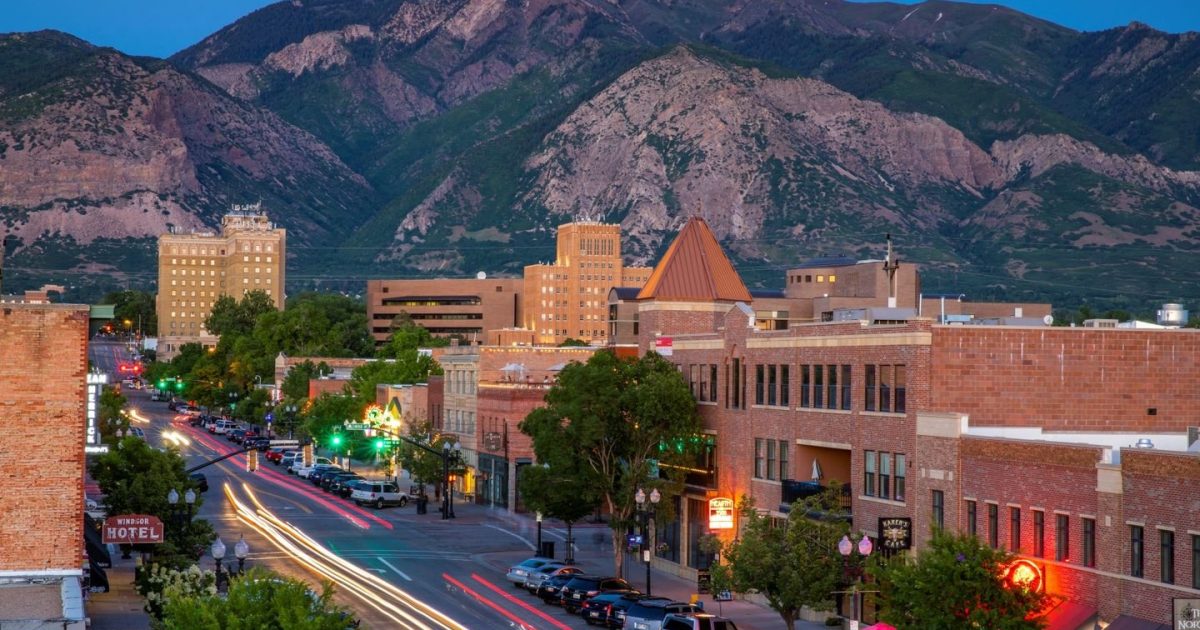
Ogden’s historic 25th Street is the most compelling urban revival story in northern Utah, combining Victorian architecture with a growing arts, dining, and craft beverage scene against a backdrop of the Wasatch Mountains
2026 Growth Catalysts
- Weber State healthcare program expansion adding enrollment and employment
- Snowbasin Resort ongoing capital investment improving ski destination appeal
- Ogden Downtown Alliance continued 25th Street development and event programming
- FrontRunner frequency improvements strengthening SLC commuter connection
- Growing remote worker migration choosing Ogden for cost and outdoor access
Investment Climate
Ogden’s investment climate in 2026 is defined by a widening gap between the city’s actual quality of life and lifestyle offering and its market pricing, which still reflects older perceptions of Ogden as a declining industrial city. That gap is closing, and investors who position ahead of full market recognition have historically captured the best returns. Key investment dynamics:
- Cash flow accessibility that does not exist elsewhere on the Wasatch Front. At $350,000 to $420,000 entry prices with rents of $1,700 to $2,100, Ogden central neighborhoods can achieve 6.5 to 7.5 percent cap rates that approach cash flow neutrality even at current mortgage rates.
- Student housing premium near Weber State where by-the-bedroom strategies generate 25 to 35 percent more revenue than conventional whole-home leasing, potentially pushing cash flow positive.
- Hill AFB BAH floor in South Ogden and Roy, where E-4 to E-6 military families provide the same recession-resistant demand dynamic described in the Layton guide at lower entry prices.
- Revitalization appreciation upside in the 25th Street corridor and east bench neighborhoods where the gap between current prices and comparable Salt Lake County values represents the appreciation runway as Ogden’s identity transition completes.
Historical Performance
| Period | Market Driver | Avg Annual Appreciation | Key Event |
|---|---|---|---|
| 2010-2015 | Post-recession recovery, early downtown revival | 3-5% | 25th Street revitalization begins gaining momentum; Weber State enrollment grows past 25,000 |
| 2016-2019 | Downtown revival acceleration, Hill AFB F-35, outdoor rec identity | 7-10% | Outdoor recreation and adventure sports identity takes hold; Ogden begins attracting outdoor-oriented millennials priced out of Park City |
| 2020-2022 | Pandemic migration, remote work, affordability advantage | 18-24% | Ogden’s affordability relative to SLC draws significant in-migration; east bench and 25th Street neighborhoods appreciate fastest |
| 2023-2024 | Rate adjustment, normalization | 4-7% | Market normalized but held better than comparable transitional cities; downtown vacancy rate declined further |
| 2025-2026 | Rate stabilization, continued revitalization, WSU growth | 8-12% (projected) | Snowbasin capital investment, WSU enrollment growth, continued 25th Street commercial development |
Demographic Trends Driving Demand
- Outdoor Recreation Identity Consolidation – Ogden has emerged as Utah’s premier outdoor recreation city for people who want genuine mountain access without Park City’s price tag. Snowbasin, Powder Mountain, and Nordic Valley give Ogden more ski resort proximity than any other Wasatch Front city. The Bonneville Shoreline Trail system provides hundreds of miles of hiking and biking directly from the city. This outdoor identity is attracting an outdoor-oriented demographic with incomes sufficient to be strong tenants but attraction to Ogden specifically over more expensive alternatives.
- 25th Street Cultural District – The revival of Historic 25th Street is transforming Ogden’s downtown into a genuine destination with dozens of independent restaurants, craft breweries, wine bars, art galleries, and boutique retailers in Victorian-era storefronts. This cultural infrastructure is attracting urban dwellers who previously would not have considered Ogden, creating demand for walkable downtown adjacent housing.
- Weber State University Growing Programs – WSU’s healthcare programs, nursing school, and Dumke College of Health Professions are among the fastest-growing in Utah, adding enrollment and healthcare professional students who are older and more responsible tenants than traditional undergraduate cohorts.
- Remote Worker Migration – Ogden’s combination of affordable housing, outdoor access, FrontRunner to SLC, and improving urban amenities makes it increasingly competitive for remote workers who want Utah’s lifestyle without SLC prices. Fiber internet infrastructure improvements support this trend.
- Hill AFB Lower-Grade Spillover – E-1 to E-4 military families whose BAH does not stretch to Layton frequently settle in South Ogden and Roy, providing stable military family demand at Ogden’s more affordable price points.
- Wasatch Front Price Compression – As Salt Lake County prices have risen dramatically, Ogden absorbs buyers and renters who have been priced out of closer-in markets, gradually compressing the historical discount between Ogden and SLC.
📚 New to real estate investing? Master the fundamentals with our professional course Learn more →
2. Neighborhood Hotspots
Ogden Investment Neighborhood Map
Interactive map of Ogden investment neighborhoods. Green stars show top investment hotspots, blue circles mark established markets, and orange circles highlight emerging corridors.
Core Investment Areas
Detailed Submarket Analysis: Ogden
| Neighborhood | Price Range (SFH) | Cap Rate | Growth Drivers | Best Strategy |
|---|---|---|---|---|
| Historic 25th Street | $290K-$480K | 6.5-8.0% | Urban revival, cultural district, young professional migration | Revitalization hold, urban demographic |
| Weber State Corridor | $280K-$420K | 7.0-9.0% | Student demand, by-bedroom premium, healthcare programs | By-bedroom leasing, highest cap rate play |
| Ogden East Bench | $380K-$600K | 5.5-6.5% | Mountain views, canyon access, premium demographics | Premium appreciation, outdoor professional target |
| South Ogden / Hill AFB Adjacent | $340K-$490K | 6.0-7.5% | Military BAH demand, FrontRunner, lower entry than Layton | Military family targeting, BAH-aligned rents |
| North Ogden / Pleasant View | $340K-$510K | 5.5-6.5% | Family demographics, good schools, safe, affordable | Stable family rental hold |
| Riverdale / Washington Terrace | $320K-$460K | 6.0-7.0% | I-15 corridor, Hill AFB proximity, commercial growth | Affordable balanced hold |
| Ogden Valley (Huntsville) | $380K-$700K | 5.0-7.0% | Snowbasin access, reservoir recreation, STR potential | STR/vacation, scenic appreciation |
| West Ogden Revitalization | $220K-$360K | 7.0-9.0% | Lowest entry, highest upside, early revitalization | Value-add, experienced investors only |
Expert Insight: “Ogden is at the same inflection point that Provo was in 2014 and Salt Lake City’s Sugar House was in 2010. The fundamentals are all there: university, revitalizing downtown, outdoor recreation identity, employment anchors, and prices that still reflect the old story rather than the new one. The investors who are buying near Weber State and in the 25th Street corridor today are going to look very smart in 5 years when the rest of the market figures out what is already happening. The mistake is waiting until Ogden looks as obviously attractive as Sandy or Draper, because by then the pricing gap will have closed.” – Tyler Maughan, Northern Utah Investment Properties
3. Property Types
| Investment Goal | Best Property Type | Best Area | Minimum Capital |
|---|---|---|---|
| Maximum Cash Flow | By-bedroom SFH or small multi-family | Weber State corridor, near-campus | $85,000+ |
| Best Appreciation | Historic Victorian or east bench SFH | 25th Street corridor, Ogden east bench | $90,000+ |
| Recession-Resistant Income | Military family SFH | South Ogden, Roy, Hill AFB adjacent | $90,000+ |
| Lowest Entry / House Hack | FHA duplex owner-occupy | Central Ogden, near Weber State | $15,000-$25,000 (FHA) |
Don’t guess the costs. Our Complete Renovation & Remodeling Cost Guide covers 400+ pages of project-by-project breakdowns with real contractor pricing ranges.
4. Cost Analysis
Acquisition Cost Breakdown (Ogden)
| Expense Item | Typical Cost | Example ($370,000 Property) | Notes |
|---|---|---|---|
| Down Payment | 25% (investment) | $92,500 | Much more accessible than SLC County; FHA house hack option at 3.5% |
| Closing Costs | 2-3% of price | $7,400-$11,100 | Utah closing costs below national average |
| Home Inspection | $350-$550 | $450 | Older housing stock in central Ogden warrants thorough inspection including knob-and-tube wiring check in pre-1950 homes |
| Radon Test | $150-$250 | $200 | Weber County elevated radon; always test |
| Initial Renovation / Touch-Up | $5,000-$50,000 | $10,000-$30,000 | Central Ogden older stock often needs meaningful updating to compete; budget realistically |
| By-Bedroom Setup (if applicable) | $1,500-$5,000 | $2,500 | Individual bedroom locks, common area furnishing for near-WSU by-bedroom properties |
| Reserves (6 months) | 6 months expenses | $8,000-$11,000 | Higher reserves recommended for older central Ogden stock given deferred maintenance risk |
| TOTAL MINIMUM ENTRY | ~32-38% of value | $122,050-$142,300 | Most accessible entry on the Wasatch Front; FHA duplex house hack path requires as little as $15,000-$20,000 |
Sample Cash Flow Analysis: Weber State By-Bedroom vs. 25th Street Whole-Home vs. East Bench SFH
| Item | Weber State By-Bedroom (3BR) | 25th Street Whole-Home (3BR) | East Bench SFH (3BR) |
|---|---|---|---|
| Purchase Price | $350,000 | $380,000 | $470,000 |
| Monthly Revenue | $2,250 (3 rooms × $750) | $1,800 | $2,100 |
| Property Taxes | -$205/mo | -$222/mo | -$275/mo |
| Insurance | -$95/mo | -$100/mo | -$120/mo |
| Management (10% by-bedroom / 9% whole) | -$225/mo | -$162/mo | -$189/mo |
| Maintenance + CapEx | -$145/mo | -$160/mo | -$176/mo |
| Vacancy (5% / 5% / 4%) | -$113/mo | -$90/mo | -$84/mo |
| Net Operating Income | $1,467/mo | $1,066/mo | $1,256/mo |
| Mortgage (25% down, 6.5%, 30yr) | -$1,659/mo | -$1,801/mo | -$2,227/mo |
| MONTHLY CASH FLOW | -$192 | -$735 | -$971 |
| Cap Rate | 5.03% | 3.37% | 3.21% |
| Total Return (10% appreciation) | ~32% | ~24% | ~21% |
The Weber State by-bedroom scenario is the standout, producing only -$192/month in cash flow at a 5.03 percent cap rate, the best result of any standard investment strategy across all nine Utah city guides in this series. At a slightly higher rent per room ($780-$800 average) or with a 4-bedroom property, this scenario can achieve genuine positive cash flow. The 25th Street and east bench scenarios show more meaningful negative carry but generate their returns primarily through appreciation in the 9 to 13 percent annual range. Ogden is the only Wasatch Front market where cash flow neutrality is a realistic target using conventional investment financing.
Expert Insight: “The by-the-bedroom strategy near Weber State is the most underutilized approach in all of northern Utah real estate. I have properties near campus where I rent each bedroom individually to nursing students and healthcare program students. These tenants are 24 to 28 years old, paying their own rent, studying seriously, and they are phenomenal tenants because a bad rental reference would hurt their career. On a $330,000 purchase I am generating $2,250 to $2,400 in monthly revenue. That is something no other Wasatch Front market can come close to at that price point.” – Maria Santos, Ogden Investment Properties
5. Legal Framework
✅ Utah State Law, No Municipal Complications
Ogden operates under Utah’s landlord-friendly framework with no additional city-level tenant protections beyond state requirements. No rent control, no just-cause eviction requirement, and a 25 to 45 day non-payment eviction process. Ogden City does have a rental property registration and inspection program for some property types, and landlords should verify current requirements. As a university-adjacent market, understanding by-the-bedroom lease structures and Weber State’s off-campus housing policies is important operational knowledge.
Utah State Essentials
- No Rent Control: Prohibited statewide. Raise rents freely at each renewal.
- Non-Payment Eviction: 3-day pay-or-vacate notice. Court filing day four. Typical resolution 25 to 45 days.
- Month-to-Month Termination: 15-day notice required.
- Security Deposits: No statutory cap. Return within 30 days with itemized accounting. Near-campus properties should use full security deposit; document condition thoroughly at move-in.
- Entry Notice: 24 hours required except genuine emergencies.
- Habitability: Heating systems must be functional. Older Ogden housing stock requires particular attention to heating, electrical, and plumbing compliance.
Ogden-Specific Considerations
- Rental Registration: Ogden City has a rental property registration program. Verify current requirements at ogdencity.com before operating any rental property in the city limits.
- By-the-Bedroom Leasing: Utah law does not prohibit individual room leases. Use separate lease agreements for each bedroom tenant. Specify shared responsibility for common areas. Consult a Utah attorney for a well-drafted by-the-room lease template.
- Historic District: Properties in Ogden’s historic district may have exterior modification restrictions. Consult the Ogden City Historic Preservation office before making exterior changes to historic properties.
- Weber State Off-Campus: WSU does not require students to live on campus after freshman year, creating a large, unrestricted off-campus rental market. No university landlord approval process as exists at BYU.
- Ogden Valley STR: Short-term rental regulations in Weber County and Huntsville township vary from Ogden City requirements. Verify current rules for Ogden Valley properties at webercountyutah.gov.
| Regulation | Ogden / Utah | Comparison (Seattle) | Investor Impact |
|---|---|---|---|
| Eviction | 3-day notice; 25-45 day total | Just cause; 90-180 day typical | Fast, low-cost resolution; critical advantage in near-campus market where lease violations do occur |
| Rent Control | Prohibited statewide | No formal control but heavy restrictions | Annual rent increases aligned with market; particularly important as 25th Street revitalization drives area rents upward |
| By-the-Bedroom Leasing | Legal; separate leases per tenant | Varies; some municipalities complicate | Powerful near WSU; use attorney-drafted individual room leases |
| Rental Registration | Ogden City program; verify current requirements | Seattle has complex registration and inspection | Minimal compliance burden; ensure registration before leasing |
| SCRA (Military Tenants) | Federal law applies to Hill AFB tenants | N/A | Same SCRA considerations as Layton apply to South Ogden and Roy military tenants |
6. Step-by-Step Ogden Investment Playbook
Choose Your Ogden Strategy
Weber State By-Bedroom (Cash Flow)
Buy a 3 to 4 bedroom home within 1 mile of Weber State campus. Lease individual bedrooms to healthcare and graduate students. Achieve the best cash flow math on the Wasatch Front. Active management required.
25th Street Revitalization Hold
Buy Victorian or historic property near the 25th Street corridor. Target young professional urban tenants. Hold through the full revitalization cycle as the perception gap closes. Patience rewarded.
FHA House Hack Duplex
Buy a duplex with 3.5% FHA down payment. Live in one unit, rent the other. Best entry-level strategy in the Ogden market. Renter’s income offsets most or all of the mortgage. Build equity and save for next acquisition.
South Ogden Military BAH Play
Buy in South Ogden or Roy targeting E-4 to E-6 Hill AFB BAH rates. Same recession-resistant military demand as Layton at 20 to 30 percent lower entry. Best stability play in the Ogden market.
Build Your Ogden Team
- Ogden-Experienced Investment Agent: Must know the neighborhood safety differentiation in detail, which central Ogden blocks are improving versus not, and which Weber State proximity streets have the strongest by-bedroom demand. Generic Wasatch Front agents often lack this granular Ogden knowledge.
- By-the-Bedroom-Experienced Property Manager: Managing a by-the-bedroom property requires a different skill set than conventional rentals: individual room advertising, individual tenant screening, coordinating shared space maintenance, and managing turnover in individual rooms without waiting for full-house vacancy. Find a manager with demonstrated by-the-bedroom experience in the Ogden market before assuming any PM can handle it.
- Utah Real Estate Attorney: Particularly important for by-the-bedroom lease structure, which requires well-drafted individual room lease agreements that clearly define shared space responsibility, individual tenant rights, and processes for resolving disputes between co-tenants.
- Ogden Inspector with Older Stock Experience: Central Ogden housing stock from the 1900s to 1950s requires an inspector who specifically knows what to look for in pre-war construction: knob-and-tube wiring, galvanized plumbing, asbestos, foundation and drainage issues, and basement moisture from the older storm systems in the city.
Expert Tip: The most important question to ask any Ogden property manager: “Do you have other by-the-bedroom properties near Weber State currently under management, and can I speak with the owners?” A manager who has never managed a student by-the-bedroom property and your $340,000 investment are a bad combination. This is a specialized management style that requires specific experience. Verify it before committing.
Ogden-Specific Due Diligence
Physical Checks (Older Ogden Stock)
- Radon test (mandatory; Weber County elevated)
- Knob-and-tube wiring check in pre-1950 homes; updating to modern electrical is often required to obtain landlord insurance
- Galvanized plumbing inspection and pressure test; older galvanized pipes corrode internally and reduce flow significantly
- Asbestos screening for pre-1980 homes (floor tiles, pipe insulation, attic insulation)
- Foundation moisture and drainage especially in basement apartments common in older Ogden stock
- Furnace and heating system condition; Utah winters require reliable heat
Neighborhood and Market Checks
- Walk the specific block and adjacent blocks at multiple times of day before purchase; Ogden neighborhood quality varies by block in some areas
- Confirm Weber State walking or biking distance for near-campus strategy (1.0 mile or under is prime; over 1.5 miles loses student premium significantly)
- Verify Ogden City rental registration requirements for the specific property type
- Check historic district designation if modifying exterior appearance is planned
- Confirm current rents in the specific block by checking active listings and talking to neighboring landlords
Executing the By-Bedroom Strategy Near Weber State
For investors pursuing the by-the-bedroom approach, these steps are the operational foundation:
- Target healthcare and graduate students: Weber State’s nursing, allied health, and graduate programs enroll students who are 22 to 30 years old, paying their own way, and career-motivated. These tenants are significantly more reliable than traditional 18-year-old undergraduates. Market specifically in WSU’s housing boards, graduate program Facebook groups, and healthcare program communication channels.
- Install bedroom locks: Each bedroom must have an individual lockable door. Privacy is non-negotiable for by-the-bedroom tenants. Budget $150 to $300 per bedroom for quality keyed locks or smart locks with individual codes.
- Common area clarity in leases: Your by-the-bedroom lease must specify each tenant’s responsibility for kitchen, living room, bathroom, and yard maintenance. Use a common area cleaning schedule or hire a monthly common area cleaning service (often $80 to $120/month) to prevent conflict.
- Individual tenant screening: Screen each bedroom tenant as a full individual applicant: credit check, employment/enrollment verification, rental history. A single bad tenant in a shared house creates problems for every other tenant and for you.
- Lease timing with the academic calendar: Structure leases to align with the May graduation and August enrollment windows. August and September are peak demand periods for near-campus rentals. Having units available for the fall semester is critical for maximum occupancy.
- Competitive pricing strategy: Research current by-the-bedroom rents in the immediate vicinity of your property on Zillow, Facebook Marketplace, and WSU’s housing board. Price $25 to $50 below the average initially to fill quickly, then raise at each renewal cycle as you build a track record.
7. Financing Options for Ogden
| Loan Type | Down Payment | Rate Premium | Best For | Ogden Note |
|---|---|---|---|---|
| FHA (Owner-Occupied, 1-4 units) | 3.5% | Standard + MIP | Duplex/triplex house hackers | Best entry-level strategy in Ogden. Buy a duplex at 3.5% down, live in one unit, rent the other. FHA allows 1 to 4 unit properties with owner occupancy. Ogden duplexes at $370,000 to $500,000 are well within FHA limits and the house hack math works here better than anywhere else in Utah. |
| Conventional Investment | 25% | +0.5-0.75% | Standard investment, by-bedroom SFH | All Ogden properties within conforming limits; by-bedroom income at Weber State can approach DSCR qualification at 1.0x for some lenders willing to underwrite room-by-room income |
| DSCR Loan | 25-30% | +1.5-2.5% | Self-employed, portfolio builders | Weber State by-bedroom properties at 7+ percent cap rates qualify for DSCR at 1.0x+ with several lenders. This is one of the few Wasatch Front markets where DSCR works comfortably on investment property. |
| Hard Money / Bridge | 20-25% | 8-12% rate | BRRRR, value-add | 25th Street and central Ogden value-add acquisitions; buy, renovate, stabilize rents, refinance into conventional. Ogden’s improving appreciation supports the ARV underwriting needed for BRRRR refinances. |
| Portfolio Loan | 20-30% | +1-2% | Multi-property investors | Zions Bank and local Utah credit unions active in Weber County; useful for investors building 3-plus property Ogden portfolios |
| VA Loan | 0% | Below market | Veterans and active duty near Hill AFB | Same VA compound strategy from the Layton guide applies here; South Ogden and Roy military investors can execute primary-then-convert at even better cash flow math than Layton given lower entry prices |
The DSCR Advantage at Ogden Cap Rates: One of the most important financing insights for Ogden is that the 7 to 9 percent cap rates achievable near Weber State with by-the-bedroom strategies actually allow DSCR loan qualification, which is extremely rare on the Wasatch Front. Most Salt Lake County and Lehi properties at 2.5 to 3.5 percent cap rates cannot qualify for DSCR financing. A Weber State by-bedroom property generating $2,200 per month in rental income on a $350,000 purchase has a debt service coverage ratio of approximately 1.05 to 1.15 at current rates with 25 percent down, within the qualification threshold for many DSCR lenders. For self-employed investors who struggle with conventional income documentation, Ogden’s by-bedroom yields open financing doors that simply do not exist elsewhere in northern Utah.
8. Frequently Asked Questions

Knowledge Quiz: Ogden Real Estate Investment
Open Quiz
5 quick questions on what you just learned about Ogden investing
1) What makes Ogden’s Weber State by-the-bedroom strategy the strongest cash flow play on the Wasatch Front?
Answer: B
The by-the-bedroom math works in Ogden because of the combination of low entry prices and meaningful revenue uplift from individual room leasing. A 3-bedroom home at $350,000 generating $2,250 per month ($750 per room) has a cap rate of approximately 5 percent, producing only -$192/month in cash flow at 25 percent down and 6.5 percent rate. This is the best cash flow result in the entire series of Utah city guides. The guide shows this as the only standard investment scenario across all nine guides where cash flow neutrality is a realistic target at conventional financing terms.
2) Why does the guide specifically recommend targeting Weber State’s healthcare and graduate students rather than traditional undergraduates for by-the-bedroom rentals?
Answer: C
The guide distinguishes between WSU’s healthcare, nursing, and graduate program students (aged roughly 22 to 30, career-focused, self-supporting) and traditional 18-year-old undergraduates. The older, career-motivated demographic is significantly more reliable as tenants because they take their rental record seriously as part of their professional reputation. A nursing student who damages a property or gets evicted faces potential consequences beyond just housing disruption. The guide notes this substantially reduces the management intensity compared to traditional student housing and makes the by-the-bedroom strategy more viable for investors who want good outcomes without constant intervention.
3) What is Ogden’s four-part investment thesis, as described in the market overview?
Answer: D
The guide describes Ogden’s investment case as resting on four converging factors: the city is undervalued relative to its employment base (suggesting appreciation upside as the gap closes), genuine revitalization is underway in the historic core (not wishful thinking), Weber State’s 28,000+ enrollment creates durable rental demand, and Ogden’s ski and outdoor recreation access (Snowbasin, Powder Mountain, Nordic Valley, Ogden Canyon) is comparable to Park City and Alta/Snowbird-area markets that cost two to three times as much. The guide argues investors who understand all four legs of this thesis are positioned ahead of broader market recognition of Ogden’s value proposition.
4) The FHA house hack duplex strategy is described as especially powerful in Ogden. Why does this strategy work particularly well here compared to other Utah markets?
Answer: A
The guide specifically highlights that Ogden has more affordable small multi-family inventory than anywhere else on the Wasatch Front, with duplexes available at $350,000 to $500,000 and triplexes at $450,000 to $600,000. At these prices, the 3.5 percent FHA down payment on an owner-occupied duplex requires only $12,000 to $18,000, making it the most accessible entry point on the Wasatch Front at as little as $15,000 to $25,000 total including closing costs. The guide identifies this as the “lowest entry” strategy in the entire Utah guide series and notes it as the ideal first step for entry-level investors who want a foothold in the Wasatch Front market.
5) What is the guide’s honest assessment of which Ogden neighborhoods investors should avoid?
Answer: C
The guide is specific about neighborhood risk: far west Ogden west of Washington Boulevard in the lowest-income corridors has higher crime concentrations, lower-quality tenant pools, and older housing stock with deferred maintenance that erodes real returns even when cap rates look attractive on paper. The guide recommends these areas only for experienced local investors with deep Ogden knowledge and on-the-ground management. The guide also cautions that some central Ogden blocks between downtown and Weber State can be uneven, and advises walking the specific block at multiple times of day before committing. Properties east of Washington Boulevard, in the 25th Street corridor, near Weber State, in South Ogden, and in North Ogden and Pleasant View are identified as appropriate for standard investors.
Work With a Local Expert in Ogden
We are building a verified network of real estate professionals across every market we cover.

About Our Expert Network
We are finalizing partnerships with verified real estate professionals across every market featured on Builds and Buys.
Our local Ogden specialists offer:
- Weber State campus proximity expertise and by-the-bedroom strategy guidance
- 25th Street corridor revitalization investment experience
- Older housing stock inspection and renovation cost knowledge for central Ogden
- Neighborhood-level safety and revitalization trajectory assessment
- Hill AFB military housing expertise for South Ogden and Roy
- Ogden Valley STR and Snowbasin-adjacent investment guidance
Services Covered
- Property sourcing and acquisition
- By-the-bedroom strategy setup
- Investment analysis and underwriting
- Value-add and renovation guidance
- FHA duplex house hack guidance
- Military tenant marketing
- Legal and title referrals
- Financing and DSCR lender connections
- Property management referrals
- Insurance and inspection referrals
- 1031 exchange coordination
- Exit strategy planning
Get Connected or Join Our Network
Looking for an Ogden investment specialist? Reach out and we will connect you with the right professional.
Contact us at support@buildsandbuys.com
Find Specialized Ogden Real Estate Professionals
Ready to Invest in Ogden?
Ogden is the most compelling undervalued opportunity on the northern Wasatch Front, and the window for purchasing at the current discount to long-term value may not be open much longer as the broader market catches up to what is already happening on the ground. The by-the-bedroom near Weber State strategy offers the best cash flow math in Utah at current rates. The 25th Street corridor offers the widest appreciation gap to comparable urban product. The FHA duplex house hack offers the lowest barrier to entry of any Wasatch Front market. And South Ogden’s military BAH demand provides the same recession-resistant income floor as Layton at lower prices. Investors who understand Ogden’s four-part thesis and move ahead of the consensus will look very smart in five to ten years.
Continue Your Research
Utah State Guide
See how Ogden compares to other Utah markets including Layton, Salt Lake City, Provo, and St. George.
Layton Guide
Compare Ogden’s military and cash flow opportunity to Layton’s premium Hill AFB market.
144-Lesson Course
University-level real estate education covering financing, law, strategy, and management.
For further guidance, explore our State-by-State Investor guides, browse our expert articles, or follow our Step-by-Step Investment Guide.



