St. George Real Estate Investment Guide For 2026
A comprehensive resource for investors targeting Utah’s fastest-growing metro, where retirement migration, national park tourism, remote worker appeal, and warm desert climate combine to create one of the most dynamic real estate investment environments in the American Southwest
Quick answers: Top 5 most searched St. George investment questions ▼
Migration data: Where people are moving from to St. George ▼
In This Guide
Click on any section to navigate directly to that content
1. St. George Market Overview
Market Fundamentals
St. George stands apart from every other Utah market in one defining way: its growth is driven by lifestyle rather than employment. While Salt Lake City attracts tech workers and Provo captures student demand, St. George draws retirees from across the western United States, national park tourists generating STR income, remote workers choosing warm weather over coastal costs, and increasingly a growing permanent workforce anchored by Dixie Regional Medical Center, Utah Tech University, and a rapidly expanding local economy. This lifestyle-driven demand creates a market with exceptional appreciation durability and a uniquely diverse investment opportunity set.
Key economic indicators defining St. George’s investment case:
- Population: 105,000 city, 200,000+ metro, growing 3 to 5% annually
- Major Employers: Dixie Regional Medical Center (largest), Utah Tech University, Washington County School District, Intermountain Health, Walmart Distribution, and a growing tech sector
- Median Household Income: $72,000 metro (lower than SLC but paired with significantly lower housing costs)
- Climate: 300+ days of sunshine, average winter high of 54°F, minimal snow
- National Park Access: Zion NP (45 min), Bryce Canyon (1.5 hrs), Grand Canyon North Rim (2.5 hrs)
- Vacancy Rate: Under 4% for long-term rental across most submarkets
St. George’s isolation from northern Utah markets actually works in its favor as an investment thesis. The market is not correlated with Silicon Slopes tech employment cycles. It does not depend on any single employer. Its growth drivers, retirement migration and tourism, are among the most durable and demographically inevitable trends of the coming decade as Baby Boomers continue entering retirement at a rate of 10,000 per day nationally.
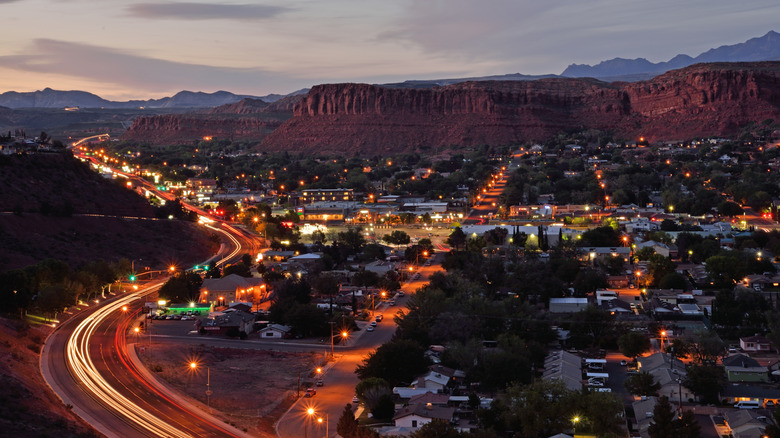
St. George’s dramatic red rock setting, year-round warm climate, and proximity to five national parks create demand drivers unlike any other Utah market
2026 Growth Catalysts
- Utah Tech University enrollment expansion and campus development
- St. George Regional Airport expansion improving direct flight access
- I-15 corridor improvements reducing drive time from Las Vegas and Salt Lake
- Desert Color master-planned community continuing to add homes and amenities
- Growing remote worker base as coastal workers discover the St. George lifestyle proposition
Investment Climate
St. George’s investment environment offers three distinct strategic opportunities that require different skill sets, capital requirements, and risk tolerances:
- Long-term retirement rental targeting the 55-plus demographic renting while evaluating permanent purchase. These tenants stay 2 to 4 years, maintain properties carefully, and have fixed retirement income that does not fluctuate with economic cycles.
- Short-term vacation rental leveraging national park tourism and the growing demand for unique desert experiences. The highest-yielding strategy when well-managed, but requires active management, marketing, and compliance with evolving STR regulations.
- Appreciation-first buy-and-hold in master-planned communities and growth corridors where St. George’s structural supply constraints and ongoing in-migration support sustained price growth regardless of STR or rental income performance.
The primary investment risk in St. George is different from other Utah markets. There is no major tech employer to anchor demand in a downturn. Instead, the risk is retirement income stability and discretionary migration slowdowns during economic recessions. Historically, however, St. George has shown resilience: retirement migration slowed during the 2008 recession but did not reverse, and the long-term demographic wave of retiring Baby Boomers provides a structural demand floor through at least 2035.
Historical Performance
| Period | Market Driver | Avg Annual Appreciation | Key Event |
|---|---|---|---|
| 2010-2015 | Post-recession recovery, early retirement migration | 4-7% | Sun River expansion; Zion NP visitation begins accelerating rapidly |
| 2016-2019 | Tourism boom, California exodus begins, STR growth | 9-14% | Zion NP visitation exceeds 4M/year; St. George airport direct flights expand |
| 2020-2022 | Pandemic migration surge, remote work appeal, record in-migration | 28-35% | St. George became one of the fastest-appreciating metros in the U.S.; Desert Color launched to massive demand |
| 2023-2024 | Rate shock, normalization | 4-9% | Market absorbed correction faster than most comparable STR-heavy markets |
| 2025-2026 | Rate stabilization, continued retirement migration, airport expansion | 12-18% (projected) | St. George Regional Airport new direct routes, Desert Color phase 3, Utah Tech enrollment milestone |
Demographic Trends Driving Demand
- Baby Boomer Retirement Wave – 10,000 Americans turn 65 every day through 2030. St. George is one of the top five destinations for western U.S. retirees seeking warm climate, outdoor recreation, and affordability.
- California Equity Migration – California retirees selling homes with $500,000 to $1,000,000+ in equity arrive in St. George with significant purchasing power and typically rent for 12 to 24 months before buying.
- National Park Tourism – Zion National Park alone draws 4 to 5 million visitors annually and growing. Guests need lodging, and the national park gateway community STR market is one of the strongest in the country.
- Remote Worker Base – St. George’s combination of warm weather, outdoor recreation, affordable housing, and improving infrastructure (fiber internet, airport direct flights) makes it increasingly viable for remote workers who previously felt too isolated.
- Utah Tech University Growth – The rebranding from Dixie State creates new academic ambition and growing enrollment that diversifies the local economy and adds a student housing demand component to the market.
- Geographic Supply Constraint – Red rock terrain to the east, federal land boundaries to the north, and the Virgin River corridor create developable land limitations that support long-term price floors in established neighborhoods.
📚 New to real estate investing? Master the fundamentals with our professional course Learn more →
2. Neighborhood Hotspots
St. George Investment Neighborhood Map
Interactive map of St. George metro investment neighborhoods. Green stars show top investment hotspots, blue circles mark established markets, and orange circles highlight emerging corridors.
Core Investment Areas
Detailed Submarket Analysis: St. George Metro
| Neighborhood | Price Range | Cap Rate / STR Yield | Growth Drivers | Best Strategy |
|---|---|---|---|---|
| Desert Color / Sand Hollow | $550K-$950K | 6-10% STR yield | Lagoon resort amenity, tourism, luxury market | Premium STR, resort vacation rental |
| Entrada / Snow Canyon | $600K-$1.2M | 4.5-6.0% | Premium views, golf, high-income retirees | Luxury appreciation, premium retirement rental |
| Little Valley / South SG | $480K-$700K | 5.0-6.5% | Fastest growth corridor, family demand, new construction | Family rental hold, balanced returns |
| Sunbrook / Bloomington Hills | $500K-$800K | 5.0-6.0% | Golf communities, retirement demographic | Retirement tenant focus, long hold |
| Sun River (55+) | $420K-$650K | 5.0-6.0% | Utah’s largest active adult community | Stable retiree rentals, low management intensity |
| Central / Downtown SG | $380K-$560K | 5.5-7.0% | Utah Tech, downtown revival, value-add | Value-add, student adjacent, appreciation play |
| Washington City | $420K-$600K | 5.5-6.5% | St. George spillover, lower entry, family demand | Affordable alternative, family rental |
| Hurricane / La Verkin | $380K-$560K | 6-9% STR potential | Zion gateway, STR potential, affordable entry | Zion-adjacent STR, lower entry, appreciation |
| Ivins / Santa Clara | $440K-$680K | 5.0-6.0% | Snow Canyon access, scenic, remote worker appeal | Scenic appreciation, remote worker target |
Expert Insight: “The most common mistake I see in St. George investment is investors buying in the STR-heavy areas expecting Airbnb income without doing the regulatory homework first. The STR rules in St. George city, Washington City, Hurricane, and Ivins are all different. I have seen investors close on Desert Color properties expecting strong STR income, then discover the specific street or community they bought in has different permit availability than the broader Desert Color area. Always confirm current STR permit availability for the specific parcel before purchase, not just the general neighborhood.” – Kim Sorensen, Southern Utah Investment Realty
3. Property Types
| Investment Goal | Best Property Type | Best Area | Minimum Capital |
|---|---|---|---|
| Maximum Income (STR) | Premium vacation rental | Desert Color, Entrada | $160,000+ |
| Best Appreciation | New construction in growth corridors | Little Valley, Desert Color, Entrada | $135,000+ |
| Lowest Management | 55-plus or retirement rental | Sun River, Sunbrook | $125,000+ |
| Best Cash Flow | Value-add SFH or Zion gateway STR | Central SG, Hurricane | $100,000+ |
Don’t guess the costs. Our Complete Renovation & Remodeling Cost Guide covers 400+ pages of project-by-project breakdowns with real contractor pricing ranges.
4. Cost Analysis
Acquisition Cost Breakdown (St. George)
| Expense Item | Typical Cost | Example ($540,000 Property) | Notes |
|---|---|---|---|
| Down Payment | 25% (investment) | $135,000 | Standard investment loan; STR lenders may require 30% on vacation properties |
| Closing Costs | 2-3% of price | $10,800-$16,200 | Utah closing costs are lower than most comparable western markets |
| Home Inspection | $400-$600 | $500 | HVAC critical in St. George’s heat; also inspect stucco and desert landscaping drainage |
| Radon Test | $150-$250 | $200 | Washington County has lower radon than northern Utah but still test |
| STR Setup Costs (if applicable) | $15,000-$35,000 | $20,000-$30,000 | Furnishing, linens, kitchenware, smart home devices, professional photography |
| STR Permit and Business License | $300-$800/year | $500 | Required in most St. George area municipalities; fees vary by city |
| Reserves (6 months) | 6 months expenses | $14,000-$18,000 | Higher for STR given seasonality and gap periods |
| TOTAL MINIMUM ENTRY (STR) | ~35-40% of value | $196,000-$220,200 | STR setup costs make initial entry higher than equivalent long-term rental; recovered in first 6-12 months of operation |
Sample Cash Flow Analysis: Desert Color STR vs. Little Valley Long-Term Rental vs. Sun River Retirement Rental
| Item | Desert Color STR | Little Valley LTR | Sun River Retirement |
|---|---|---|---|
| Purchase Price | $720,000 | $560,000 | $500,000 |
| Monthly Revenue | $5,500 (avg; 75% occ) | $2,200 | $2,050 |
| Property Taxes | -$420/mo | -$327/mo | -$292/mo |
| Insurance (STR is higher) | -$220/mo | -$130/mo | -$120/mo |
| HOA Fees | -$180/mo | -$100/mo | -$200/mo (Sun River) |
| Management (STR 20% / LTR 9%) | -$1,100/mo | -$198/mo | -$185/mo |
| Maintenance + CapEx + Supplies | -$550/mo | -$176/mo | -$164/mo |
| Vacancy / Seasonality | Built into 75% occupancy | -$88/mo (4%) | -$41/mo (2%) |
| Net Operating Income | $3,030/mo | $1,181/mo | $1,048/mo |
| Mortgage (25% down, 6.5%, 30yr) | -$3,411/mo | -$2,652/mo | -$2,369/mo |
| MONTHLY CASH FLOW | -$381 | -$1,471 | -$1,321 |
| Cap Rate / STR Yield | 5.05% | 2.53% | 2.51% |
| Total Return (15% appreciation) | ~34% | ~26% | ~28% |
The Desert Color STR scenario is the standout: only -$381/month cash flow compared to -$1,400+ for the long-term rental scenarios, while generating a 5 percent cap rate and 34 percent total return estimate. The STR premium is driven by the Desert Color lagoon amenity generating nightly rates of $200 to $400 versus comparable properties elsewhere in St. George at $100 to $180. The critical caveat is that STR performance depends heavily on active management quality, listing optimization, and consistent 5-star guest reviews. A poorly managed STR at 50 percent occupancy produces far worse results than the 75 percent scenario modeled here.
Expert Insight: “The biggest differentiator in St. George STR income is not the property, it is the management. I manage properties in Desert Color that generate $85,000 per year and identical properties two streets away run by owners doing it themselves that earn $45,000. The gap comes from listing optimization, pricing algorithms, professional photography, guest communication speed, and review management. If you are going to invest in St. George STR, either hire a proven local management company or commit to learning the platform management skills before you buy.” – Derek Foulger, Desert Southwest Vacation Rentals
5. Legal Framework
✅ Utah Landlord-Tenant Law: Straightforward and Investor-Friendly
St. George and Washington County operate entirely under Utah state landlord-tenant law with no additional municipal tenant protections beyond basic fair housing. No rent control, no just-cause eviction requirement, and a 25 to 45 day non-payment eviction timeline. Utah is consistently rated among the top 5 most landlord-friendly states nationally. The primary regulatory complexity in St. George is the STR permitting system, which varies meaningfully between St. George city, Washington City, Hurricane, and Ivins.
⚠️ STR Regulations: The Critical St. George Variable
Short-term rental regulations in the St. George metro are evolving rapidly and vary significantly by municipality. St. George city enacted an STR ordinance limiting permits in residential zones, requiring annual renewal, and imposing occupancy and noise restrictions. Washington City, Hurricane, and Ivins have different and often more permissive frameworks. Never assume STR legality based on neighborhood reputation alone. Always verify current permit availability for the specific parcel address with the relevant city before purchasing with STR intent.
Utah State Landlord-Tenant Essentials
- No Rent Control: Prohibited statewide. Increase rents freely with proper notice at each lease renewal.
- Non-Payment Eviction: 3-day pay-or-vacate notice. Court filing day four. Typical resolution 25 to 45 days.
- Lease Termination: 15-day notice for month-to-month. Fixed-term leases expire naturally.
- Security Deposits: No statutory cap. Return within 30 days with itemized accounting.
- Tenant Screening: Full landlord discretion within fair housing requirements.
- Entry Notice: 24 hours required except genuine emergencies.
- Habitability: Functional cooling as well as heat required in desert climate. Air conditioning failures in St. George summer must be treated as urgent repair items.
STR Regulations by Municipality
- St. George City: STR permits required. Residential zones have permit caps; check availability. Annual renewal and inspection. Noise and occupancy limits enforced. Visit sgcity.org for current ordinance.
- Washington City: Generally more permissive than St. George city. Business license required. Visit washingtonutah.gov for current rules.
- Hurricane: STR-friendly for Zion gateway properties. Business license and sales tax collection required. Visit hurricanecity.com.
- Ivins: Limited STR in some zones. Verify at ivinscity.com for specific parcel zoning.
- Sun River HOA: Age-restricted community; verify HOA rental rules before purchasing for rental, as some Sun River communities limit rental terms.
STR Due Diligence Checklist
- Confirm current STR permit availability for specific parcel
- Verify HOA CC&Rs allow STR operation
- Budget for transient room tax registration and collection
- Confirm adequate parking for STR occupancy limits
- Review neighbor notification requirements if any
| Regulation | St. George / Utah | Comparison (Seattle) | Investor Impact |
|---|---|---|---|
| Eviction | 3-day notice; 25-45 day total | Just cause; 90-180 day typical | Far lower legal costs and lost rent |
| Rent Control | Prohibited statewide | No formal control but heavy restrictions | Full flexibility to adjust rents to market |
| STR Rules | Permit required; varies by city; residential zone caps | Primary residence only; 120-day cap | STR viable in SG with permit; verify availability per parcel |
| Transient Room Tax | Required on STR income; varies 6-10% by municipality | Platform collects in Seattle | Must register for and remit room tax; platforms collect but verify registration |
| Tenant Screening | Landlord discretion within fair housing | First-in-time rule | Choose best qualified applicant freely |
6. Step-by-Step St. George Investment Playbook
Choose Your St. George Strategy
Premium STR (Desert Color / Entrada)
Buy in St. George’s premium STR zones, furnish to resort standard, and operate on Airbnb and VRBO with professional management. Best cash flow of any St. George strategy. Requires STR permit verification, active management, and higher setup costs.
Retirement Rental (Sun River / Sunbrook)
Buy in St. George’s premier retirement communities, target retirees renting before purchasing, and benefit from the lowest management intensity and highest tenant quality of any St. George strategy. Best for passive, out-of-state investors.
Growth Corridor Buy-and-Hold (Little Valley)
Buy new construction in St. George’s fastest-growing corridors. Target family tenants. Accept modest negative carry for Utah’s highest per-metro appreciation rates. Best long-term appreciation thesis with the simplest management profile.
Zion Gateway STR (Hurricane)
Buy in Hurricane for lower entry than Desert Color with the same national park tourism demand. Zion NP’s 4 to 5 million annual visitors create strong year-round STR demand. Best entry-level STR thesis in the wider St. George metro.
Build Your St. George Team
- STR-Experienced St. George Agent: Must know STR permit availability by neighborhood, current regulation status across municipalities, and how to evaluate STR income projections realistically. An agent who does not know the STR permit landscape in each specific zone is a liability.
- Local STR Management Company: Non-negotiable for out-of-state STR investors. Must have demonstrated performance data (occupancy rates, average nightly rates, review scores) for their current portfolio. Ask for trailing 12-month revenue data on comparable properties in their portfolio.
- Utah Real Estate Attorney: For LLC structuring and STR compliance review. Particularly important given the evolving regulatory environment.
- Southern Utah Property Inspector: Must know desert climate construction issues: stucco cracking from temperature cycling, HVAC sizing for extreme summer heat, pool and spa mechanical condition, and drainage from desert flash floods.
- STR Insurance Specialist: Standard homeowner’s or landlord’s insurance does not cover STR operations. Need specific vacation rental insurance (Lloyd’s, CBIZ, or similar) plus platform damage protection (Airbnb AirCover, VRBO’s program).
Expert Tip: When interviewing STR management companies in St. George, ask them specifically: “What was the average occupancy rate and gross revenue per property in your portfolio last year, broken down by Desert Color, central St. George, and Washington County?” Companies that cannot or will not share this data do not have the operational transparency to manage your most important asset effectively.
St. George-Specific Due Diligence
Physical Checks
- HVAC system capacity and condition (desert heat requires oversized, well-maintained systems)
- Stucco and exterior condition (thermal cycling in desert climates cracks stucco; expensive to remediate)
- Pool and spa mechanical inspection (pool equipment in desert heat degrades faster than national averages)
- Drainage and grading from flash flood potential (desert storms deliver intense rainfall)
- Desert landscaping irrigation system condition
- Roof condition and attic insulation (extreme summer heat demands excellent insulation)
- Radon test (lower risk than northern Utah but still test)
STR and Regulatory Checks
- Confirm STR permit availability for the specific parcel address (not just general neighborhood)
- Verify HOA CC&Rs permit STR operation, including nightly minimum stay requirements
- Request trailing 12-month STR revenue data from seller or listing agent if property is operating
- Check transient room tax registration status if buying an operating STR
- Confirm adequate parking for maximum STR occupancy
- Review any pending STR regulatory changes at the city level
Maximizing STR Income in St. George
For investors operating STRs, these strategies specifically drive St. George outperformance:
- Desert Color Lagoon positioning: If operating in Desert Color, every listing, photo, and description must feature the lagoon prominently. Guests book Desert Color specifically for the lagoon experience. Properties that do not emphasize this in their marketing leave significant revenue on the table.
- Red rock photography premium: Professional photography that captures the surrounding red rock scenery, Entrada cliffs, or Snow Canyon vistas commands measurably higher click-through rates on booking platforms. This is a $1,000 to $2,000 investment that pays back in days.
- National park proximity marketing: Explicitly list driving times to Zion (45 min), Bryce Canyon (1.5 hrs), and Grand Canyon North Rim (2.5 hrs) in every listing. These are the reason many guests are in southern Utah, and their search terms include national park proximity.
- Year-round demand positioning: St. George has no true off-season. Spring is peak Zion season. Summer is pool and Desert Color lagoon season. Fall brings road tripping and hiking. Winter is mild enough for golf and outdoor activity. Price accordingly year-round rather than cutting rates aggressively in summer.
- Outdoor amenity investment: Properties with private pools, hot tubs, and outdoor entertainment areas achieve 30 to 50 percent higher nightly rates than equivalent indoor-only properties in St. George. Outdoor amenity investment in the STR context generates the highest ROI of any upgrade category.
7. Financing Options for St. George
| Loan Type | Down Payment | Rate Premium | Best For | St. George Note |
|---|---|---|---|---|
| Conventional Investment | 25% | +0.5-0.75% | W-2 income investors, LTR strategy | Most St. George properties within conforming limits; standard investment pricing |
| Second Home Loan | 10-20% | +0.25-0.5% | Part-time personal use + rental | Lower rate than investment loan if you genuinely use the property yourself. Better pricing but personal use requirements; lender will scrutinize STR listing on tax returns |
| DSCR Loan (STR income) | 25-30% | +1.5-2.5% | Self-employed, STR income documentation | Several DSCR lenders now accept STR income from AirDNA or Rabbu data for underwriting; Desert Color STRs at 75% occupancy can qualify at 1.0x DSCR |
| Jumbo Investment | 25-30% | +0.75-1.25% | Premium Entrada or luxury Desert Color | Required for properties above $806,500; luxury Entrada and premium Desert Color homes |
| Portfolio Loan | 20-30% | +1-2% | Multiple STR properties, portfolio builders | Several southern Utah-focused lenders offer STR portfolio products; useful for investors building 3-plus property STR portfolios |
| Hard Money / Bridge | 20-30% | 8-12% rate | Value-add, quick close, BRRRR | Southern Utah hard money available; useful for central SG value-add and renovation-to-STR conversions |
DSCR and STR Income Note: DSCR lending for STR properties has evolved significantly. Several lenders now accept AirDNA market data or trailing Airbnb/VRBO income statements to document projected rental income. For Desert Color properties at 75 percent occupancy, the STR income typically exceeds the debt service threshold for 1.0x DSCR qualification, opening this financing path to self-employed investors who cannot document W-2 income. Always ask your lender specifically how they treat short-term rental income documentation before ruling out DSCR for an STR property.
8. Frequently Asked Questions

Knowledge Quiz: St. George Real Estate Investment
Open Quiz
5 quick questions on what you just learned about St. George investing
1) What are the four primary demand drivers that make St. George’s growth fundamentally different from other Utah markets?
Answer: D
St. George’s growth is driven by lifestyle rather than employment, which distinguishes it from every other major Utah market. The four primary drivers are: retirement migration (Baby Boomers choosing warm climate and affordability), national park tourism (Zion gets 4 to 5 million visitors annually), remote worker appeal (warm weather, affordability, improving infrastructure), and Utah Tech University growth (formerly Dixie State, diversifying the local economy). This lifestyle-driven demand is more recession-resistant than employment-dependent demand because retirement is a life stage transition, not a job market function.
2) What is the single most important due diligence step before purchasing any St. George property with STR intent?
Answer: A
The guide explicitly warns that STR regulations vary significantly between St. George city, Washington City, Hurricane, and Ivins, and that even within a neighborhood like Desert Color, specific streets or sub-associations may have different permit availability. An investor who assumes STR legality based on general neighborhood reputation without confirming availability at the specific parcel level has committed a potentially investment-destroying due diligence failure. The guide provides the warning: “Never assume STR legality based on neighborhood reputation alone. Always verify current permit availability for the specific parcel address.”
3) What makes Desert Color’s STR nightly rates 40 to 60 percent higher than comparable St. George properties?
Answer: C
Desert Color’s one-acre Crystal Lagoons man-made lagoon is the defining amenity that drives premium STR rates. Guests specifically search for and book Desert Color properties for the Caribbean-blue freshwater lagoon experience, which is one of very few of its kind in the western United States. This creates destination demand that is independent of national park visitation, meaning Desert Color STRs have strong summer occupancy from pool and lagoon seekers even when Zion gateway properties see summer slowdowns. The guide notes that nightly rates of $200 to $400 are sustainable because guests are paying for an experience unavailable elsewhere in the region.
4) According to the guide’s cash flow analysis, how does the Desert Color STR compare to Little Valley long-term rental in monthly cash flow?
Answer: B
The guide’s three-way comparison shows the Desert Color STR at 75 percent occupancy generates -$381/month in cash flow, dramatically better than the Little Valley long-term rental at -$1,471/month and the Sun River retirement rental at -$1,321/month. The STR generates $5,500/month in average revenue versus $2,200 for the long-term rental, and while STR management costs are higher (20% vs. 9%), the gross income premium more than compensates. The guide cautions that this performance depends on maintaining 75 percent occupancy through professional management and listing optimization.
5) Why is St. George’s retirement rental market considered more recession-resistant than markets like Lehi or Salt Lake City?
Answer: C
The guide explains that St. George’s retirement demand is recession-resistant because it is driven by life stage transitions (people reaching retirement age) rather than employment conditions. Retirees do not stop retiring during recessions, and their income sources (Social Security, pensions, retirement savings) are not directly tied to current job market performance. The guide also notes that 10,000 Americans turn 65 every day through 2030, creating a structural demand wave that is independent of economic cycles. This is fundamentally different from Lehi, where tech sector layoffs directly reduce rental demand, or Salt Lake City, where unemployment affects tenant ability to pay.
Work With a Local Expert in St. George
We are building a verified network of real estate professionals across every market we cover.

About Our Expert Network
We are finalizing partnerships with verified real estate professionals across every market featured on Builds and Buys. Each expert is selected for their investment experience, local market knowledge, and commitment to helping investors make sound decisions.
Our local St. George specialists offer:
- Deep knowledge of STR permit availability by neighborhood and municipality across the St. George metro
- Desert Color, Entrada, and Sun River specialist expertise
- STR income underwriting using actual AirDNA and Rabbu market data
- Retirement market tenant targeting and property positioning guidance
- Full transaction support from search through closing
- STR management company referrals with verified performance data
Services Covered
- Property sourcing and acquisition
- Investment analysis and underwriting
- STR permit research and verification
- STR income projection analysis
- New construction and builder access
- Value-add and renovation guidance
- Legal and title referrals
- STR financing specialist connections
- STR management company referrals
- STR insurance specialist referrals
- 1031 exchange coordination
- Exit strategy planning
Get Connected or Join Our Network
Looking for a St. George STR or investment specialist? Reach out and we will connect you with the right professional.
Are you a real estate professional specializing in St. George, Desert Color, or southern Utah investment? We are always expanding our network.
Contact us at support@buildsandbuys.com
Find Specialized St. George Real Estate Professionals
Ready to Invest in St. George?
St. George is one of the most unique investment propositions in the western United States. No other market combines the structural demand of Baby Boomer retirement migration, national park tourism income, remote worker appeal, and genuine lifestyle magnetism in the same metro. Desert Color’s lagoon resort amenity is creating STR income streams that outperform most comparable markets nationally. The retirement tenant base provides the lowest default risk and most predictable long-term rental income of any Utah submarket. And St. George leads all Utah metros in appreciation. For investors who match the right strategy to the right submarket and execute with appropriate management, St. George offers a compelling combination of appreciation, income, and structural demand durability that is difficult to replicate elsewhere in the region.
Continue Your Research
Utah State Guide
See how St. George compares to Salt Lake City, Provo, Lehi, Park City, and other Utah markets.
Moab Guide
Compare St. George’s STR market to Moab’s Arches and Canyonlands national park gateway investment thesis.
144-Lesson Course
University-level real estate education covering financing, law, strategy, and management.
For further guidance, explore our State-by-State Investor guides, browse our expert articles, or follow our Step-by-Step Investment Guide.