
Gilbert Arizona Real Estate Investment Guide For 2026
A comprehensive resource for investors targeting one of America’s fastest-growing suburbs, where master-planned communities, tech corridor expansion, and elite school districts drive sustained demand in the East Valley
Quick answers: Top 5 most searched Gilbert investment questions ▼
Migration data: Where people are moving from to Gilbert ▼
In This Guide
Click on any section to navigate directly to that content
1. Gilbert Market Overview
Market Fundamentals
Gilbert stands as one of the most compelling single-family rental markets in the entire United States. What was a small farming town of 5,000 people in 1980 is now a municipality of 285,000 with a median household income exceeding $100,000, schools ranked among Arizona’s very best, and a location at the center of the East Valley technology corridor. No other Phoenix suburb delivers Gilbert’s combination of tenant quality, landlord-friendly law, and sustained population momentum.
Key economic indicators defining Gilbert’s investment case:
- Population: 285,000+ and among the fastest-growing large cities in the U.S.
- Major Employers: Intel (Chandler fab), TSMC (nearby), Banner Health, Dignity Health, Gilbert Public Schools, Isagenix, SanTan Brewing
- Median Household Income: $100,000+ (top 5% of all U.S. cities this size)
- Job Growth: 3.2% annually, led by semiconductor manufacturing and healthcare
- School Rankings: Multiple A+ rated schools in Gilbert Unified and Higley Unified districts
- Safety: Consistently ranked one of America’s safest cities over 200,000 population
Gilbert’s economy benefits from its position between the Chandler tech corridor (Intel, PayPal, Wells Fargo tech hub) and the Mesa Gateway Airport area, where aviation and logistics employers concentrate. Healthcare is a second major pillar, with Banner Health and Dignity Health operating major facilities that employ thousands of stable, well-paid workers.
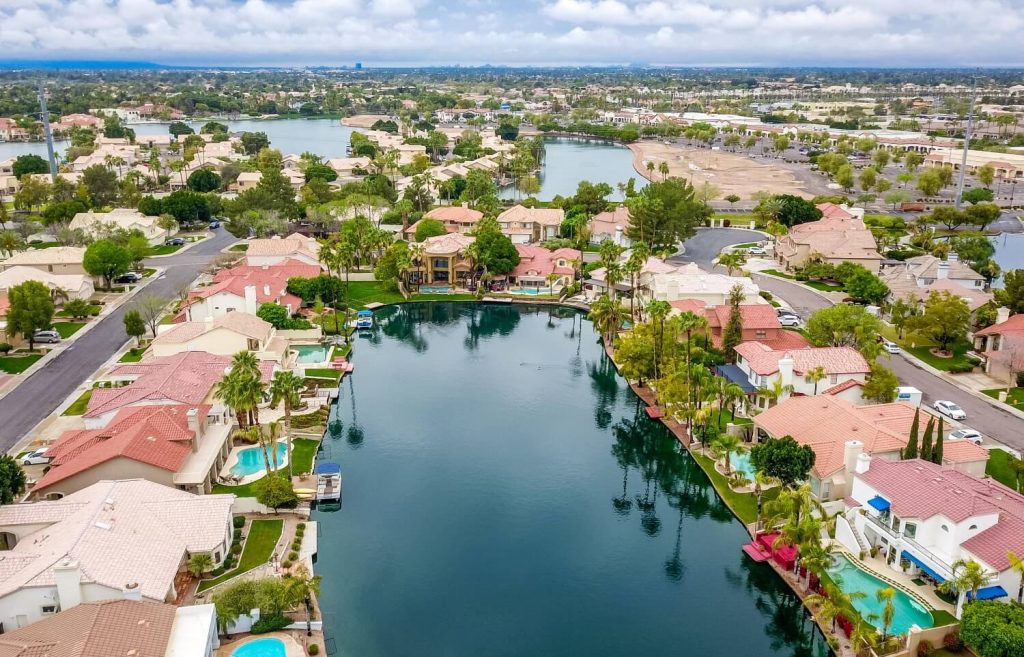
Gilbert’s Heritage District anchors a town that has transformed from farming community to one of America’s wealthiest suburbs
2026 Economic Outlook
- Intel’s $20B Chandler expansion driving sustained tech hiring adjacent to Gilbert
- TSMC fab construction creating semiconductor supply chain employment
- Mesa Gateway Airport area growth expanding logistics and aviation employment base
- Banner Health expanding Gilbert Regional Medical Center
- Heritage District Phase 2 commercial development adding walkable amenities
Investment Climate
Gilbert’s investment environment sits in a favorable middle ground: better cash flow than Scottsdale and North Tempe, better tenant quality than Glendale or Surprise, and a legal environment that strongly favors property owners. Arizona’s landlord-friendly statutes eliminate many of the risks that plague investors in California or northeastern markets. The practical results:
- Evictions resolved in 3 to 6 weeks versus 6 to 18 months in tenant-protective states
- No rent control at any level, giving owners full pricing flexibility at lease renewal
- Strong security deposit rights, reducing risk of tenant damage losses
- No just-cause eviction requirement, allowing non-renewal of problematic tenants
- Low property taxes, typically 0.55 to 0.75% of assessed value for rentals
The primary investment risk in Gilbert is entry price. Median home values have risen from approximately $280,000 in 2019 to $530,000 in 2026. Investors who bought before 2021 enjoy excellent cash flow and massive equity gains. Investors entering at current prices need to underwrite carefully, focusing on neighborhoods with higher cap rates or value-add potential.
Historical Performance
| Period | Market Driver | Avg Annual Appreciation | Key Event |
|---|---|---|---|
| 2010-2014 | Post-recession recovery, suburban revival | 6-9% | Heritage District redevelopment begins |
| 2015-2019 | California migration surge, tech corridor growth | 7-10% | Gilbert ranked #1 safest city in America multiple years |
| 2020-2022 | Remote work migration, pandemic demand surge | 22-30% | Gilbert among top 10 fastest-appreciating markets nationally |
| 2023-2024 | Rate adjustment, market normalization | 2-5% | Inventory rose modestly but demand remained resilient |
| 2025-2026 | Semiconductor boom, rate stabilization | 6-9% (projected) | Intel and TSMC expansion creating sustained employment wave |
Gilbert’s 15-year track record shows average annual appreciation of 8 to 12%, with dramatic outperformance during migration waves. A $280,000 Gilbert property purchased in 2019 would be worth approximately $530,000 today, nearly doubling in value in six years. Even after the pandemic-era surge, the fundamentals of job growth, school quality, and limited supply support continued long-term appreciation.
Demographic Trends Driving Demand
- California Family Relocations – Families earning Bay Area or LA salaries remotely, buying Gilbert homes at half the price of comparable California properties
- Semiconductor Industry Workers – Intel and TSMC hiring waves bringing engineers and technicians who rent before buying
- Healthcare Professional Concentration – Banner and Dignity Health employees seeking family-friendly, school-district-focused neighborhoods
- Military Spillover – Williams Gateway and Luke Air Force Base personnel choosing Gilbert’s safety and school quality for families
- Young Family Formation – Gilbert’s median age of 33.4 reflects a community in family formation, generating multi-year rental tenure before home purchase
- Geographic Buildout Constraint – Gilbert is approaching land buildout, surrounded by Chandler, Mesa, Queen Creek, and Tempe, limiting future supply
📚 New to real estate investing? Master the fundamentals with our professional course Learn more →
2. Neighborhood Hotspots
Gilbert Investment Neighborhood Map
Interactive map of Gilbert’s investment neighborhoods. Green stars show top hotspots, blue circles mark established markets, and orange circles highlight emerging areas.
Core Investment Neighborhoods
Detailed Submarket Analysis: Gilbert Neighborhoods
| Neighborhood | Price Range (SFH) | Cap Rate | Growth Drivers | Best Strategy |
|---|---|---|---|---|
| Heritage District | $400K-$600K | 5.0-6.5% | Walkability, dining scene, young professional demand | Appreciation, professional tenant buy-and-hold |
| Morrison Ranch | $550K-$850K | 4.5-5.5% | Lakes, trails, top schools, master-planned lifestyle | Premium hold, family rental, low turnover |
| Finley Farms / Val Vista | $450K-$650K | 5.5-6.5% | Established community, school access, value pricing | Best cash flow in Gilbert, value-add |
| Power Ranch | $500K-$700K | 5.0-6.0% | Award-winning amenities, community feel, school access | Family rental, premium buy-and-hold |
| Seville / South Gilbert | $480K-$720K | 5.5-7.0% | Golf resort amenities, newer construction, appreciation potential | Appreciation play, resort-style rental |
| Higley / Warner Corridor | $430K-$620K | 5.5-6.5% | Higley Unified district, East Valley employment | Stable family rental, buy-and-hold |
| Agritopia | $550K-$800K | 4.5-5.5% | Unique farm community lifestyle, Heritage District adjacent | Boutique hold, premium lifestyle tenants |
| SE Gilbert / Greenfield | $400K-$550K | 6.0-7.5% | New construction, improving retail, best entry price | Best Gilbert cash flow, long-term appreciation hold |
| Gilbert / Mesa Gateway | $380K-$520K | 6.0-7.0% | Airport employment, entry pricing, improving area | Value-add, emerging hold |
Expert Insight: “The most undervalued opportunity in Gilbert right now is the Finley Farms and Val Vista corridor. These established neighborhoods from the 1990s and early 2000s offer homes with mature landscaping, community pools, and access to the same school districts as newer master-planned communities, but at prices 15 to 20 percent below Power Ranch or Morrison Ranch. Investors who buy here and hold 7 to 10 years will benefit from both cash flow and appreciation as Gilbert reaches full buildout and older stock gains relative value.” – David Reyes, East Valley Investment Specialists
3. Property Types
| Investment Goal | Best Property Type | Best Neighborhoods | Minimum Capital |
|---|---|---|---|
| Maximum Cash Flow | Value-add SFH or SE Gilbert new construction | SE Gilbert, Greenfield, Val Vista | $100,000+ |
| Best Appreciation | Premium SFH in Morrison Ranch or Seville | Morrison Ranch, Seville, Heritage District | $150,000+ |
| Lowest Maintenance | New construction SFH or townhome | SE Gilbert, Lindsay/Germann, Power Ranch | $100,000+ |
| Entry-Level Investment | House hack with casita or townhome | Finley Farms, Higley, older corridors | $40,000+ (FHA) |
Don’t guess the costs. Our Complete Renovation & Remodeling Cost Guide covers 400+ pages of project-by-project breakdowns with real contractor pricing ranges.
4. Cost Analysis
Acquisition Cost Breakdown (Gilbert, Arizona)
| Expense Item | Typical Cost | Example ($530,000 Property) | Notes |
|---|---|---|---|
| Down Payment | 25% (investment) | $132,500 | Standard for investment property financing in Arizona |
| Closing Costs | 2-3% of price | $10,600-$15,900 | Title, escrow, lender fees. Arizona has no transfer tax, reducing costs vs. many states. |
| Home Inspection | $400-$600 | $500 | Include roof inspection, HVAC inspection, and pool inspection if applicable |
| Termite Inspection | $75-$150 | $100 | Required by most lenders. Arizona has active termite activity, especially in older construction. |
| Pool Inspection | $150-$300 | $200 | Many Gilbert homes have pools. Equipment replacement can run $5,000-$15,000. |
| Initial Repairs / Updates | 0-8% of price | $0-$42,400 | Highly variable. New construction = $0. Older value-add = potentially significant. |
| HOA Setup / Transfer Fee | $200-$600 | $400 | Most Gilbert communities have HOAs. Verify rental permission and caps before purchase. |
| Reserves (6 months) | 3-6 months expenses | $10,000-$18,000 | AC replacement ($6,000-$12,000) is the #1 surprise expense in Arizona rentals |
| TOTAL MINIMUM ENTRY | ~27-30% of value | $154,300-$209,600 | Achievable entry capital for motivated investors with solid income and reserves |
Sample Cash Flow Analysis: Finley Farms 4-Bedroom Single-Family
| Item | Monthly | Annual | Notes |
|---|---|---|---|
| Gross Rent | $2,400 | $28,800 | 4BR, 2BA, 1,900 sqft, Finley Farms area |
| Less Vacancy (4%) | -$96 | -$1,152 | Gilbert’s vacancy rate is low; family tenants stay long |
| Property Taxes | -$267 | -$3,200 | ~0.60% of $530K assessed value (rental rate) |
| Insurance | -$130 | -$1,560 | Landlord policy; Arizona rates are reasonable |
| HOA Fees | -$85 | -$1,020 | Typical Gilbert HOA for community pool and common areas |
| Property Management (9%) | -$216 | -$2,592 | Competitive Gilbert PM rates; Arizona-friendly market |
| Maintenance + CapEx (8%) | -$192 | -$2,304 | AC service, pool upkeep (if applicable), general maintenance |
| Net Operating Income | $1,414 | $16,972 | Before mortgage |
| Mortgage ($530K, 25% down, 6.75%, 30yr) | -$2,302 | -$27,624 | P&I on $397,500 loan |
| CASH FLOW | -$888 | -$10,652 | Negative at current rates; total return story strong |
| Cap Rate | 3.2% | NOI / Purchase Price | |
| Total Return (8% appreciation) | ~18% | Including equity, appreciation, principal paydown on invested capital |
Note that SE Gilbert properties at the $420,000 to $460,000 price point with similar rents produce meaningfully better cash flow, often approaching breakeven or slight positive cash flow at current rates. Investors focused on monthly income should target SE Gilbert or value-add Finley Farms properties rather than premium-priced Morrison Ranch or Seville.
Expert Insight: “Gilbert is one of the very few Phoenix metro markets where I feel genuinely comfortable telling clients to buy at current prices with a 7-year hold horizon. The tenant quality here is exceptional. We’re talking household incomes of $90,000 to $120,000, families who treat the home like their own, and who stay for years at a time. That dramatically changes your real-world operating costs versus a market where turnover is high and tenant screening is harder. The math on paper is tighter than 2020, but the lived experience of owning a Gilbert rental is far superior to most alternatives at this price point.” – Sandra Kim, East Valley Investment Realty
5. Legal Framework
✅ Arizona Is One of America’s Most Landlord-Friendly States
Unlike California, New York, or Seattle, Arizona law strongly protects property owners. There is no statewide rent control and Arizona state law preempts any city or county from enacting rent control. Eviction timelines are among the fastest in the nation. Gilbert follows Arizona’s Residential Landlord and Tenant Act without adding local restrictions, creating a clean and predictable operating environment.
Arizona Landlord Rights
- No Rent Control: Arizona state law explicitly preempts any municipality from capping rents. Owners can increase rent to market rate at any lease renewal with proper notice.
- Fast Eviction Process: Non-payment eviction can begin after just 5 days with a 5-day pay-or-quit notice. The full court process typically resolves in 3 to 6 weeks total.
- Security Deposit Rights: Up to 1.5 months rent. Owner has 14 business days after move-out to return deposit or provide itemized deductions with documentation.
- Month-to-Month Termination: Either party can terminate a month-to-month tenancy with 30 days written notice. No just-cause requirement for non-renewal.
- Lease Non-Renewal: Owners can choose not to renew a lease without stating cause. Simply provide notice before lease expiration.
- Self-Help Remedies: Owners can terminate utilities in abandoned units after following proper notice procedures. Arizona law is more practical than most states.
Arizona Landlord Obligations
- Habitability: Maintain the unit in habitable condition. Repair requests must be addressed: 24 hours for emergency conditions (heat, water), 10 days for other repairs.
- Notice for Entry: 2 days notice required for non-emergency entry. Emergency entry is permitted without notice.
- Disclosure Requirements: Provide written disclosure of any known material defects, lead paint disclosures on pre-1978 construction, and registered sex offender proximity if known.
- Pool Safety: Pools must meet Arizona barrier requirements (6-foot fence, self-closing gate). Ensure compliance before placing tenants.
- AC Maintenance: Arizona courts treat air conditioning as a habitability requirement given extreme summer temperatures. Budget for prompt AC service.
- HOA Rules: Owners remain responsible for ensuring tenants comply with HOA rules. Include HOA rules in lease addendum and retain enforcement rights.
Key Arizona Resources
- Arizona Residential Landlord and Tenant Act: azleg.gov
- Arizona Department of Housing: housing.az.gov
- Gilbert Town Code: gilbert.az.gov
- Arizona Multihousing Association: azama.org
| Regulation | Arizona / Gilbert Rule | Investor Impact |
|---|---|---|
| Rent Control | Prohibited by state law. No caps permitted. | Full pricing flexibility at every renewal. Exceptional owner protection. |
| Eviction for Non-Payment | 5-day pay-or-quit notice, then file immediately | 3 to 6 week resolution typical. Far faster than most U.S. markets. |
| Security Deposit | Maximum 1.5 months rent. Return within 14 business days. | Reasonable protection; allows meaningful damage recovery. |
| Lease Non-Renewal | No just-cause requirement. 30 days notice for MTM. | Can remove problematic tenants without cause. Strong owner control. |
| Rent Increase Notice | 30 days written notice for MTM tenants. No cap on amount. | Simple compliance. Can reset to market quickly when needed. |
| Short-Term Rentals | Arizona limits HOA ability to ban STRs but requires municipal registration | Register with Gilbert, collect TPT (sales tax). HOA rules may still apply. |
| Property Taxes | Rental classification (Class 4) taxed at higher rate than owner-occupant | Budget ~0.60-0.75% of assessed value. Lower than most major metros nationally. |
6. Step-by-Step Gilbert Investment Playbook
Choose Your Gilbert Strategy
Gilbert supports four distinct investment approaches. Choose based on your capital position, risk tolerance, and return goals:
Premium Family Rental
Buy in Morrison Ranch, Power Ranch, or Seville. Target family tenants with $100,000+ household income. Accept neutral to slightly negative cash flow for superior tenant quality and long-term appreciation in Gilbert’s most desirable areas.
Cash Flow Focus
Target SE Gilbert, Finley Farms, or the Greenfield corridor. Buy at $400,000 to $480,000, rent for $2,100 to $2,400/month. Best cash flow available in Gilbert with only moderate sacrifice in neighborhood prestige.
Value-Add / BRRRR
Purchase dated 1990s to 2000s properties in established neighborhoods. Renovate kitchens, bathrooms, and flooring. Increase rent $300 to $600/month. Refinance improved equity and repeat. Finley Farms and older Val Vista offer the best opportunities.
Midterm Corporate Rental
Furnish a 3 to 4 bedroom home near the Chandler/Gilbert tech corridor and market to Intel/TSMC contractors, Banner Health traveling nurses, and relocating families. Achieves $3,200 to $5,000/month gross versus $2,400/month long-term lease.
Build Your Gilbert Investment Team
Arizona’s landlord-friendly environment reduces team complexity versus coastal markets, but quality local expertise still matters significantly:
- East Valley Investment Agent: Prioritize agents who track active rental returns by subdivision, not just price-per-square-foot. Gilbert’s 15+ distinct master-planned communities have meaningfully different investment profiles.
- Arizona-Licensed Property Manager: Choose a manager experienced specifically with HOA-governed communities. Gilbert’s HOAs create an additional layer of compliance that not all managers handle well.
- Arizona Real Estate Attorney: For entity setup and lease template review. Arizona lease law is favorable but needs to be correctly implemented from the start.
- Reliable HVAC Contractor: In Gilbert’s extreme summer heat, AC failures are the #1 habitability emergency. Establish a relationship and service contract before you need it urgently.
- Real Estate CPA Familiar with Arizona: For rental depreciation, Arizona-specific tax treatment, and entity structuring. Arizona has its own quirks in property tax classification.
Critical HOA Check: Before purchasing in any Gilbert master-planned community, request the HOA’s CC&Rs and verify: (1) rental is permitted, (2) no rental cap limits the percentage of rentable homes, (3) lease term minimums (many HOAs require 6 or 12-month minimum leases), and (4) tenant screening criteria you must follow in addition to your own.
Gilbert-Specific Due Diligence
Physical Due Diligence
- Full home inspection including roof, HVAC, electrical, and plumbing
- Pool inspection for equipment condition (filtration, heater, plaster condition)
- Termite inspection (active subterranean termites throughout East Valley)
- HVAC age and condition (replacement in Arizona costs $6,000-$12,000; critical reserve item)
- Water softener condition (Gilbert’s hard water destroys appliances and plumbing without treatment)
- Roof inspection (flat/low-slope roofs common in Arizona need special attention)
- Check for stucco cracks that may indicate foundation settling
Financial and Legal Due Diligence
- Pull HOA financials: reserve fund adequacy, pending special assessments, litigation
- Verify HOA rental policy and current rental percentage in the community
- Confirm current property tax classification and verify rental tax obligation
- Review any active building permits or code violations with Gilbert Building Safety
- Confirm flood zone status (many SE Gilbert areas were reclassified in recent years)
- Review title report for any liens, easements, or CC&R violations
- Verify school district boundaries match your marketing assumptions
Optimize for Gilbert’s Tenant Market
Gilbert’s tenant pool is one of the highest-quality in Arizona. Maximize your performance with these market-specific strategies:
- School district marketing: Always prominently feature the specific school district in your listing. Families relocating from California research Arizona schools intensively. Gilbert Unified, Higley Unified, and Chandler Unified (for border properties) each attract different demographics.
- Pool properties command premiums: A pool adds $150 to $300/month in rent in summer but requires proactive maintenance budgeting. Price the pool maintenance into your operating budget from day one.
- 3-car garage premium: Gilbert families often have multiple vehicles and recreational equipment. 3-car garage homes rent 10 to 15% above equivalent 2-car homes and vacancy is significantly lower.
- Appliance package quality: Gilbert’s high-income tenants expect quality appliances. Stainless steel and updated finishes reduce vacancy days and justify higher rents versus dated interiors.
- California migration marketing: List on Zillow and Redfin with California-focused SEO. Many Gilbert tenants are California families who have relocated or are planning to relocate within the next 6 months and are researching remotely.
7. Financing Options for Gilbert
| Loan Type | Down Payment | Rate Premium | Best For | Gilbert Note |
|---|---|---|---|---|
| Conventional Investment | 25% | +0.5-0.75% | W-2 income investors, good credit | Most Gilbert properties qualify for conforming loans; median price is near conforming limit |
| DSCR Loan | 25-30% | +1.5-2.0% | Self-employed or multiple-property investors | Many SE Gilbert and Finley Farms properties can qualify at 1.0x DSCR; check carefully at current rates |
| House Hack (FHA) | 3.5% | Standard + MIP | Owner-occupying, building first investment | Excellent entry strategy; Gilbert casita-equipped properties are perfect for house hacking |
| Portfolio Loan | 20-25% | +1-1.5% | Investors with 4+ properties or non-standard income | Western Alliance Bank and other Arizona-based lenders active in East Valley investor portfolios |
| Hard Money (Bridge) | 15-25% | 9-12% rate | BRRRR acquisitions, value-add buys | Arizona has active hard money market; use for quick close on value-add acquisitions then refinance |
| 1031 Exchange Into Gilbert | 0% (from exchange equity) | Standard rate | Investors upgrading from other markets | California investors selling appreciated property frequently exchange into Gilbert family rentals |
| New Construction Financing | 20-25% | Standard | Buying new builds in SE Gilbert from builders | Some Gilbert builders offer preferred lender incentives (rate buydowns, closing cost credits) |
Gilbert Financing Reality: Unlike Seattle or San Francisco, many Gilbert rental properties at the $400,000 to $500,000 price point can approach DSCR qualification at 1.0x coverage, making a broader range of financing tools available than in higher-cost coastal markets. This is a genuine advantage for investors who want to scale without full income documentation. Always run the actual DSCR numbers against current rates and rents rather than relying on general assumptions.
8. Frequently Asked Questions

Knowledge Quiz: Gilbert Arizona Real Estate Investment
Open Quiz
5 quick questions on what you just learned about Gilbert investing
1) What does Arizona state law say about rent control in cities like Gilbert?
Answer: B
Arizona state law explicitly preempts any city, town, or county from enacting rent control. This means Gilbert, Chandler, Phoenix, or any other Arizona municipality cannot cap rents. Owners have full pricing flexibility at every lease renewal with only standard notice requirements.
2) What does the guide identify as the #1 surprise expense for Gilbert rental property owners?
Answer: C
The guide identifies AC replacement as the #1 surprise expense in Arizona rentals. Gilbert summers routinely reach 110 to 115 degrees Fahrenheit, making AC a habitability requirement under Arizona law. Replacement costs $6,000 to $12,000 per unit, and larger homes with dual systems can cost $8,000 to $15,000. Investors must maintain a dedicated reserve for this.
3) What does the guide say is the critical first check before buying a Gilbert property in a master-planned community?
Answer: D
The guide stresses that many Gilbert HOAs limit the percentage of homes that can be rented at any given time (commonly 20 to 30%). If a community is at its cap, you cannot legally rent the property. Always verify the current rental percentage and the cap before closing. This is the most overlooked due diligence step for Gilbert investors.
4) What major employment anchor does the guide identify as the primary driver of Gilbert’s tech tenant demand?
Answer: A
The guide identifies Intel’s $20 billion Chandler expansion (directly adjacent to Gilbert’s eastern border) as the primary tech employment driver. TSMC fab construction nearby adds additional engineering demand. Together these semiconductor investments are creating sustained waves of high-income tech workers who rent in Gilbert before purchasing.
5) Which Gilbert neighborhood does the guide call the best value play for cash flow-focused investors?
Answer: B
The guide calls Finley Farms and Val Vista the value play in Gilbert. These established 1990s and early 2000s neighborhoods offer cap rates of 5.5 to 6.5 percent with access to the same school districts as newer master-planned communities, but at prices 15 to 20 percent below Power Ranch or Morrison Ranch. The expert quote specifically highlights this corridor as the most undervalued opportunity in Gilbert.
Work With a Local Expert in Gilbert
We are building a verified network of real estate professionals across every market we cover.

About Our Expert Network
We are finalizing partnerships with verified real estate professionals across every market featured on Builds and Buys. Each expert in our network is selected for their hands-on investment experience, local market knowledge, and commitment to helping buyers and investors make sound decisions.
Our local specialists offer:
- Proven experience with investment and income-producing properties
- Deep knowledge of local pricing, rental yields, and neighborhood dynamics
- Guidance on financing, legal structure, and due diligence
- Access to off-market and pre-market opportunities
- Full transaction support from search through closing
- Ongoing portfolio and property management referrals
Services Covered
- Property sourcing and acquisition
- Investment analysis and underwriting
- Buyer representation
- Market comparables and valuations
- Short-term and long-term rental strategy
- Value-add and renovation guidance
- Legal and title referrals
- Financing and lender connections
- Property management referrals
- Insurance and inspection referrals
- 1031 exchange coordination
- Exit strategy planning
Get Connected or Join Our Network
Looking for a local expert to help with your investment? Reach out and we will connect you with the right professional for your market and strategy.
Are you a real estate professional with a track record working with investors? We are always expanding our network of verified local experts.
Contact us at support@buildsandbuys.com
Find Specialized Gilbert Real Estate Professionals
Ready to Invest in Gilbert?
Gilbert is not the cheapest market in the Phoenix metro, but it consistently delivers one of the best risk-adjusted returns. Top-ranked schools, six-figure household incomes, landlord-friendly law, tech employer proximity, and a community approaching land buildout create a structural investment case that few Phoenix suburbs can match. Investors who buy in Finley Farms, Power Ranch, or SE Gilbert at today’s prices and hold through the next cycle will benefit from both quality tenancy and sustained equity growth.
Continue Your Research
Arizona State Guide
See how Gilbert compares to Phoenix, Scottsdale, Tucson, and other Arizona markets.
Step-by-Step Invest
Complete framework for building a real estate investment strategy from scratch.
144-Lesson Course
University-level real estate education covering financing, law, strategy, and management.
For further guidance, explore our State-by-State Investor guides, browse our expert articles, or follow our Step-by-Step Investment Guide.



