Tempe Arizona Real Estate Investment Guide For 2026
A comprehensive resource for investors looking to capitalize on one of the Southwest’s strongest rental markets, powered by Arizona State University, light rail access, and a dense tech and finance employment corridor
Quick answers: Top 5 most searched Tempe investment questions ▼
Migration data: Where people are moving from to Tempe ▼
In This Guide
Click on any section to navigate directly to that content
1. Tempe Market Overview
Market Fundamentals
Tempe stands apart from every other Phoenix metro city because of one inescapable structural reality: Arizona State University. With 80,000+ enrolled students making it the largest single-campus university enrollment in the United States, ASU creates a demand engine for rental housing that no economic cycle can eliminate. No recession, no interest rate spike, and no remote work trend can stop 20,000 new freshmen from needing housing near campus every fall. This permanent demand floor makes Tempe one of the most recession-resistant rental markets in the country.
Beyond the university, Tempe has matured into a genuine urban employment hub. Key economic indicators:
- Population: 195,000+ city proper; median age 29, youngest major city in Arizona
- Major Employers: ASU (12,000+ employees), State Farm, Insight Direct, Infosys, Silicon Valley Bank, Bridgestone Americas, Go Daddy
- Renter Rate: 62%+ of households rent, among the highest in Arizona and nationally
- Light Rail: Valley Metro light rail connects Tempe to downtown Phoenix, Sky Harbor Airport, Mesa, and the Chandler tech corridor
- Vacancy Rate: Under 4% overall; under 2% within half a mile of ASU campus during academic year
- No State Income Tax: Arizona’s flat 2.5% income tax vs. California’s up to 13.3%
Tempe’s economy blends university activity with a growing tech and financial services sector drawn to the city’s central location, walkable urban core, and talent pipeline from ASU’s engineering, business, and law programs. This dual driver of student and professional demand creates a rental market with exceptional depth across all price points.
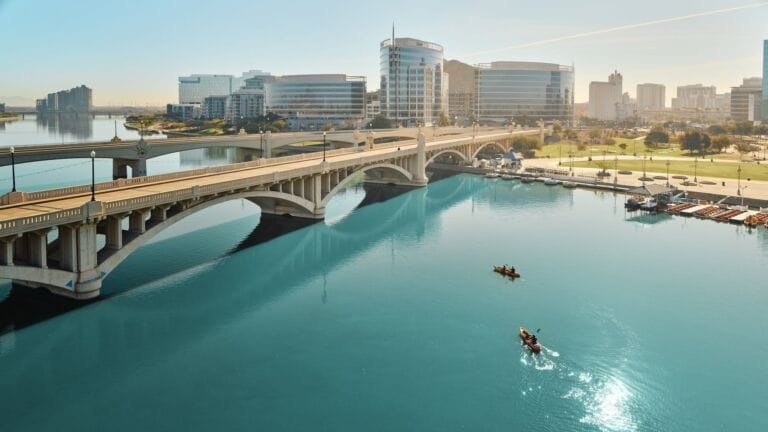
Tempe’s Town Lake waterfront and ASU campus create a rare combination of student and urban professional rental demand in one compact, fully built-out city
2026 Economic Outlook
- ASU enrollment continues to grow, adding hundreds of new students annually
- Downtown Tempe revitalization expanding restaurant, retail, and Class A office space
- Light rail ridership recovering and expanding demand corridors
- State Farm’s Tempe campus anchoring financial services employment near Town Lake
- Tech startup ecosystem seeded by ASU Entrepreneurship programs maturing
Investment Climate
Tempe’s investment environment is defined by high cash flow potential, manageable entry points relative to quality, and the defensive durability of university-driven demand. Successful Tempe investors tend to share these characteristics:
- Strategy clarity between student housing (higher yield, higher management intensity), professional rental (balanced returns, lower turnover), and short-term rental (highest ceiling, most active operation)
- Submarket precision understanding that a half-mile difference in proximity to campus can mean a 20-30% difference in achievable rent per bedroom for student housing
- Tenant management systems given higher-than-average turnover in the student housing segment and the importance of parent co-signer agreements
- Light rail awareness as properties within walking distance of stations command meaningful rent premiums from non-driving young professionals
- Event premium capture for STR operators around ASU football, Fiesta Bowl, spring training, and graduation periods that can generate monthly revenue equivalent to 2-3 months of long-term rent in a single weekend
Unlike Chandler’s family-focused market or Scottsdale’s luxury segment, Tempe requires investors to actively choose their strategy. The same property operated as student housing, professional rental, or STR will produce dramatically different outcomes. Tempe rewards strategic clarity and penalizes passive ownership with no clear plan.
Historical Performance
| Period | Market Driver | Avg Annual Appreciation | Key Event |
|---|---|---|---|
| 2010-2014 | Post-recession recovery; ASU enrollment expansion | 4-7% | ASU surpasses 70,000 enrollment; student housing demand spikes |
| 2015-2019 | Light rail expansion; State Farm campus opens | 7-10% | Town Lake area transforms into premium professional rental corridor |
| 2020-2022 | Pandemic migration, remote work, California exodus | 16-22% | Student housing recovers rapidly; professional demand surges |
| 2023-2024 | Rate normalization; healthy correction | 2-5% | Student housing holds stronger than broader market during correction |
| 2025-2026 | ASU growth, downtown revitalization, tech hiring | 6-9% (projected) | Downtown Tempe office and hospitality expansion driving professional demand |
Tempe’s 15-year track record shows average annual appreciation of 7-9% with notably lower volatility than Phoenix proper during downturns. The ASU demand floor prevented Tempe from experiencing the severe vacancy spikes that hit other Phoenix suburbs in 2023-2024. A $300,000 Tempe property purchased near campus in 2010 is worth approximately $750,000-$900,000 today, while delivering consistent positive cash flow the entire holding period for investors who operated student housing well.
Demographic Trends Driving Demand
- ASU Enrollment Growth – ASU has grown from 58,000 students in 2010 to 80,000+ today and continues expanding. Each enrollment cohort needs housing. On-campus capacity serves only a fraction of students, creating permanent off-campus demand.
- Post-Graduate Stickiness – A significant percentage of ASU graduates choose to remain in Tempe after graduation, transitioning from student to professional renter without vacating the market. This graduation-to-professional pipeline sustains demand even outside the student housing segment.
- Light Rail Connectivity – Valley Metro light rail gives Tempe renters car-free access to downtown Phoenix, Sky Harbor Airport, and eventually to Chandler and Mesa. This connectivity premium drives demand from young professionals who prefer urban transit access over suburban car dependency.
- Built-Out Supply Constraint – Like Chandler, Tempe is essentially fully built out. New supply is almost entirely high-rise apartment towers that do not directly compete with individual investor SFH and condo rentals, protecting existing investors from supply dilution.
- Event-Driven STR Demand – ASU football at State Farm Stadium (nearby), Fiesta Bowl, spring training, ASU graduation, and the Tempe Festival of the Arts create sustained spikes in STR demand that allow sophisticated operators to generate 40-60% more annual revenue than comparable long-term rental income.
📚 New to real estate investing? Master the fundamentals with our professional course Learn more →
2. Neighborhood Hotspots
Tempe Investment Neighborhood Map
Interactive map of Tempe’s investment neighborhoods. Green stars show top hotspots, blue circles mark established markets, and orange circles highlight emerging areas.
Core Investment Neighborhoods
Detailed Submarket Analysis: All Tempe Neighborhoods
| Neighborhood | Price Range | Cap Rate | Growth Drivers | Best Strategy |
|---|---|---|---|---|
| ASU Campus / Mill Avenue | $350K-$600K | 6.5-9.0% | 80,000+ ASU students, perpetual demand, walkability | By-the-room student housing, STR events |
| Tempe Town Lake | $450K-$900K | 4.5-5.5% | State Farm, waterfront lifestyle, tech professionals | Premium long-term, appreciation focus |
| University Drive Corridor | $280K-$450K | 6.0-7.5% | Campus proximity, light rail, diverse student demand | Student rentals, value-add, accessible entry |
| South Tempe (Kyrene / Rural) | $430K-$700K | 4.8-5.8% | Top schools, family demand, Chandler tech access | Family buy and hold, 2+ year leases |
| McClintock / Apache Corridor | $270K-$430K | 5.5-7.0% | Light rail, diverse demand, affordable entry | Balanced returns, diverse tenant pool |
| Rural Road (Mid-Tempe) | $300K-$490K | 5.2-6.2% | Central location, grad students, light rail | Graduate student, young professional |
| Tempe Marketplace (East) | $350K-$530K | 5.0-6.0% | Newer stock, shopping access, Mesa border | Working family, newer construction hold |
| Priest Drive / Downtown Adjacent | $300K-$470K | 5.5-7.0% | Downtown proximity, light rail, value-add | Renovation, BRRRR, appreciation play |
| Guadalupe Road / South Border | $280K-$420K | 5.8-7.0% | Affordability, workforce housing, Chandler access | Best Tempe cash flow, workforce rental |
| Baseline / South ASU Research Park | $290K-$450K | 5.5-6.8% | ASU Research Park growth, grad students, improving | Emerging play, grad student, appreciation |
Expert Insight: “The biggest mistake investors make in Tempe is treating every neighborhood the same. The university market and the Town Lake market are essentially two different investment products in the same city. Campus-area properties operated by the room are some of the highest-yielding assets in all of Arizona, but they require active management, detailed leases, and parent co-signers to operate well. Town Lake properties are the opposite: set-and-forget professional tenants, lower yields, but exceptional appreciation and essentially no management intensity. Decide which business you are running before you buy, because the wrong strategy in the right neighborhood still underperforms.” – Jennifer Walsh, ASU-Area Investment Specialist
3. Property Types
| Investment Goal | Best Property Type | Best Neighborhoods | Minimum Capital |
|---|---|---|---|
| Maximum Cash Flow | 4-5BR SFH operated by-the-room | ASU Campus area, University Drive | $90,000+ |
| Maximum Appreciation | Waterfront condo or SFH | Town Lake, Hayden Ferry | $120,000+ |
| Highest STR Revenue | 3-4BR SFH with pool near campus | ASU Campus, McClintock | $95,000+ plus furnishing |
| Lowest Management | South Tempe SFH or Town Lake condo | South Tempe, Town Lake | $110,000+ |
Don’t guess the costs. Our Complete Renovation & Remodeling Cost Guide covers 400+ pages of project-by-project breakdowns with real contractor pricing ranges.
4. Cost Analysis
Acquisition Cost Breakdown (Tempe)
| Expense Item | Typical Cost | Example ($450,000 Property) | Notes |
|---|---|---|---|
| Down Payment | 25% (investment) | $112,500 | Standard investment property; 20% possible with strong profile |
| Closing Costs | 2-3% of price | $9,000-$13,500 | Title company state; escrow, lender fees, recording |
| Home Inspection | $400-$600 | $500 | Include roof and HVAC inspection specifically |
| Pool Inspection (if applicable) | $150-$250 | $200 | Required for STR and student housing; adds $200-$400/month value |
| HVAC Inspection | $150-$300 | $200 | Critical in Arizona heat; replacement runs $8,000-$15,000 |
| Initial Updates / Staging | 0-8% of price | $0-$36,000 | Student housing may need durable flooring and furnishings; STR needs full furnishing ($15,000-$25,000) |
| Reserves (6 months) | 6 months expenses | $10,000-$14,000 | Cover summer vacancy gap in student housing and HVAC emergencies |
| TOTAL MINIMUM ENTRY | ~28-32% of value | $132,400-$176,500 | Lower capital requirement than comparable quality West Coast university markets |
Sample Cash Flow Analysis: ASU Area 4BR Student Rental (By-the-Room)
| Item | Monthly | Annual | Notes |
|---|---|---|---|
| Gross Rent (4 rooms x $1,200) | $4,800 | $57,600 | 0.5 mile from ASU campus; 12-month leases Aug-July |
| Less Vacancy (5%) | -$240 | -$2,880 | Summer turnover; parent co-signers cover most gaps |
| Property Taxes | -$338 | -$4,050 | ~0.9% of $450K assessed value (investment rate) |
| Insurance | -$140 | -$1,680 | Student housing policy; slightly higher than standard landlord |
| Utilities (landlord-paid) | -$350 | -$4,200 | Water, trash, internet included in student housing rent; students pay electric |
| Property Management (10%) | -$480 | -$5,760 | Student housing specialist PM; higher rate than standard due to complexity |
| Maintenance + CapEx (10%) | -$480 | -$5,760 | Higher rate for student housing due to tenant wear and annual turnover |
| Net Operating Income | $2,772 | $33,270 | Before mortgage |
| Mortgage ($450K purchase, 25% down, 7.0%, 30yr) | -$2,246 | -$26,952 | Loan amount $337,500; P&I only |
| CASH FLOW | +$526 | +$6,318 | Positive cash flow with professional management; self-management adds ~$5,000/year |
| Cap Rate | 7.4% | NOI / Purchase price; exceptional for a major Arizona market | |
| Total Return (8% appreciation) | ~28% | Including positive cash flow, appreciation, and principal paydown on invested capital |
This analysis demonstrates why by-the-room student housing near ASU is one of the strongest performing strategies in the entire Phoenix metro. The same property rented as a whole unit would fetch $2,400-$2,600/month, producing negative cash flow of $300-$500/month at current rates. The by-the-room premium effectively doubles gross income and turns a marginal deal into a genuinely cash-flowing investment.
STR Cash Flow Analysis: ASU Area 3BR with Pool (Event-Focused)
| Item | Monthly Avg | Annual | Notes |
|---|---|---|---|
| STR Gross Revenue (65% occupancy avg) | $4,900 | $58,800 | $220/night avg blended; event weekends at $350-$500 |
| Platform Fees + Taxes | -$637 | -$7,644 | 3% host fee + Arizona STR tax (~12%) |
| Co-Host / STR Management (25%) | -$1,051 | -$12,612 | Includes cleaning coordination; self-manage saves this |
| Fixed Costs (Tax, Insurance, HOA, Pool) | -$680 | -$8,160 | Combined fixed operating costs |
| Supplies, Restocking, Maintenance | -$300 | -$3,600 | Consumables, linen replacement, minor repairs |
| Net Operating Income | $2,232 | $26,784 | Before mortgage |
| Mortgage ($480K purchase, 25% down, 7.0%, 30yr) | -$2,395 | -$28,740 | Loan amount $360,000 |
| CASH FLOW (STR) | -$163 | -$1,956 | Near-neutral; improves to strongly positive if self-managed or at 75%+ occupancy |
Expert Insight: “The comparison investors need to make in Tempe is not between Tempe and the national market. It is between by-the-room and whole-unit leasing on the same property near ASU. I have clients who own identical 4BR homes within the same block. The ones leasing by the room are generating $5,200/month. The ones renting whole are getting $2,600/month. Same purchase price, same mortgage, dramatically different outcomes. The by-the-room model requires real management systems, solid leases, and parent co-signers on every tenant. But for investors willing to build those systems, ASU is one of the best income-generating university markets in the entire country.” – Marcus Thompson, Tempe Student Housing Specialist
5. Legal Framework
✅ Arizona and Tempe: Strongly Landlord-Friendly
Tempe operates under Arizona state law, which is firmly landlord-friendly. No rent control, no just-cause eviction requirement, no source-of-income protections. Arizona explicitly prohibits cities from enacting rent control. Tempe adds a short-term rental licensing requirement but cannot ban STR operations. The overall regulatory environment is a competitive advantage for Tempe investors, especially compared to California university towns like Berkeley, Santa Barbara, or Los Angeles where landlord restrictions are severe.
Arizona Landlord-Tenant Law (Key Points)
- Non-Payment Eviction: 5-day pay-or-quit notice. Total process typically 3-5 weeks to Sheriff execution. Far faster and cheaper than any California, Oregon, or Washington equivalent.
- No Rent Control: Arizona ARS 33-1329 preempts any local rent control ordinance. Landlords may raise rents by any amount with proper notice at lease expiration.
- Security Deposit: Maximum 1.5x monthly rent. Must be returned within 14 business days of move-out with itemized deductions.
- Rent Increase Notice: 30 days written notice for month-to-month leases. Fixed-term leases cannot be increased until expiration.
- Entry Notice: 48 hours required except for emergencies.
- No Just-Cause Requirement: At lease expiration, landlords may choose not to renew without stating a reason. This is a meaningful advantage over California and other regulated markets.
- Student Housing Leases: Arizona law permits individual room leases with separate tenant agreements. Each tenant in a by-the-room arrangement can be held individually responsible for their portion of rent.
Tempe-Specific Requirements
- Transaction Privilege Tax (TPT): All Tempe landlords must register and remit combined state and city TPT on rental income (approximately 3.5% for long-term rentals). Register at azdor.gov before collecting first rent payment.
- STR License: Short-term rental operators in Tempe must obtain a city STR license ($250/year). Properties must comply with Tempe’s noise, parking, and occupancy ordinances.
- Student Housing Best Practices: While not legally required, by-the-room operators should use ASU-standard 12-month leases (August-July), collect parent co-signers, and document move-in condition with photos for every room. Arizona security deposit law applies per tenant in a by-the-room arrangement.
- Pool Safety: Arizona requires specific pool barrier requirements. Ensure compliance before tenant move-in, especially for student housing where liability from pool incidents is elevated.
- HOA Rental Restrictions: Many Tempe condo complexes limit investor-owned rentals to 20-30% of units. Always verify HOA rental cap and current investor ownership percentage before purchasing a condo.
Useful Tempe Resources
- City of Tempe STR Registration: tempe.gov/shortterm
- Arizona DOR TPT License: azdor.gov
- Arizona Residential Landlord Act: azleg.gov
- Arizona Apartment Association: azaa.org
| Regulation | Tempe / Arizona | Berkeley / California (Comparison) | Investor Impact |
|---|---|---|---|
| Rent Control | Prohibited by state law | Strong rent control; annual increase limits | Full rent flexibility in Tempe; zero in Berkeley |
| Eviction (Non-Payment) | 5-day notice; 3-5 weeks total | 3-day notice; 3-6+ months total | Dramatically faster and lower cost in Tempe |
| By-the-Room Leasing | Permitted; individual leases valid | Complex regulations; each tenant may have full tenant rights | By-the-room model far cleaner legally in Arizona |
| STR Regulation | License required; no prohibition | Heavy restrictions; many cities near-prohibition | More STR operational flexibility in Tempe |
| Just Cause Eviction | Not required | Required in many California cities | Full non-renewal flexibility in Arizona |
| Property Tax Rate | ~0.9-1.1% assessed (investment) | ~1.0-1.2% (limited by Prop 13 on existing) | Comparable rates but no Prop 13 reassessment risk on Arizona sale |
6. Step-by-Step Tempe Investment Playbook
Choose Your Tempe Strategy
Tempe’s diverse demand base means the right strategy depends entirely on your capital, time commitment, and return preference. The four primary Tempe approaches:
By-the-Room Student Housing
Maximum yield. Buy 4-5BR near ASU. Lease by room with individual tenant agreements and parent co-signers. Target 12-month leases starting August. Accept higher management intensity in exchange for cap rates of 6.5-9.0% that are rare in any major Arizona market.
Event STR near Campus
Highest revenue ceiling. Buy 3-4BR with pool within 1 mile of ASU. Operate as STR targeting football, Fiesta Bowl, spring training, graduation, and spring break. Combine with mid-week corporate or traveling nurse bookings to sustain occupancy between events.
Town Lake Professional Rental
Premium appreciation. Buy waterfront condo or downtown adjacent property. Lease to State Farm, ASU, or tech professional tenants on 12-24 month leases. Minimal management. Lower yield than student housing but exceptional appreciation and tenant stability.
South Tempe Family Buy and Hold
Stability and balance. Buy 3-4BR SFH in South Tempe’s Kyrene or Rural Road corridor. Target dual-income families with school-age children using Tempe Union schools. 2-3 year lease stability with cash flow near neutral and solid appreciation from Chandler tech corridor spillover.
Build Your Tempe Team
Tempe’s strategies require specialized team members. Unlike Chandler’s relatively standardized family rental market, Tempe’s diversity of approaches demands strategy-matched expertise:
- ASU-Area Investor Agent: Must have specific experience evaluating student rental properties. Should understand the difference in achievable rent between whole-unit and by-the-room leasing and be able to identify properties with the bedroom count and layout that maximize student housing income.
- Student Housing Property Manager: For by-the-room operations, find a Tempe-based PM who specifically manages student housing. Verify they use individual room lease agreements, require parent co-signers, and have an August move-in management system.
- STR Co-Host (if applicable): For event STR operations, find an ASU-area co-host with demonstrated experience managing booking spikes during football and Fiesta Bowl weekends. Ask for occupancy and revenue data on comparable properties they manage.
- Arizona Real Estate Attorney: For LLC setup and lease template review. Student housing by-the-room leases should be reviewed by Arizona counsel to ensure individual room agreements are properly structured.
- HVAC Contractor: Non-negotiable in Arizona heat. Student housing has higher HVAC usage than family housing. Build the relationship before summer when emergency service demand peaks.
- Arizona CPA with Real Estate Focus: For TPT setup, student housing depreciation strategy, and Arizona-specific tax planning across potentially multiple investment properties.
Tempe-Specific Due Diligence
Physical Due Diligence
- HVAC age and capacity (student housing and STR have higher HVAC usage than standard rentals)
- Bathroom count and condition (student housing yield scales with bathroom count; 4BR/2BA outperforms 4BR/1BA significantly)
- Pool equipment age and condition (STR and student housing pool value requires functional equipment)
- Parking count (student housing and STR need adequate off-street parking)
- Noise insulation (multi-tenant student properties need adequate sound separation between rooms)
- Internet infrastructure (strong WiFi is a non-negotiable amenity for both student housing and STR)
Market and Regulatory Due Diligence
- Verify exact distance from ASU main campus (walk score matters enormously for student housing rent)
- Check HOA rental restrictions and caps for condos (verify current investor ownership % before buying)
- Confirm STR eligibility if planning short-term rental operation
- Review HOA financials for deferred maintenance and reserve funding
- Check any active Tempe code violations or noise complaint history on student housing properties
- Verify TPT license status if purchasing existing rental with tenants
Maximizing Rental Performance in Tempe
Strategy-specific tips for maximizing returns in each Tempe investment approach:
- Student Housing Lease Timing: List student rooms in January-March for August occupancy. The best ASU student tenants plan months in advance. Properties listed in June for August often get weaker tenant applicants. Early listing is the single most important factor in tenant quality for student housing.
- Parent Co-Signer Protocol: Require a parent or guardian co-signer for every student tenant under 25. Use a separate co-signer agreement that makes the parent jointly and severally liable for the full lease term. This effectively eliminates rent default risk in student housing.
- ASU Academic Calendar Alignment: Structure leases to run August 1 to July 31, matching ASU’s academic year. This ensures you are never mid-lease when demand peaks at the start of the fall semester.
- STR Event Calendar: Block ASU home football weekends, the Fiesta Bowl, spring training season (February-March), spring break (mid-March), and ASU graduation (May) as minimum 3-night bookings at peak pricing 6-12 months in advance. These dates can generate $1,500-$3,500 per weekend.
- Town Lake Amenity Marketing: For professional rentals near Town Lake, prominently market lake access, State Farm campus proximity (walking commute), and the Mill Avenue restaurant/entertainment scene. These features justify $200-$400/month premiums over comparable properties away from the lake.
7. Financing Options for Tempe
| Loan Type | Down Payment | Rate Premium | Best For | Tempe Note |
|---|---|---|---|---|
| Conventional Investment | 25% | +0.5-0.75% | Strong W-2 income, 720+ credit | Most Tempe SFH under $726,200 qualify for conforming; best rate for most investors |
| DSCR Loan | 25-30% | +1.0-2.0% | Self-employed, multiple properties, no income doc | Student housing by-the-room income often qualifies at 1.0x+ DSCR; verify with lender how room income is underwritten |
| House Hacking (FHA) | 3.5% | Standard + MIP | Owner-occupying one room or unit; first investment | ASU grad students and young investors can house hack near campus with FHA; powerful first step |
| Portfolio Loan | 20-30% | +1-2% | Multiple properties, non-standard income | Arizona Bank & Trust and Western Alliance offer portfolio products for serial Tempe investors |
| Hard Money / Bridge | 15-25% | 9-12% rate | BRRRR acquisitions, value-add deals | Active hard money market in Phoenix metro; useful for older duplex and renovation acquisitions in mid-Tempe |
| Cash-Out Refi / HELOC | N/A (existing equity) | Standard | Leveraging equity from existing property | California equity play common; investors use Bay Area or LA equity to buy Tempe properties with large down payments |
| STR-Specific Financing | 25-30% | +1.5-2.5% | STR operators using Airbnb income for qualification | Some lenders will underwrite using AirDNA market data for Tempe STR income; useful for properties where STR income clearly covers DSCR threshold |
Tempe Financing Reality: Tempe’s student housing market offers something rare in Arizona: properties where by-the-room rental income can qualify for DSCR financing because the income-to-debt ratio is so favorable. A $450,000 4BR home near ASU generating $4,800/month in by-the-room rent has enough NOI to clear a 1.0x DSCR threshold at current rates. This opens student housing to self-employed investors and those with multiple properties who would struggle to qualify for conventional loans. Verify with your specific lender how they underwrite individual room leases versus whole-unit income, as this varies by lender.
8. Frequently Asked Questions

Knowledge Quiz: Tempe Real Estate Investment
Open Quiz
5 quick questions on what you just learned about Tempe investing
1) What is the primary reason Tempe’s rental market is considered more recession-resistant than most Phoenix suburbs?
Answer: C
No recession eliminates the need for 80,000 students to find housing near ASU’s main campus. This creates a demand floor that insulates Tempe’s rental market from the vacancy spikes that hit more purely employment-driven suburban markets during economic downturns. The 2023-2024 Phoenix metro correction saw Tempe’s student housing segment remain stronger than surrounding suburbs for exactly this reason.
2) What does the guide identify as the single most important protection for student housing investors in Tempe?
Answer: B
Parent co-signers are identified as the most critical protection in by-the-room student housing. A parent or guardian co-signer who is jointly and severally liable for the full lease term effectively eliminates rent default risk even if the student loses a part-time job or faces financial difficulty. Arizona permits individual room leases with separate co-signer agreements, making this the standard operating procedure for experienced ASU-area investors.
3) According to the cash flow analysis, how does by-the-room leasing compare to whole-unit leasing on the same ASU-area 4BR property?
Answer: D
The guide’s cash flow analysis shows that a 4BR ASU-area property generates $4,800/month by-the-room versus $2,400-$2,600 whole-unit. At current mortgage rates, the whole-unit approach produces negative cash flow of $300-$500/month. The same property operated by-the-room delivers positive cash flow of $526/month with professional management and approximately $1,000+/month if self-managed. The by-the-room premium effectively doubles gross income and changes the entire investment equation.
4) Which Tempe event does the guide say can generate $3,000-$6,000 in a single week of STR income?
Answer: A
The Fiesta Bowl and College Football Playoff bowl week at State Farm Stadium generates among the highest STR demand spikes in the entire Phoenix metro. Rates increase 3-5x normal during bowl week, with minimum 3-7 night stays standard. A well-positioned Tempe STR can generate $3,000-$6,000 during this single week. Pre-blocking these dates 6-12 months in advance at peak pricing is identified as a key best practice for Tempe STR operators.
5) What is the recommended lease term structure for by-the-room student housing near ASU?
Answer: C
The guide recommends 12-month leases running August 1 through July 31 for ASU student housing. This structure ensures students pay through July even if they return home in May, with parent co-signers covering any non-payment. It also positions lease expirations perfectly for re-leasing when incoming freshman demand peaks at the start of the fall semester. 10-month leases leave landlords with 2 months of vacancy (June-July), effectively reducing annual income by 17%.
Work With a Local Expert in Tempe
We are building a verified network of real estate professionals across every market we cover.

About Our Expert Network
We are finalizing partnerships with verified real estate professionals across every market featured on Builds and Buys. Each expert in our network is selected for their hands-on investment experience, local market knowledge, and commitment to helping buyers and investors make sound decisions.
Our local specialists offer:
- Proven experience with investment and income-producing properties
- Deep knowledge of local pricing, rental yields, and neighborhood dynamics
- Guidance on financing, legal structure, and due diligence
- Access to off-market and pre-market opportunities
- Full transaction support from search through closing
- Ongoing portfolio and property management referrals
Services Covered
- Property sourcing and acquisition
- Investment analysis and underwriting
- Buyer representation
- Market comparables and valuations
- Short-term and long-term rental strategy
- Value-add and renovation guidance
- Legal and title referrals
- Financing and lender connections
- Property management referrals
- Insurance and inspection referrals
- 1031 exchange coordination
- Exit strategy planning
Get Connected or Join Our Network
Looking for a local expert to help with your investment? Reach out and we will connect you with the right professional for your market and strategy.
Are you a real estate professional with a track record working with investors? We are always expanding our network of verified local experts.
Contact us at support@buildsandbuys.com
Find Specialized Tempe Real Estate Professionals
Ready to Invest in Tempe?
Tempe is one of the most strategically interesting investment markets in all of Arizona. The ASU demand floor creates a recession-resistant foundation that no other Phoenix suburb can replicate. The diversity of strategies, from 7-9% cap rate student housing to event-driven STR to premium Town Lake appreciation plays, means virtually every investor type can find a compelling entry point. Add Arizona’s landlord-friendly laws, no rent control, and efficient eviction process, and Tempe’s investment case is among the strongest of any university market in the country.
Continue Your Research
Arizona State Guide
See how Tempe compares to Chandler, Scottsdale, Flagstaff, Tucson, and every other Arizona market.
Step-by-Step Invest
Complete framework for building a real estate investment strategy from scratch.
144-Lesson Course
University-level real estate education covering financing, law, strategy, and management.
For further guidance, explore our State-by-State Investor guides, browse our expert articles, or follow our Step-by-Step Investment Guide.