
Chandler Arizona Real Estate Investment Guide For 2026
A comprehensive resource for investors looking to capitalize on one of Arizona’s most dynamic tech-corridor markets, where Intel, financial services, and top-ranked schools drive exceptional long-term demand
Quick answers: Top 5 most searched Chandler investment questions ▼
Migration data: Where people are moving from to Chandler ▼
In This Guide
Click on any section to navigate directly to that content
1. Chandler Market Overview
Market Fundamentals
Chandler stands as one of the most compelling balanced-return real estate investment cities in the entire Sun Belt, powered by a world-class semiconductor and financial services employment base, the top-ranked school district in Maricopa County, and a nearly fully built-out land supply that structurally limits new housing competition. From the master-planned communities of Ocotillo to the revitalizing Downtown Arts District and the family enclaves surrounding Chandler Unified schools, the city offers diverse investment opportunities across a wide range of strategies and price points.
Key economic indicators defining Chandler’s investment case:
- Population: 285,000+ city proper, part of the 5.0M+ Phoenix metro
- Major Employers: Intel (Ocotillo campus, 12,000+ employees), PayPal, Wells Fargo, Bank of America, Isagenix, Microchip Technology, Orbital ATK
- Median Household Income: $85,000+ (among the highest in Maricopa County)
- Job Growth: 3.2% annually, consistently above both state and national averages
- No State Income Tax: Arizona has a flat 2.5% income tax (among the lowest in the nation) vs. California’s up to 13.3%
- Vacancy Rate: Under 5% for quality SFH rentals, under 4% near Intel campus
Chandler’s economy is anchored by semiconductors but diversified across financial technology, aerospace, healthcare, and professional services. This breadth creates resilient housing demand across multiple renter demographics, from Intel engineers earning $130,000+ to healthcare workers and young families seeking top schools.
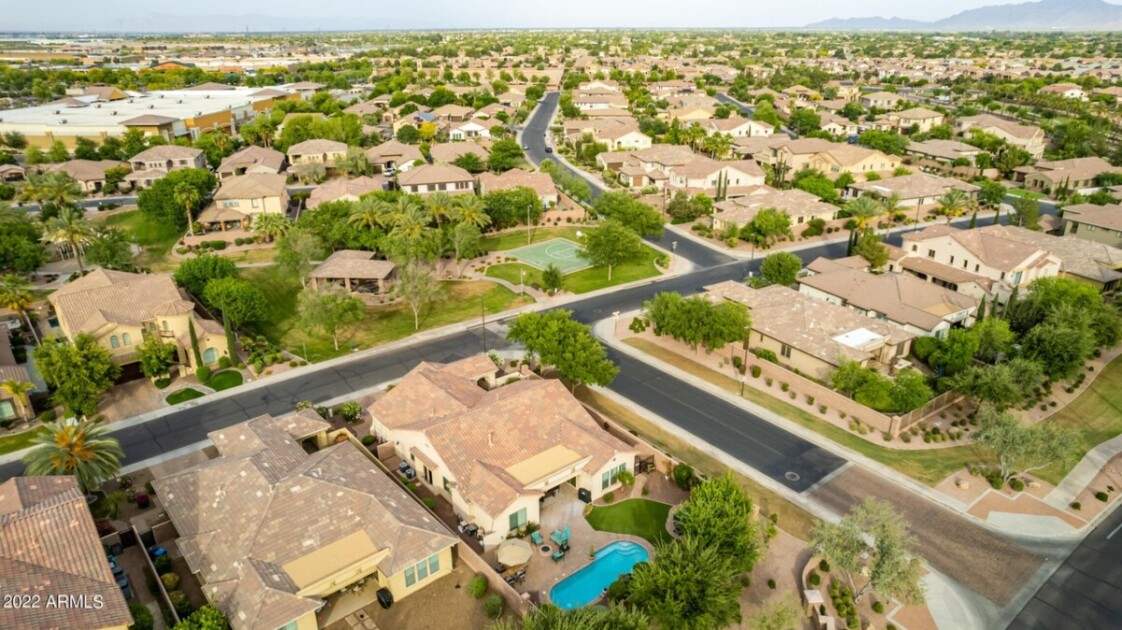
Chandler’s master-planned communities and tech employment base create one of Arizona’s most stable long-term rental markets
2026 Economic Outlook
- Intel Ocotillo expansion adding thousands of additional high-wage jobs through 2028
- CHIPS Act investment reshaping the entire East Valley semiconductor supply chain
- TSMC Phoenix fab creating ripple effect for Chandler supplier and support firms
- Downtown Chandler revitalization adding retail, dining, and walkability premium
- Financial services sector (PayPal, Wells Fargo) continuing steady hiring
Investment Climate
Chandler’s investment environment is defined by a rare combination that few markets offer: genuine cash flow potential alongside solid appreciation, in a landlord-friendly state with no rent control and efficient eviction processes. Successful Chandler investors tend to share these characteristics:
- Family rental focus targeting the 3-4BR market where Intel and PayPal employees relocating from California represent the ideal tenant demographic
- School district awareness with Chandler Unified district boundaries acting as a meaningful premium driver of up to 8-12% on home values vs. adjacent Maricopa or Gilbert unified boundaries
- CHIPS Act positioning understanding that Intel’s Ocotillo expansion is a 10-15 year employment tailwind that will systematically compress vacancy rates near the campus
- Built-out supply recognition knowing that Chandler’s near-complete development means new supply is minimal, protecting existing investors from competition
- Short-term rental discipline leveraging Chandler’s light STR regulations for properties near the Fashion Center, baseball spring training, and Intel corporate housing needs
Unlike Phoenix’s urban core, Chandler does not require accepting negative cash flow or making a 10+ year appreciation bet. Many properties in Chandler’s middle market achieve positive cash flow with standard financing, making it accessible to a wider range of investors.
Historical Performance
| Period | Market Driver | Avg Annual Appreciation | Key Event |
|---|---|---|---|
| 2010-2014 | Post-recession recovery, Intel stability | 4-6% | Chandler recovers faster than Phoenix due to employment anchors |
| 2015-2019 | Tech corridor growth, California migration begins | 7-10% | PayPal and financial services firms establish East Valley presence |
| 2020-2022 | Pandemic migration, remote work acceleration | 18-25% | California exodus hits Chandler hard; inventory hits historic lows |
| 2023-2024 | Rate normalization, market reset | 2-5% | Healthy correction; strong fundamentals prevent significant decline |
| 2025-2026 | CHIPS Act investment, Intel expansion wave | 6-9% (projected) | Semiconductor supply chain buildout creating new demand wave |
Chandler’s 15-year track record shows average annual appreciation of 7-9%, with the added benefit that the market held its value better than Phoenix proper during the 2008-2010 downturn due to Intel’s employment stability. A $350,000 Chandler property purchased in 2010 would be worth approximately $900,000 to $1,100,000 today, representing one of the strongest suburban wealth-building outcomes in the entire Southwest.
Demographic Trends Driving Demand
- Intel Semiconductor Expansion – The Ocotillo campus is adding thousands of engineering and manufacturing jobs through 2028, each representing a high-income household needing housing near the campus
- TSMC and Supplier Ripple Effect – TSMC’s Phoenix investment is driving dozens of Taiwanese and Korean semiconductor suppliers to establish East Valley operations, many choosing Chandler for its proximity to both fabs
- California Financial Services Migration – Wells Fargo, PayPal, and Bank of America have major Chandler campuses, drawing professionals who want Bay Area careers at Arizona costs
- School District Premium – Chandler Unified consistently ranks among Arizona’s top 3 school districts, driving family formation and keeping families anchored to the city for 10-15 year periods
- Built-Out Land Supply – Chandler is approximately 97% built out, meaning new housing inventory is minimal and any demand increase directly pressures existing prices and rents
- Retiree Stability – Sun Lakes and Solera communities provide a stable base of older residents who tend to age in place, reducing turnover and supporting surrounding market values
📚 New to real estate investing? Master the fundamentals with our professional course Learn more →
2. Neighborhood Hotspots
Chandler Investment Neighborhood Map
Interactive map of Chandler’s investment neighborhoods. Green stars show top hotspots, blue circles mark established markets, and orange circles highlight emerging areas.
Core Investment Neighborhoods
Detailed Submarket Analysis: All Chandler Neighborhoods
| Neighborhood | Price Range (SFH) | Cap Rate | Growth Drivers | Best Strategy |
|---|---|---|---|---|
| Ocotillo / Intel Campus | $500K-$750K | 4.5-5.2% | Intel employment, semiconductor expansion, CHIPS Act | Buy and hold, premium family rental |
| Dobson Ranch | $425K-$650K | 4.8-5.5% | Master-planned lifestyle, lakes, mature community | Long-term hold, value-add, stable income |
| Downtown Arts District | $350K-$600K | 5.0-6.5% | Urban revitalization, walkability, corporate housing demand | STR, young professional, appreciation |
| Fulton Ranch / Bridlewood | $575K-$900K | 4.2-5.0% | Luxury appeal, top schools, mountain views | Premium long-term, executive rentals |
| Kyrene Corridor (North) | $400K-$600K | 4.8-5.5% | Tempe spillover, freeway access, ASU proximity | Balanced returns, professional tenants |
| Ray Road Corridor (Mid-Chandler) | $380K-$580K | 5.0-5.8% | Central access, family demand, Intel commute | Family buy and hold, strong cash flow |
| Fashion Center Corridor | $320K-$500K | 5.2-6.0% | Retail access, financial services employment, Loop 202 | Accessible entry, diverse tenant pool |
| Sun Lakes (55+) | $350K-$550K | 5.5-6.5% | Active adult lifestyle, retiree stability, amenities | Niche 55+ rental, low-turnover income |
| South Chandler / Germann | $390K-$560K | 5.2-6.2% | Newer stock, affordability, growth trajectory | Emerging play, value for newer construction |
| East Chandler / Santan Corridor | $360K-$520K | 5.5-6.5% | Gilbert spillover, affordability, freeway access | Best Chandler value, appreciation upside |
Expert Insight: “The most underappreciated opportunity in Chandler right now is the 1-3 mile radius around the Intel Ocotillo campus. The CHIPS Act funding means Intel’s headcount in Chandler will grow substantially through 2028 and beyond. Properties in this zone are trading at 10-15% premiums to the broader Chandler market, but given the employment tailwind, that premium is likely to grow rather than compress. Engineers arriving from Oregon, California, and overseas need housing near the campus fast, and they are willing to pay top dollar for quality rental homes near top schools.” – David Chen, East Valley Investment Specialist
3. Property Types
| Investment Goal | Best Property Type | Best Neighborhoods | Minimum Capital |
|---|---|---|---|
| Maximum Cash Flow | 55+ community SFH or STR condo | Sun Lakes, Downtown, Fashion Center | $80,000+ |
| Maximum Appreciation | SFH near Intel campus | Ocotillo, Fulton Ranch | $125,000+ |
| Balanced Returns | 3BR SFH in established community | Dobson Ranch, Ray Road Corridor | $100,000+ |
| Lowest Management | New construction SFH or townhome | South Chandler, Santan Corridor | $110,000+ |
Don’t guess the costs. Our Complete Renovation & Remodeling Cost Guide covers 400+ pages of project-by-project breakdowns with real contractor pricing ranges.
4. Cost Analysis
Acquisition Cost Breakdown (Chandler)
| Expense Item | Typical Cost | Example ($525,000 Property) | Notes |
|---|---|---|---|
| Down Payment | 25% (investment) | $131,250 | Standard for investment properties; 20% possible with strong profile |
| Closing Costs | 2-3% of price | $10,500-$15,750 | Title, escrow, lender fees; Arizona is a title company state |
| Home Inspection | $400-$600 | $500 | Include roof inspection separately; flat roofs common in Chandler |
| Pool Inspection | $150-$250 | $200 | 70%+ of Chandler SFH have pools. Inspect equipment carefully. Pool adds $200-$400/month in maintenance costs. |
| HVAC Inspection | $150-$300 | $200 | Critical in Arizona heat. Replacement runs $8,000-$15,000. Verify age and condition. |
| Initial Repairs / Updates | 0-8% of price | $0-$42,000 | Highly variable. 1980s-90s stock may need kitchen/bath updates to command premium rents. |
| Reserves (6 months) | 6 months expenses | $12,000-$16,000 | Emergency fund for vacancy, HVAC replacement, pool issues |
| TOTAL MINIMUM ENTRY | ~28-32% of value | $154,650-$205,700 | Significantly lower capital requirement than comparable quality markets on the West Coast |
Sample Cash Flow Analysis: Dobson Ranch 3BR Single-Family Home
| Item | Monthly | Annual | Notes |
|---|---|---|---|
| Gross Rent | $2,550 | $30,600 | 3BR/2BA, Dobson Ranch, updated kitchen and baths |
| Less Vacancy (4%) | -$102 | -$1,224 | Conservative; actual vacancy often under 3% |
| Property Taxes | -$395 | -$4,740 | ~0.9% of $527K assessed value (investment property rate) |
| Insurance | -$130 | -$1,560 | Landlord policy; lower in Arizona than Pacific Northwest or Florida |
| HOA | -$90 | -$1,080 | Dobson Ranch HOA; includes lake and golf amenities access |
| Pool Service | -$200 | -$2,400 | Monthly pool service; standard cost in Chandler |
| Property Management (9%) | -$230 | -$2,754 | Competitive rates in Phoenix metro; self-manage saves this entirely |
| Maintenance + CapEx (8%) | -$204 | -$2,448 | Dry climate reduces many maintenance issues vs. humid markets |
| Net Operating Income | $1,199 | $14,394 | Before mortgage |
| Mortgage ($527K purchase, 25% down, 7.0%, 30yr) | -$2,641 | -$31,692 | Loan amount $395,250; P&I only |
| CASH FLOW | -$1,442 | -$17,298 | Slightly negative at 7% rate; self-management turns positive |
| Cap Rate | 2.74% | NOI / Purchase price | |
| Total Return (8% appreciation) | ~22% | Including equity, appreciation, principal paydown on invested capital |
Key note: The above analysis uses professional management. Investors who self-manage save $2,754/year and turn the property cash flow positive (+$1,300/year). Investors who bought at 2021-2022 prices and refinanced at 5-6% rates are achieving positive cash flow of $300-$600/month on comparable properties. Rate buydowns and seller concessions are additional tools currently available to reduce carrying costs.
Short-Term Rental Cash Flow Analysis: Downtown Chandler 2BR Condo
| Item | Monthly | Annual | Notes |
|---|---|---|---|
| STR Gross Revenue (70% occupancy) | $3,850 | $46,200 | $185/night avg, 21 nights/month; conservative for Downtown Chandler |
| Platform Fees (Airbnb/VRBO, 3%) | -$115 | -$1,386 | Host fee |
| STR Co-Host / Management (25%) | -$934 | -$11,208 | Turnover cleaning, guest communication; skip if self-managing |
| Property Taxes, Insurance, HOA | -$450 | -$5,400 | Combined fixed costs |
| Supplies and Restocking | -$150 | -$1,800 | Consumables, linens replenishment |
| Net Operating Income | $2,201 | $26,406 | Before mortgage |
| Mortgage ($420K purchase, 25% down, 7.0%, 30yr) | -$2,111 | -$25,332 | Loan amount $315,000 |
| CASH FLOW (STR) | +$90 | +$1,074 | Near-neutral at 70% occupancy; strongly positive at 80%+ |
Expert Insight: “The key to Chandler cash flow is the pool. Every property with a private pool commands $200-$350/month more in rent than comparable properties without one. But pool service, chemicals, and equipment replacement eat into that premium. For maximum cash flow, look for properties with pools that have newer equipment (2020 or later) and add the pool service cost into your lease as a landlord-paid amenity. Tenants absorb the premium rent, you absorb the service cost, and everyone wins. For short-term rentals, a private pool is not optional. It is the single feature that most drives nightly rate in the Chandler market.” – Rosa Martinez, Phoenix East Valley Investment Specialist
5. Legal Framework
✅ Arizona and Chandler: Among the Most Landlord-Friendly in the U.S.
Arizona state law is firmly landlord-friendly and Chandler adds no additional tenant protections beyond the state level. There is no rent control, no just-cause eviction requirement, no first-in-time rule, and no source of income protections. Arizona state law preempts any city or county from enacting rent control ordinances. This legal environment is a significant competitive advantage for Chandler investors compared to markets in California, Oregon, Washington, or New York.
Arizona Landlord-Tenant Law Basics
Arizona’s Residential Landlord and Tenant Act (ARS Title 33, Chapter 10) governs all residential rental relationships in Chandler. Key provisions:
- Non-Payment Eviction: 5-day pay-or-quit notice. If not cured, landlord may file with the justice court immediately. Total timeline typically 3-5 weeks including court date and writ execution.
- Lease Violation Eviction: 10-day notice to comply or vacate. Non-material violations may be cured.
- Immediate Termination: Material and irreparable breaches (criminal activity, significant damage, threatening behavior) may allow immediate termination with 5 days notice.
- Security Deposit: Limited to 1.5x monthly rent. Must return within 14 business days of move-out with itemized deductions. Intentional non-compliance can result in double damages.
- No Rent Control: Arizona law (ARS 33-1329) explicitly prohibits rent control ordinances at any local level. Landlords may raise rents by any amount with proper notice.
- Rent Increase Notice: 30 days written notice required for month-to-month tenancies. Fixed-term leases cannot be increased until expiration unless lease specifically provides for it.
- Entry Notice: 48 hours notice required before entry except for emergency repairs.
- STR Preemption: Arizona law prevents cities from banning short-term rentals. Chandler may require a license but cannot prohibit operation entirely.
Chandler-Specific Requirements
Chandler adds minimal requirements on top of Arizona state law:
- Business License: All Chandler rental property owners must obtain a Transaction Privilege Tax (TPT) license from the Arizona Department of Revenue and remit rental tax. As of 2025, the combined state and city rental tax rate is approximately 2.4% on gross rents.
- Short-Term Rental License: STR operators must register with the City of Chandler and obtain a license ($150/year). Properties must comply with noise, parking, and occupancy standards.
- Pool Fencing: Arizona requires specific barrier requirements around all private pools. Ensure compliance to avoid liability and insurance issues.
- Smoke and Carbon Monoxide Detectors: Must be present and functional per Arizona fire code.
- Lead Paint Disclosure: Required for properties built before 1978, consistent with federal law.
- Move-In Inspection: Best practice (not legally required) to complete a detailed written move-in inspection checklist signed by the tenant to protect security deposit deductions.
Useful Chandler Resources
- City of Chandler Business Services: chandleraz.gov/business
- Arizona Dept of Revenue TPT License: azdor.gov
- Arizona Residential Landlord/Tenant Act: azleg.gov
- Arizona Apartment Association: azaa.org
| Regulation | Chandler / Arizona | California (Comparison) | Investor Impact |
|---|---|---|---|
| Rent Control | Prohibited by state law | AB 1482 limits increases to 5%+CPI | Full rent flexibility in Chandler |
| Eviction (Non-Payment) | 5-day notice; 3-5 week total | 3-day notice; 2-4+ months total | Dramatically faster and cheaper in Arizona |
| Security Deposit | Max 1.5x rent; 14-day return | Max 2x rent; 21-day return | Slightly less deposit protection but reasonable |
| Just Cause Eviction | Not required | Required for tenants 12+ months | Full flexibility on non-renewal in Arizona |
| STR Regulations | License required; no prohibition | Varies; many cities have severe restrictions | More operational flexibility in Chandler |
| Source of Income | No requirement | Many cities require Section 8 acceptance | Full screening discretion in Arizona |
| Property Tax | ~0.9-1.1% assessed value (investment) | ~1.1% (limited by Prop 13) | Similar but Arizona has no Prop 13 reset risk on sale |
6. Step-by-Step Chandler Investment Playbook
Choose Your Chandler Strategy
Chandler is one of the few major Arizona markets where multiple strategies can work simultaneously. Choose your approach based on capital available, time commitment, and return priority:
Intel Corridor Buy and Hold
Buy near Ocotillo campus. Target Intel engineering families as tenants. Accept slightly lower cap rates (4.5-5.2%) in exchange for the tightest vacancy rates in all of Chandler and maximum appreciation upside from ongoing semiconductor expansion.
Cash Flow Family Rental
Buy 3-4BR in established mid-Chandler neighborhoods. Target dual-income families with school-age children who become anchor tenants for 2-3 year periods. Positive or near-neutral cash flow with solid appreciation.
Short-Term / Corporate Rental
Buy in Downtown Chandler or near the Intel corridor. Furnish and list on Airbnb and VRBO plus corporate housing platforms like Furnished Finder. Intel, PayPal, and Wells Fargo all relocate employees to Chandler regularly, creating built-in 30-90 day corporate demand.
Value-Add BRRRR
Buy dated 1980s-1990s homes in Dobson Ranch, Kyrene, or mid-Chandler. Update kitchen, baths, and flooring. Refinance based on higher appraised value. Repeat. Chandler’s dry climate means no moisture damage or mold surprises that plague BRRRR in humid markets.
Build Your Chandler Team
Unlike Seattle or San Francisco, Chandler’s investor-friendly environment means your team needs less regulatory expertise and more market-specific deal knowledge. Essential team members:
- East Valley Investment-Focused Agent: Must understand the Intel/semiconductor employment driver and be able to analyze properties near the Ocotillo campus specifically. General Phoenix metro agents often lack East Valley submarket expertise.
- Arizona Real Estate Attorney: For entity setup (LLC is highly recommended for liability protection) and lease template review. Arizona law is straightforward but proper documentation still matters enormously.
- East Valley Property Manager: If not self-managing, verify the company has specifically managed Chandler properties. Ask about their pool management protocols as this is a major differentiator in Arizona.
- Licensed Arizona Home Inspector with Pool Certification: Non-negotiable. A failing pool heater or deteriorating equipment can cost $5,000-$12,000. Ensure they specifically inspect pool equipment age and condition.
- HVAC-Specialist Contractor: Arizona heat puts extreme demands on air conditioning systems. Build a relationship with an HVAC contractor before you need emergency service in July.
- Arizona CPA with Real Estate Focus: For TPT license setup, depreciation strategy, and Arizona-specific cost segregation analysis on higher-value properties.
Chandler-Specific Due Diligence
Standard due diligence plus these Chandler-critical checks:
Physical Due Diligence
- HVAC age and condition (systems over 12 years old may need replacement within your hold period)
- Pool and pool equipment inspection (pool heater, pump, filter age and condition)
- Flat or low-slope roof inspection (common in 1980s-90s Chandler construction)
- Stucco and exterior condition (Arizona sun degrades stucco; check for cracking and water intrusion at penetrations)
- Foundation inspection (expansive soils are present in some Chandler areas)
- Pest inspection for termites and scorpions (both common in Chandler)
Market and Regulatory Due Diligence
- Verify Chandler Unified vs. other school district boundaries (significant rent premium difference)
- Check HOA rental restrictions and percentage caps for investor-owned units
- Verify STR eligibility if planning short-term rental (some HOAs prohibit)
- Review HOA financials for deferred maintenance and underfunded reserves
- Confirm TPT license status for existing rental properties being purchased with tenants
- Check for any active Chandler code violations on the property
Competing in Chandler’s Market and Maximizing Rent
Chandler is a competitive market but far less frenzied than the 2021-2022 peak. Current effective strategies:
- Target Intel Relocation Season: Intel’s largest hiring and relocation waves happen January-March and August-September, coinciding with semiconductor project starts and back-to-school moves. Having a property listed and tenant-ready during these windows maximizes your tenant quality and minimizes vacancy.
- School District Marketing: When listing for rent, explicitly advertise the school district and specific elementary school attendance zone. Chandler Unified families actively search by elementary school, and marketing this correctly commands a real premium vs. listing on price alone.
- Pool as Rental Differentiator: Professionally photograph the pool and include it prominently in listings. Chandler renters expect pools; a property with a pool and professional service typically rents 2-3 weeks faster than comparable non-pool properties.
- Corporate Housing Platforms: Register on Furnished Finder, Landing, and corporate housing networks in addition to Airbnb for STR properties. Intel and PayPal HR departments actively use these platforms for relocating employees.
- Off-Market Sourcing: Direct outreach to owners of 1980s-90s homes in Dobson Ranch and mid-Chandler with “we buy houses” letters targeting long-term owners who may be motivated to sell to avoid probate or manage aging properties. Best source of value-add opportunities.
7. Financing Options for Chandler
| Loan Type | Down Payment | Rate Premium | Best For | Chandler Note |
|---|---|---|---|---|
| Conventional Investment | 25% | +0.5-0.75% | Strong W-2 income, good credit (720+) | Most Chandler properties under $726,200 qualify for conforming; above that requires jumbo |
| DSCR Loan | 25-30% | +1.0-2.0% | Self-employed, multiple properties, no income doc | Unlike Seattle, Chandler’s cap rates (4.5-6%) make DSCR qualification achievable at 1.0x on many properties |
| House Hacking (FHA) | 3.5% | Standard + MIP | Owner-occupying one unit; first investment property | Best entry-level path to Chandler ownership for new investors |
| Portfolio Loan | 20-30% | +1-2% | Multiple properties, unusual income, self-employed | Several Phoenix-area community banks (Arizona Bank & Trust, Western Alliance) offer portfolio products |
| Hard Money / Bridge | 15-25% | 9-12% rate | BRRRR acquisitions, value-add deals, competitive offers | Active hard money lender market in Phoenix metro; several specialize in East Valley |
| Cash-Out Refi / HELOC | N/A (existing equity) | Standard | Leveraging equity from primary residence or existing investment | California investors frequently use California equity to fund all-cash or large-down Chandler purchases |
| VA Loan (Owner-Occ) | 0% | Below market | Active military and veterans buying primary residence with rental intent | Chandler proximity to various military installations in East Valley makes this relevant for some buyers |
Chandler Financing Reality: Unlike Seattle or Los Angeles, many Chandler investment properties can qualify for DSCR loans because rental income is closer to covering debt service at current rates. This opens Chandler to self-employed investors, serial investors with multiple properties, and anyone who wants to qualify based on the property rather than personal income. The California equity play is also significant in Chandler: investors from the Bay Area and Los Angeles frequently sell or refinance a California property and use the freed equity to buy 2-4 Chandler properties outright or with very large down payments, dramatically improving their cash flow position and locking in positive returns from day one.
8. Frequently Asked Questions

Knowledge Quiz: Chandler Real Estate Investment
Open Quiz
5 quick questions on what you just learned about Chandler investing
1) What makes the Ocotillo neighborhood specifically valuable for rental investors in Chandler?
Answer: B
The Ocotillo area sits adjacent to Intel’s massive semiconductor campus and benefits from the tightest rental market in all of Chandler. Intel engineers earning $130,000-$200,000+ represent an ideal tenant base, and the CHIPS Act expansion means this employment anchor is growing substantially through 2028. Vacancy rates in this corridor run under 3%.
2) How does Arizona’s Transaction Privilege Tax affect Chandler rental investors?
Answer: C
Arizona’s TPT is a sales tax on business activity including rental income. Chandler landlords must register with the Arizona Department of Revenue and remit the combined state and city TPT of approximately 3.5% on long-term rental income. STR income is taxed at a higher rate of roughly 12-13% including transient occupancy tax, though platforms like Airbnb collect and remit this automatically in Arizona.
3) Why does the guide say Chandler is one of the most water-secure cities in Arizona?
Answer: D
Chandler’s water security rests on three pillars: CAP Colorado River allocations, advanced water reclamation infrastructure for industrial and landscaping use, and Arizona’s 100-year Assured Water Supply program for new development. This makes Chandler far more water-secure than newer outer-suburban communities that rely more heavily on groundwater.
4) What is the key difference between Arizona eviction law and California eviction law that benefits Chandler investors?
Answer: A
Arizona’s eviction process starts with a 5-day pay-or-quit notice for non-payment and the total process from first notice to Sheriff execution typically takes 3-5 weeks. California requires a 3-day notice but the total process routinely takes 2-4+ months and can extend much further for contested cases. This difference represents thousands of dollars in lost rent and legal costs for California investors compared to Arizona.
5) According to the guide, what is the single most impactful feature for short-term rental performance in Chandler?
Answer: C
The guide explicitly states that for short-term rentals in Chandler, a private pool is not optional, it is essential for competitive performance. A pool can add $40-$80 per night to the achievable rate and improve occupancy by 15-25 percentage points. In the STR market, this single feature has a larger impact on revenue than any other property characteristic specific to the Chandler market.
Work With a Local Expert in Chandler
We are building a verified network of real estate professionals across every market we cover.

About Our Expert Network
We are finalizing partnerships with verified real estate professionals across every market featured on Builds and Buys. Each expert in our network is selected for their hands-on investment experience, local market knowledge, and commitment to helping buyers and investors make sound decisions.
Our local specialists offer:
- Proven experience with investment and income-producing properties
- Deep knowledge of local pricing, rental yields, and neighborhood dynamics
- Guidance on financing, legal structure, and due diligence
- Access to off-market and pre-market opportunities
- Full transaction support from search through closing
- Ongoing portfolio and property management referrals
Services Covered
- Property sourcing and acquisition
- Investment analysis and underwriting
- Buyer representation
- Market comparables and valuations
- Short-term and long-term rental strategy
- Value-add and renovation guidance
- Legal and title referrals
- Financing and lender connections
- Property management referrals
- Insurance and inspection referrals
- 1031 exchange coordination
- Exit strategy planning
Get Connected or Join Our Network
Looking for a local expert to help with your investment? Reach out and we will connect you with the right professional for your market and strategy.
Are you a real estate professional with a track record working with investors? We are always expanding our network of verified local experts.
Contact us at support@buildsandbuys.com
Find Specialized Chandler Real Estate Professionals
Ready to Invest in Chandler?
Chandler is one of the clearest investment cases in the entire Sun Belt. The Intel and CHIPS Act semiconductor employment wave is just beginning, the city is nearly fully built out limiting new supply, landlord laws are among the friendliest in the nation, and multiple investment strategies can generate genuine returns here. Whether you are targeting Intel corridor family rentals, Downtown short-term corporate housing, value-add renovation in Dobson Ranch, or 55+ stable income from Sun Lakes, Chandler offers an investment thesis for every strategy. The window to buy before the next Intel employment wave fully registers in prices is open now.
Continue Your Research
Arizona State Guide
See how Chandler compares to Scottsdale, Tempe, Flagstaff, Tucson, and every other Arizona market.
Step-by-Step Invest
Complete framework for building a real estate investment strategy from scratch.
144-Lesson Course
University-level real estate education covering financing, law, strategy, and management.
For further guidance, explore our State-by-State Investor guides, browse our expert articles, or follow our Step-by-Step Investment Guide.



