
Albany / Lebanon Oregon Real Estate Investment Guide For 2026
A comprehensive resource for investors targeting Oregon’s most undervalued mid-Willamette Valley market, a dual-city corridor offering genuine cash flow potential, a resurgent manufacturing economy, and Corvallis spillover demand that is steadily lifting values in 2026
Quick answers: Top 5 most searched Albany/Lebanon investment questions ▼
Migration data: Where people are moving from to Linn County ▼
In This Guide
Click on any section to navigate directly to that content
1. Albany / Lebanon Market Overview
Market Fundamentals
Albany and Lebanon form the economic spine of Linn County, Oregon’s mid-Willamette Valley corridor situated between Salem to the north and Eugene to the south along Interstate 5. Albany, at 57,000 residents, is the county seat and the larger of the two cities, anchored by Linn-Benton Community College, a significant healthcare sector, and a historic downtown that has drawn meaningful reinvestment in recent years. Lebanon, 14 miles to the southeast with 19,500 residents, is a more industrial small city with a resurgent manufacturing economy centered on specialty chemicals, rare earth materials, and timber processing.
Key economic indicators defining the dual-city investment case:
- Albany Population: 57,000+ with 2.8% annual growth
- Lebanon Population: 19,500+ with 2.2% annual growth
- Major Employers: Samaritan Health (Albany), Linn-Benton Community College, Imerys Talc, Lebanon Seaboard Chemical, Lebanon Steel Fabricators, and numerous timber and agriculture operations
- Corvallis Proximity: Albany is 10 miles from Corvallis and Oregon State University, giving it direct exposure to the OSU economy without Corvallis prices
- Linn-Benton Community College: 7,000+ students on Albany campus generating housing demand
- Vacancy Rate: Under 4% for long-term rentals across both cities
The investment story in Albany and Lebanon is fundamentally about affordability relative to nearby markets. Corvallis median home prices exceed $530,000, Salem exceeds $380,000, and Eugene exceeds $420,000. Albany and Lebanon at $310,000 to $360,000 and $280,000 to $330,000 respectively represent the last genuinely affordable Willamette Valley cities in the I-5 corridor. Investors who recognize this relative value, combined with the organic demand generated by OSU spillover and industrial employment, are finding returns here that have largely disappeared from Oregon’s larger metros.
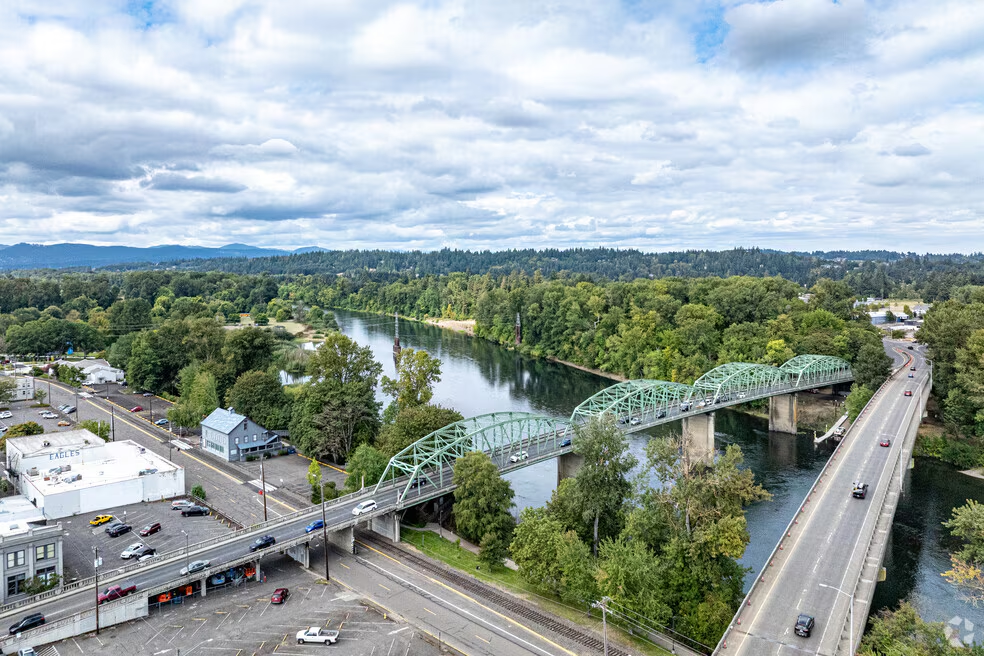
Albany’s historic carousel district and Willamette River setting anchor a city undergoing meaningful downtown reinvestment
2026 Economic Outlook
- OSU’s $1.2 billion research campus expansion driving Corvallis housing demand and Albany spillover
- Domestic rare earth and specialty mineral reshoring benefiting Lebanon’s industrial base
- Albany’s Carousel District renovation drawing new dining, retail, and professional tenants
- Linn-Benton Community College enrollment growth in healthcare and trades programs
- Highway 20 corridor improvements reducing commute times to Corvallis
Investment Climate
The Albany and Lebanon investment environment is the most cash flow accessible of any major Willamette Valley market west of the Cascades. Unlike Portland, Eugene, or even Salem where negative carry is the norm with conventional financing, strategic property selection in Albany and Lebanon can produce near-neutral or modestly positive monthly cash flow. The trade-off is lower appreciation than Corvallis or Portland, though Albany specifically is beginning to close that gap as Corvallis becomes increasingly unaffordable.
- Cash flow realism: Albany and Lebanon are among the few Oregon I-5 corridor markets where a 25 percent down conventional loan on a well-selected rental can approach break-even
- Value-add abundance: Both cities have significant inventories of 1960s to 1990s housing that has been neglected and responds strongly to targeted renovation
- Multi-family opportunity: Small apartment buildings and duplexes in Albany trade at cap rates that are genuinely attractive by Oregon standards
- Appreciation asymmetry: Albany benefits from a price ceiling set by Corvallis, meaning as Corvallis prices rise, Albany gets lifted. Lebanon’s appreciation is more tied to industrial employment cycles
- Oregon rent control applies: SB 608 caps increases and requires just cause eviction after 12 months, requiring careful tenant selection and lease management
Historical Performance
| Period | Market Driver | Avg Annual Appreciation | Key Event |
|---|---|---|---|
| 2010-2015 | Post-recession recovery, modest growth | 2-4% | Timber industry stabilization; LBCC enrollment growth |
| 2016-2019 | Portland and Corvallis spillover accelerates | 5-8% | Oregon SB 608 enacted; Albany downtown renovation begins |
| 2020-2022 | Remote work migration, inventory shock | 11-17% | Out-of-state buyers discover Linn County affordability; multiple offer markets |
| 2023-2024 | Rate correction, price normalization | 1-3% | Modest price softening; rents held firm due to supply constraint |
| 2025-2026 | Rate stabilization, industrial reshoring | 3-6% (projected) | OSU expansion and rare earth sector driving new employment and housing demand |
A $220,000 Albany property purchased in 2015 would be worth approximately $370,000 to $410,000 today, representing cumulative appreciation of 68 to 86 percent over 10 years. While this lags Portland and Corvallis in percentage terms, the lower base price means total dollar gains and cash-on-cash returns on invested capital are often competitive with higher-priced Oregon markets.
Demographic Trends Driving Demand
- Corvallis Cost Pressure: OSU students, staff, and young professionals who cannot afford Corvallis’s $530,000+ median prices are increasingly turning to Albany as their primary rental and first-purchase market
- Industrial Workforce Growth: Lebanon’s rare earth and specialty chemical sector is drawing technical and skilled trade workers to Linn County, many of whom rent before deciding to purchase
- Healthcare Sector: Samaritan Health Services employs thousands across Albany and the broader mid-valley, creating a professional renter demographic with stable income
- LBCC Student Population: 7,000+ students on the Albany campus generate year-round rental demand in south Albany neighborhoods within commuting distance of campus
- Remote Worker Affordability: Fully remote professionals earning Portland or Bay Area salaries while living in Albany or Lebanon at a fraction of metro cost are an emerging and growing tenant demographic
- Retirees and Move-Downs: Oregon retirees from higher-cost areas are finding Albany and Lebanon’s housing costs, services, and accessibility to I-5 and the broader valley compelling
📚 New to real estate investing? Master the fundamentals with our professional course Learn more →
2. Neighborhood Hotspots
Albany / Lebanon Investment Neighborhood Map
Interactive map spanning Albany, Lebanon, and the surrounding Linn County investment corridor. Green stars mark top investment hotspots, blue circles show established markets, and orange circles highlight emerging areas.
Core Investment Neighborhoods
Detailed Submarket Analysis: Linn County Investment Areas
| Neighborhood / Area | Price Range | Cap Rate | Growth Drivers | Best Strategy |
|---|---|---|---|---|
| Albany Historic District | $290K-$415K | 5.5-7.5% | Downtown revitalization, walkability, young professional demand | Value-add historic rehab, buy-and-hold |
| South Albany / LBCC | $270K-$360K | 6.0-8.0% | LBCC enrollment, healthcare workforce, stable occupancy | Student rental, duplex, BRRRR |
| North Albany / Corvallis Corridor | $330K-$460K | 5.0-6.5% | OSU commuter demand, Corvallis price pressure spillover | Appreciation play, Corvallis commuter rental |
| West Albany | $295K-$390K | 5.5-7.0% | Healthcare workforce, family rental demand, value-add stock | Long-term family rental, value-add |
| Southeast Albany | $275K-$360K | 5.5-7.0% | LBCC adjacency, workforce demand, affordable entry | Workforce rental, buy-and-hold |
| Lebanon Downtown | $255K-$340K | 6.5-8.5% | Industrial workforce, highest cap rates, affordable entry | Cash flow focus, duplex, workforce rental |
| Lebanon East / Rural Fringe | $240K-$320K | 6.0-7.5% | Rural lifestyle demand, lowest Lebanon prices, space premium | Value-add SFH, long-term hold |
| Millersburg | $240K-$310K | 6.5-8.0% | Most affordable in corridor, industrial adjacency, Albany spillover | Highest cash flow entry point, value-add |
| Sweet Home | $200K-$290K | 7.0-9.0% | Timber workforce, outdoor recreation, lowest county prices | Highest yield, patient long-term hold |
Expert Insight: “Investors keep asking me where in Oregon they can still find properties that at least approach cash flow with conventional financing. Albany and Lebanon are consistently my answer. A $290,000 south Albany duplex near LBCC rented at $1,100 per unit is as close to real cash flow as you will find anywhere in the Willamette Valley. The properties are unglamorous and the market is not on anyone’s hot list, which is precisely why the returns are still there. The moment Albany starts trending on real estate investor social media, those returns will compress. Now is the window.” – Patricia Okafor, Mid-Willamette Valley Investment Specialist
3. Property Types
| Investment Goal | Best Property Type | Best Location | Minimum Capital |
|---|---|---|---|
| Best Cash Flow in Oregon | Duplex or small apartment near LBCC | South Albany, Lebanon Downtown | $85,000+ |
| Best Appreciation Play | SFH in North Albany Corvallis corridor | North Albany, Historic District | $90,000+ |
| Lowest Entry Point | Value-add SFH or duplex | Millersburg, Lebanon East, Sweet Home | $65,000+ |
| Balanced Returns | Value-add SFH near LBCC or downtown | South Albany, Albany Historic District | $75,000+ |
Don’t guess the costs. Our Complete Renovation & Remodeling Cost Guide covers 400+ pages of project-by-project breakdowns with real contractor pricing ranges.
4. Cost Analysis
Acquisition Cost Breakdown (Albany / Lebanon)
| Expense Item | Typical Cost | Example ($320,000 Property) | Notes |
|---|---|---|---|
| Down Payment | 25% (investment) | $80,000 | Standard; 20% sometimes accepted with strong credit and reserves |
| Closing Costs | 2-3% of price | $6,400-$9,600 | Title, escrow, lender fees, Linn County recording |
| Home Inspection | $375-$550 | $450 | Include crawlspace, roof, and HVAC components for older stock |
| Sewer Scope | $175-$300 | $225 | Recommended on all pre-1990 Albany and Lebanon homes |
| Oil Tank Scan | $150-$250 | $175 | Pre-1970 properties only; oil heat common in older Linn County homes |
| Initial Repairs | 0-10% of price | $0-$32,000 | Older stock often needs roof, HVAC, or deferred maintenance |
| Reserves (6 months) | 6 months expenses | $7,000-$10,000 | Emergency fund for vacancy and repairs; lower than in high-rent markets |
| TOTAL MINIMUM ENTRY | ~28-35% of value | $94,250-$132,450 | Most accessible entry of any Willamette Valley market west of the Cascades |
Sample Cash Flow Analysis: South Albany 3BR Single-Family (Long-Term Rental)
| Item | Monthly | Annual | Notes |
|---|---|---|---|
| Gross Rent | $1,600 | $19,200 | 3BR near LBCC, renovated, south Albany |
| Less Vacancy (4%) | -$64 | -$768 | Low near LBCC; conservative estimate |
| Property Taxes | -$225 | -$2,700 | ~0.85% of $315K assessed value; Linn County |
| Insurance | -$95 | -$1,140 | Landlord policy; lower premiums than Portland or coast |
| Property Management (9%) | -$144 | -$1,728 | Oregon SB 608 compliance; recommended for out-of-area investors |
| Maintenance + CapEx (8%) | -$128 | -$1,536 | Older home; budget for deferred maintenance items |
| Net Operating Income | $940 | $11,328 | Before mortgage |
| Mortgage ($315K purchase, 25% down, 6.75%, 30yr) | -$1,525 | -$18,300 | P&I on $236,250 loan |
| CASH FLOW | -$585 | -$6,972 | Modestly negative; best LTR performance in Willamette Valley |
| Cap Rate | 3.59% | NOI / Purchase Price | |
| Total Return (4.5% appreciation) | ~14% | Including appreciation and principal paydown on leveraged capital |
Sample Cash Flow Analysis: Lebanon Duplex (Long-Term Rental, Both Units)
| Item | Monthly | Annual | Notes |
|---|---|---|---|
| Unit A Rent (2BR) | $1,150 | $13,800 | Lebanon downtown area, renovated 2BR |
| Unit B Rent (2BR) | $1,100 | $13,200 | Slightly smaller unit, same building |
| Gross Income | $2,250 | $27,000 | |
| Less Vacancy (5%) | -$113 | -$1,350 | Conservative; Lebanon vacancy typically under 4% |
| Property Taxes | -$240 | -$2,880 | ~0.85% of $340K assessed value |
| Insurance | -$130 | -$1,560 | Multi-family landlord policy |
| Property Management (9%) | -$203 | -$2,430 | Oregon regulatory compliance management |
| Maintenance + CapEx (8%) | -$180 | -$2,160 | Older duplex; shared systems need CapEx reserve |
| Net Operating Income | $1,384 | $16,620 | Before mortgage |
| Mortgage ($360K purchase, 25% down, 6.75%, 30yr) | -$1,743 | -$20,916 | P&I on $270,000 loan |
| CASH FLOW | -$359 | -$4,296 | Near break-even; among best LTR cash flow in Oregon |
| Cap Rate | 4.62% | Strong by Oregon standards; reflects Lebanon value pricing | |
| Total Return (4% appreciation) | ~15% | Including appreciation, near-break-even carry, principal paydown |
The Lebanon duplex analysis illustrates the core Albany/Lebanon investment thesis: these are the markets where Oregon’s math still works at conventional financing rates. The duplex runs within $360 per month of break-even at 6.75 percent interest, meaning a modest rate reduction, a small principal increase, or a rent adjustment at next turnover gets this property to positive cash flow. No other Willamette Valley market west of the Cascades can make that statement on a conventionally financed rental property in 2026.
Expert Insight: “Albany is one of the last places in Oregon where the rent-to-price ratio is still reasonable for a real estate investor. People in Portland are paying $875,000 for a property that rents for $2,800. In south Albany I can find a $290,000 duplex renting for $2,200 combined. The math is completely different. Yes, the appreciation is slower. But you are not subsidizing your tenant’s housing by $2,000 a month either. For income investors and anyone building their first portfolio, Albany and Lebanon are where I tell them to start.” – James Whitfield, Linn County Investment Specialist
5. Legal Framework
⚠️ Oregon Rent Control and Tenant Protection Notice
Oregon’s SB 608 (2019) applies equally in Albany and Lebanon as in Portland. This is a statewide law with no local opt-out. Linn County investors must plan for rent control caps, just cause eviction requirements, and relocation assistance obligations. This section is an overview only. Always consult an Oregon licensed real estate attorney before purchasing rental properties, and confirm regulations are current as Oregon’s landlord-tenant laws continue to evolve through the legislature.
Oregon Statewide Requirements
- Rent Control Cap (SB 608): Annual increases on existing tenants capped at 7% plus CPI. The cap resets at tenant turnover, allowing landlords to price new tenancies at market rate. Plan annual increases from day one to stay close to market.
- Just Cause Eviction (after 12 months): Once a tenant has been in place 12 months, documented just cause is required for termination. Grounds include non-payment, material lease violation, property damage, criminal activity, and owner move-in for primary residence.
- Relocation Assistance: No-fault terminations require one month rent paid to the departing tenant. Budget for this when purchasing properties with long-term tenants who may need to vacate.
- New Construction Exemption: Properties under 15 years old are exempt from rent control. New ADUs and new builds enjoy full rent flexibility during this window.
- 90-Day Notice for Large Increases: Increases exceeding 10% require 90 days written notice statewide.
- Security Deposit Return: Must return within 31 days with itemized accounting for any deductions. Landlords who miss this deadline lose the right to make deductions.
- 24-Hour Entry Notice: Oregon requires 24 hours written notice before non-emergency landlord entry.
- Habitability Warranty: Heat, hot water, weatherproofing, and basic plumbing must be maintained at all times with response times defined by statute.
Albany and Lebanon Local Specifics
- Albany STR Permitting: Short-term rentals within Albany city limits require a city business license. Contact Albany Community Development (541-917-7550) to confirm current STR zoning requirements before purchasing any property intended for short-term rental use.
- Lebanon STR Regulations: Lebanon has its own STR permitting framework. Contact Lebanon Planning (541-258-4900) for current requirements on specific addresses.
- Linn County Property Tax: Effective rate runs approximately 0.80 to 0.95 percent of assessed value. Oregon’s compression system typically means assessed values are meaningfully below market, limiting tax exposure compared to most states.
- Rental Registration: Neither Albany nor Lebanon currently has a mandatory rental registration program equivalent to Portland’s RRIO, reducing administrative compliance burden for investors.
- Building Code Compliance: Rental properties must meet minimum habitability standards under Oregon’s state building code. Albany and Lebanon both conduct complaint-based inspections.
- Oregon Bureau of Labor and Industries (BOLI): Administers fair housing and tenant protection complaints. Landlords who violate rent control or screening requirements can face BOLI enforcement actions.
Key Oregon and Local Resources
- Oregon Rental Housing Association: orha.com
- Oregon BOLI (tenant rights): oregon.gov/boli
- City of Albany Planning: cityofalbany.net/planning
- City of Lebanon Planning: ci.lebanon.or.us
- Linn County Assessor: co.linn.or.us/assessor
| Regulation | Oregon Requirement | Investor Impact | Planning Consideration |
|---|---|---|---|
| Annual Rent Increases | 7% + CPI cap for existing tenants | Cannot close large below-market gaps mid-tenancy | Apply maximum allowed increase annually; don’t skip years |
| Just Cause Eviction | Required after 12 months occupancy | Cannot remove compliant long-term tenants | Screen tenants meticulously before the 12-month threshold |
| Relocation Assistance | 1 month rent for no-fault termination | Owner move-in requires paying tenant to vacate | Budget $1,100-$1,600 for relocation if needed |
| New Construction Exemption | Exempt from rent control for 15 years | Full rent flexibility on newly built properties | New ADU construction benefits from this exemption |
| Security Deposit | Return within 31 days with itemization | Strict timeline; forfeits deduction rights if missed | Use detailed move-in/move-out condition checklists with photos |
| Rental Registration | Not required in Albany or Lebanon (unlike Portland) | Lower administrative burden than Portland | Simplifies operations; confirm no new ordinances adopted |
6. Step-by-Step Albany / Lebanon Investment Playbook
Choose Albany vs Lebanon vs Both
Albany and Lebanon are genuinely different markets with different return profiles. Your choice should be driven by your primary investment objective.
Choose Albany For
- Better appreciation potential linked to Corvallis price growth
- Downtown revitalization playing driving young professional rental demand
- LBCC student rental market with strong and predictable occupancy
- More diverse employment base reducing single-sector risk
- Better amenity access for tenants (restaurants, healthcare, retail)
Choose Lebanon For
- Highest cap rates in the Willamette Valley corridor
- Lower entry prices reducing capital required per property
- Industrial workforce creating stable working-class rental demand
- Less investor competition meaning more properties at rational prices
- Cash flow math that comes closer to working than anywhere else in western Oregon
The Dual-City Portfolio Strategy
Many sophisticated Oregon investors combine both: one to two Albany properties near LBCC for consistent occupancy and appreciation exposure, and one Lebanon duplex for cash flow. The combination produces a portfolio with diversified demand drivers, blended returns that are competitive with any Oregon market, and a total capital requirement under $250,000 for three units.
Build Your Linn County Team
Albany and Lebanon are smaller markets where the local network is your competitive advantage. Key team members:
- Linn County Investment Agent: Must have specific experience with income-producing properties in Albany and Lebanon. Mid-valley agents familiar with the LBCC rental market and Lebanon industrial corridor will identify opportunities Portland-focused agents miss entirely.
- Oregon Landlord-Tenant Attorney: Necessary for lease compliance with SB 608, entity structuring, and eviction procedures. An attorney familiar with Linn County court practices is preferable to a Portland-only practice.
- Local Property Manager: Confirm membership in Oregon Rental Housing Association and active management portfolio in Albany or Lebanon specifically. Mid-valley property managers know local tenant screening norms better than metro firms.
- General Contractor: Local contractors in Linn County are more affordable than Portland-area contractors and have faster permit turnaround times with Albany and Lebanon building departments. Build this relationship before your first value-add project.
- Oregon Real Estate CPA: Oregon’s property tax compression system, SB 608 planning, and federal depreciation strategy require a CPA who actively works with Oregon residential investors.
Expert Tip: Albany and Lebanon have active local landlord networks that are far more accessible than Portland’s fragmented investor community. The Central Oregon Coast Association of Realtors mid-valley chapter and the Linn-Benton Rental Housing Association are your best entry points. Local relationships surface off-market deals, vetted contractors, and property managers that you will never find searching online from out of town.
Linn County Due Diligence Priorities
Physical Due Diligence
- Crawlspace moisture inspection (Willamette Valley rainfall averages 42 inches annually; crawlspace vapor barriers and drainage are critical)
- Roof condition on all pre-2000 homes; moss growth accelerates deterioration in the wet valley climate
- HVAC system age and efficiency (oil heat systems in pre-1975 homes require oil tank scan and potential conversion budgeting)
- Sewer scope on all pre-1990 properties
- Foundation drainage on any property on a slope or near seasonal waterways
- Electrical panel upgrade needs on pre-1990 homes (many still have 100-amp service insufficient for modern rental needs)
Regulatory and Market Due Diligence
- Verify current tenant lease terms, current rent versus market, and any active BOLI complaints or dispute history
- Confirm STR permitting eligibility with city before purchasing for short-term rental use
- Pull all permits for improvements and additions; unpermitted work is common in older Linn County homes
- Check for any Lebanon industrial contamination issues near target properties in east Lebanon
- Verify flood zone status near Willamette River tributaries that run through Albany (floodplain properties need specific insurance)
- Review any HOA rules if property is in a newer Albany subdivision with rental restrictions
Manage Oregon Rent Control Proactively
The investors who underperform in Oregon rental markets are almost always those who manage rent control reactively rather than proactively. Here is what proactive management looks like:
- Price to market at every new tenancy. When a tenant vacates, take the time to research current market rents before advertising. Underpricing at lease-up is the most common and most costly mistake, since SB 608 then limits how quickly you can close that gap.
- Apply the maximum allowed increase every year. Many landlords skip increases to avoid friction with good tenants. This compounds over time: a landlord who skips three years of 9 percent annual increases falls 30 percent below market and has no legal way to catch up quickly. Apply the increase, communicate professionally, and maintain the relationship.
- Document everything from move-in day. Detailed condition reports, time-stamped photos, and written communication records are your protection if just cause eviction becomes necessary after 12 months.
- Screen rigorously during the first 12 months. During the first 12 months you have maximum flexibility. Use it. Establish clear income requirements (2.5 to 3 times monthly rent), credit score minimums, and rental history requirements. Apply them consistently and document your screening decisions.
- Use ADU construction for rent control exemption. If you add a new ADU to an Albany property, that unit is exempt from rent control for 15 years from construction completion. This is one of the most powerful rent flexibility tools available in Oregon.
7. Financing Options for Albany / Lebanon
| Loan Type | Down Payment | Rate Premium | Best For | Linn County Note |
|---|---|---|---|---|
| Conventional Investment | 25% | +0.5-0.75% | Strong W-2 income, good credit | All Albany and Lebanon properties comfortably under conforming loan limits |
| DSCR Loan | 25-30% | +1-2% | No income verification, portfolio scaling | Works better here than in Portland due to higher cap rates; Lebanon duplexes often qualify at 1.0x or above |
| House Hacking (FHA) | 3.5% | Standard + MIP | Owner-occupying one unit of 2-4 unit property | Best low-capital entry in Oregon; Albany duplexes near LBCC are ideal for this strategy |
| USDA Rural Development | 0% (eligible areas) | Below market | Owner-occupants in eligible rural Linn County zones | Some Lebanon and rural Linn County areas qualify; verify on USDA eligibility map |
| Portfolio Loan | 20-30% | +1-2% | Multiple properties, self-employed investors | Mid-valley community banks including Oregon Pacific Bank and Umpqua offer portfolio products |
| Hard Money (Bridge) | 15-25% | 8-12% rate | BRRRR acquisitions, quick closes, value-add | Oregon hard money lenders active in Linn County; lower LTV required on rural-fringe properties |
| Commercial Multi-Family | 25-35% | +1-2% | 5+ unit apartment buildings | Albany 5-20 unit buildings at 7-9% cap rates make commercial financing work; contact local Oregon lenders |
Albany / Lebanon Financing Advantage: Unlike most Oregon markets, DSCR loans sometimes actually qualify on Lebanon multi-family properties because the cap rates are high enough relative to debt service. A Lebanon duplex with $27,000 annual gross income and $16,620 NOI against a $270,000 loan at 6.75 percent ($21,600 annual debt service) runs a DSCR of approximately 0.77x, still below 1.0x but closer than anything available in Portland or Eugene. At a 20 percent down payment reducing the loan to $288,000 with lower debt service, some Lebanon properties cross the 1.0x threshold needed for DSCR qualification. This financing flexibility for self-employed or portfolio investors is a genuine structural advantage over higher-priced Oregon cities.
8. Frequently Asked Questions

Knowledge Quiz: Albany / Lebanon Real Estate Investment
Open Quiz
5 quick questions on what you just learned about Linn County investing
1) What is the primary appreciation driver for Albany specifically that does not apply equally to Lebanon?
Answer: C
Albany sits 10 miles from Corvallis and Oregon State University. As Corvallis median prices exceed $530,000, OSU students, staff, and tech employees increasingly turn to Albany as an affordable alternative. This Corvallis price pressure spillover is Albany’s primary appreciation driver and creates a price floor that Lebanon, which is more isolated from major university employment, does not share to the same degree.
2) Which property type does the guide identify as offering the best cash flow in the Willamette Valley?
Answer: B
The guide’s Lebanon duplex analysis shows a property running within $359 per month of break-even at 6.75% interest rates, with a 4.62% cap rate. The guide calls this among the best long-term rental cash flow available anywhere in Oregon west of the Cascades. South Albany duplexes near LBCC perform similarly. No other Willamette Valley market can produce these near-neutral cash flow numbers on conventionally financed residential property in 2026.
3) What is one major compliance advantage Albany and Lebanon have over Portland for landlords?
Answer: D
Portland’s Rental Registration and Inspection Ordinance (RRIO) requires all rental units to be registered with the city and undergo rolling inspections. Albany and Lebanon currently have no equivalent mandatory registration program, reducing the administrative compliance burden for landlords compared to Portland. Oregon SB 608 rent control and just cause eviction requirements apply equally statewide in all cities including Albany and Lebanon.
4) What is the guide’s recommended short-term rental alternative for Albany and Lebanon given the lack of leisure tourism?
Answer: A
The guide identifies mid-term furnished rentals (30+ day minimum stays) as the superior alternative to nightly STR in Albany and Lebanon. Traveling healthcare workers from Samaritan Health, construction supervisors on long-term project assignments, and OSU visiting researchers generate genuine mid-term demand. This approach achieves $1,800 to $2,400 per month, significantly above long-term rental rates, without the nightly turnover management complexity of traditional STR operation.
5) What physical due diligence item does the guide identify as uniquely critical for older Linn County homes given the local climate?
Answer: C
The Willamette Valley receives approximately 42 inches of rain annually. The guide specifically calls out crawlspace moisture inspection as a critical due diligence item for older Linn County homes because crawlspace vapor barriers and drainage systems deteriorate in this wet climate and can lead to structural wood rot, mold, and HVAC damage if neglected. This is one of the most commonly underestimated inspection items for out-of-state investors who are not familiar with the Pacific Northwest’s rainfall patterns.
Work With a Local Expert in Albany / Lebanon
We are building a verified network of real estate professionals across every market we cover.

About Our Expert Network
We are finalizing partnerships with verified real estate professionals across every market featured on Builds and Buys. Each expert in our network is selected for their hands-on investment experience, local market knowledge, and commitment to helping buyers and investors make sound decisions.
- Proven experience with cash flow rental, duplex, and value-add investment in Albany and Lebanon
- Deep knowledge of Linn County pricing, rental yields, and neighborhood dynamics
- Guidance on Oregon SB 608 compliance, financing, and due diligence
- Access to off-market and pre-market opportunities across Linn County
- Full transaction support from search through closing
- Ongoing portfolio and property management referrals
Services Covered
- Property sourcing and acquisition
- Investment analysis and underwriting
- Buyer representation
- BRRRR and value-add guidance
- Student and workforce rental strategy
- Market comparables and valuations
- Legal and title referrals
- Financing and lender connections
- Property management referrals
- Insurance and inspection referrals
- 1031 exchange coordination
- Exit strategy planning
Get Connected or Join Our Network
Looking for a local expert in Albany, Lebanon, or the surrounding Linn County area? Reach out and we will connect you with the right professional.
Are you a real estate professional with a track record in the mid-Willamette Valley? We are always expanding our verified expert network.
Contact us at support@buildsandbuys.com
Find Specialized Real Estate Professionals for Linn County
Ready to Invest in Albany / Lebanon?
Albany and Lebanon are not glamorous markets and they are not on any Oregon hot list. That is exactly the point. The investors who build meaningful wealth in real estate are often the ones who find markets where the numbers still work before everyone else does. In the Willamette Valley in 2026, that market is the Albany and Lebanon corridor. Cash flow that approaches break-even, value-add inventory that has not been picked clean, a university community anchoring one end, and a resurgent industrial economy on the other. The window is open. It will not stay open indefinitely.
Continue Your Research
Oregon State Guide
See how Albany and Lebanon compare to Portland, Bend, Eugene, and other Oregon markets.
Step-by-Step Invest
Complete framework for building a real estate investment strategy from scratch.
144-Lesson Course
University-level real estate education covering financing, law, strategy, and management.
For further guidance, explore our State-by-State Investor guides, browse our expert articles, or follow our Step-by-Step Investment Guide.



