Hood River / The Dalles Oregon Real Estate Investment Guide For 2026
A comprehensive resource for investors targeting the Columbia River Gorge corridor — where the world’s premier windsurfing and kiteboarding destination, a Columbia Gorge National Scenic Area designation that permanently caps new development, Hood River Valley wine and orchard tourism, and a growing Google-anchored technology economy in The Dalles create two distinct but complementary investment opportunities along one of America’s most dramatic river corridors
Quick answers: Top 5 most searched Hood River investment questions ▼
Migration data: Where people are moving from to Hood River ▼
In This Guide
Click on any section to navigate directly to that content
1. Hood River / The Dalles Market Overview
Two Communities, One Gorge Corridor
The Columbia River Gorge corridor contains two investment markets that are adjacent geographically but fundamentally different in character and investment profile. Hood River, 63 miles east of Portland on I-84, is a globally recognized outdoor sports and agricultural destination with premium pricing to match. The Dalles, 30 miles further east, is a working Columbia River city undergoing a technology-driven transformation anchored by Google’s major data center, offering the same Gorge setting at dramatically lower prices.
Hood River fundamentals:
- Population: 8,000+ city, 24,000+ Hood River County
- Median Home Price: $650,000+ and supply-constrained by federal land designations
- Key Identity: World’s #1 windsurfing and kiteboarding destination; Hood River Fruit Loop agritourism; Mt. Hood ski gateway
- County: Hood River County — not subject to Portland city ordinances
- Vacancy Rate: Under 2.5%, among Oregon’s tightest markets
The Dalles fundamentals:
- Population: 16,000+
- Median Home Price: $340,000-$370,000 — 45-50% below Hood River
- Key Identity: Historic Columbia River trading and agricultural hub, Google data center tech economy, growing outdoor recreation appeal
- County: Wasco County — not subject to Portland city ordinances
- Cap Rates: 6.5-8.5%, among the best available in the Gorge corridor
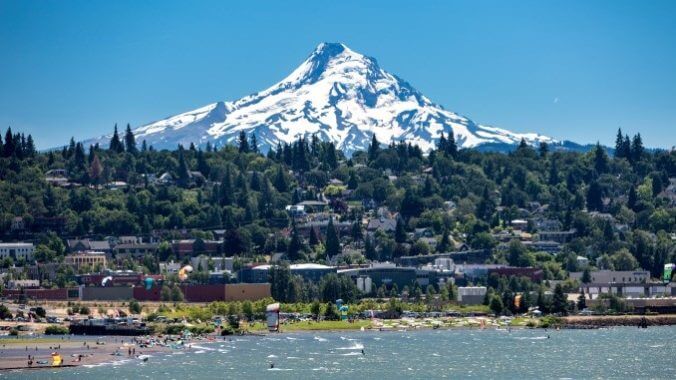
Hood River’s Columbia River setting, Mt. Hood backdrop, and world-class wind sports scene create one of Oregon’s most distinctive and permanently supply-constrained investment markets
2026 Outlook for Both Markets
- Hood River: Fruit Loop tourism growth, wind sports international recognition expanding, Gorge fire recovery driving renewed investment interest
- The Dalles: Google data center expansion attracting additional tech employers, remote worker migration accelerating, Pacific Crest Trail tourism growing
- Both: No Portland city ordinances, independent county regulatory environments
The Columbia Gorge National Scenic Area — Hood River’s Permanent Supply Cap
The Columbia River Gorge National Scenic Area (CRGNSA) is the defining investment framework for Hood River and the most important single fact for any Gorge corridor investor to understand:
- Federal designation, not state or local: The CRGNSA was established by Congress in 1986 and is managed by the USDA Forest Service. Federal designations of this type do not expire, cannot be reversed by local governments, and are not subject to Oregon’s land use planning system. This is permanent supply restriction of the highest legal order.
- 292,000 acres of restricted land: The CRGNSA covers 292,000 acres on both the Oregon and Washington sides of the Gorge. Development within the scenic area is strictly limited to protect viewsheds, natural character, and scenic resources. New commercial, industrial, or large-scale residential development in the most sensitive areas requires federal approval and is rarely granted.
- Impact on Hood River specifically: Hood River city sits within the Gorge, surrounded by National Scenic Area land. The mountains (Mt. Hood and adjacent Cascades) form the southern boundary. The Columbia River and National Scenic Area land form the northern boundary. Hood River County’s eastern and western corridors are restricted by CRGNSA guidelines. The available area for new development is essentially determined and cannot expand.
- Why this is good for existing investors: Every property you own in Hood River benefits from a supply cap that no other Pacific Northwest market outside Sisters can match. The CRGNSA makes Hood River’s supply constraint permanent in federal law, creating a compounding appreciation dynamic over long hold periods.
Hood River’s Global Wind Sports Economy
Hood River’s status as the world’s premier windsurfing and kiteboarding destination is not casual marketing language — it is an economically significant and demonstrable fact that directly drives real estate values:
- The Gorge wind science: The Columbia River Gorge acts as a Venturi tube, funneling air between the Cascade Mountains and the Columbia Plateau. The temperature differential between the moist Pacific air and the dry eastern Oregon desert creates a consistent pressure gradient that drives reliable afternoon winds through the Gorge from late May through September. These are not occasionally windy conditions — they are the most predictably consistent wind in North America for sailing sports, averaging 15-30+ knots during summer afternoons.
- International visitor demographics: Hood River’s wind sports visitors include professional athletes competing in major events, serious recreational enthusiasts from across the United States, and international visitors from Europe, Brazil, Australia, and beyond. These visitors have high disposable incomes, travel specifically to Hood River for the wind conditions, and pay premium STR rates to be close to the waterfront launching areas.
- Event calendar: The American Windsurfing Tour, the Gorge 422 kiteboarding race, and multiple professional competitions bring media coverage and international recognition that sustains Hood River’s global reputation. This is not fragile tourism — it is built on irreplaceable natural conditions that have been consistent for millennia.
- Investment implication: STR properties in Hood River that are positioned to serve the wind sports visitor demographic — river views, walking distance to the Event Site (the primary launch area), and outdoor sports amenity design — command premium nightly rates from a guest demographic that returns year after year. Nightly rates of $280-$450+ for well-positioned Hood River properties during peak wind season (June through August) are achievable and documented.
The Dalles — Google and the Technology Transition
The Dalles investment case rests on a technology-driven economic transformation that has been underway for nearly two decades and continues to deepen:
- Google’s major investment: Google established one of its largest data center operations in The Dalles in 2006 and has expanded significantly since. The data center benefits from inexpensive hydroelectric power from the Columbia River dams, cool air for server cooling, and a stable geological environment. Google has invested hundreds of millions of dollars in The Dalles infrastructure.
- Employment and salary impact: Google’s data center brings high-wage tech employment to a historically working-class Columbia River community. More importantly, it has attracted Google suppliers, contractors, and a broader tech ecosystem whose employees earn Portland or Seattle salaries while living in a community with $355,000 median home prices.
- Remote work acceleration: The Dalles’ combination of affordable housing, high-speed internet infrastructure (necessitated by Google’s presence), and Columbia Gorge outdoor recreation access makes it an increasingly competitive destination for remote workers from Portland and Seattle who want to cut housing costs while maintaining tech-sector income.
- Pacific Crest Trail proximity: The PCT passes near The Dalles, creating a through-hiking community that has grown significantly as PCT thru-hiking popularity has increased. Properties that can market PCT proximity and serve the long-distance hiking community have a small but growing STR niche.
Historical Performance
| Period | Hood River Driver | The Dalles Driver | Key Event |
|---|---|---|---|
| 2010-2014 | Wind sports tourism, slow recovery | Google stability, industrial employment | Both cities recover modestly; Hood River’s lifestyle premium provides floor |
| 2015-2019 | Portland overflow, Fruit Loop growth, STR development | Google expansion, remote worker early wave | Hood River 8-12% appreciation; The Dalles 4-7% as Google economy grows |
| 2017 | Eagle Creek Fire disruption and recovery | Some visitor disruption | Eagle Creek Fire closes parts of Gorge; Hood River property values hold as wind sports unaffected |
| 2020-2022 | Pandemic lifestyle migration surge | Remote work wave accelerates Google economy benefit | Hood River 18-28% appreciation; The Dalles 12-18% as remote workers discover affordability |
| 2025-2026 | Stabilization, sustained lifestyle demand, STR growth | Google expansion, tech migration, PCT tourism | Hood River 5-9%; The Dalles 4-7% as tech economy continues gradual revaluation |
📚 New to real estate investing? Master the fundamentals with our professional course Learn more →
2. Neighborhood Hotspots
Hood River / The Dalles Investment Map
Interactive map of the Columbia River Gorge investment corridor. Green stars show top hotspots, blue circles mark established markets, and orange circles highlight emerging areas.
Core Investment Areas
Detailed Submarket Analysis
| Location | Price Range | Cap Rate | Key Driver | Best Strategy |
|---|---|---|---|---|
| HR Waterfront / Event Site | $650K-$1.2M | 5.5-8.0% | Global wind sports tourism, river access | Peak STR, wind sports demographic |
| HR Heights / Upper Hood River | $600K-$950K | 4.5-6.5% | Views, school district, family community | LTR professional, view premium appreciation |
| HR Valley / Fruit Loop | $520K-$900K | 5.0-8.5% | Agritourism, orchard, Mt. Hood views | Dual-season STR, orchard retreat niche |
| HR East / CRGNSA Edge | $560K-$820K | 5.0-6.5% | Gorge views, HCRH access, scenic area edge | View premium, Gorge access, appreciation hold |
| Mosier / Rowena | $430K-$650K | 5.5-7.5% | Gorge access at HR discount, community character | Lifestyle premium at accessible HR entry point |
| The Dalles Downtown / Riverfront | $310K-$470K | 6.5-8.5% | Tech workers, revitalization, river access | Best Dalles appreciation, tech worker LTR |
| The Dalles East / Newer Stock | $320K-$460K | 6.5-8.5% | Google workers, family demand, newer stock | Best Dalles cash flow, family LTR |
| The Dalles West / Older Stock | $280K-$400K | 7.0-9.0% | Most affordable in Gorge corridor | Value-add BRRRR, highest Dalles yields |
Expert Insight: “Hood River and The Dalles are the same story told 30 miles apart. In Hood River you’re paying for the globally recognized brand, the world-class wind, and the National Scenic Area supply constraint. In The Dalles you’re paying for Google’s salary base, the same Gorge scenery, and an affordable market that sophisticated investors have been quietly accumulating for five years. I have clients who own in both and use the Dalles cash flow to carry the Hood River appreciation hold. The combination is very effective.” – Sarah Wolfe, Columbia River Gorge Investment Properties
3. Property Types
| Investment Goal | Best Property Type | Best Location | Minimum Capital |
|---|---|---|---|
| Maximum STR Revenue | HR waterfront / Event Site STR | Hood River waterfront district | $175,000+ |
| Most Unique STR Niche | Fruit Loop orchard retreat | Hood River Valley | $135,000+ |
| Best Cash Flow | The Dalles LTR tech worker | The Dalles East / Newer stock | $80,000+ |
| Best Appreciation | HR waterfront or Heights | Hood River city | $163,000+ |
Don’t guess the costs. Our Complete Renovation & Remodeling Cost Guide covers 400+ pages of project-by-project breakdowns with real contractor pricing ranges.
4. Cost Analysis
Hood River STR vs. The Dalles LTR — Side-by-Side Comparison
| Item | Hood River Waterfront STR | The Dalles LTR (East) | Notes |
|---|---|---|---|
| Purchase Price | $750,000 | $380,000 | $370K price difference for same Gorge corridor |
| Annual Gross Revenue | $68,000 (STR, 55% occupancy at $280 avg rate) | $21,600 (LTR, $1,800/month) | STR generates 3x the gross income |
| Operating Expenses | $28,000 (STR management 25%, cleaning, supplies, taxes, insurance) | $9,800 (taxes, insurance, management 10%, maintenance) | STR costs are higher as % of revenue |
| NOI | $40,000 | $11,800 | HR STR NOI is 3.4x The Dalles LTR NOI |
| Annual Mortgage | $42,564 (25% down, 6.5%, 30yr on $562,500) | $21,564 (25% down, 6.5%, 30yr on $285,000) | HR mortgage is 2x The Dalles |
| Annual Cash Flow | -$2,564 | -$9,764 | HR STR is near-neutral; The Dalles LTR has higher negative carry |
| Down Payment Required | $187,500 | $95,000 | HR requires $92,500 more capital |
| Total Return (7% appreciation) | ~25% on invested capital | ~10% on invested capital | Higher return on HR due to larger asset and STR near-neutrality |
This comparison illustrates why Hood River waterfront STR is the financially superior strategy despite the higher purchase price: near-neutral cash flow on a $750,000 asset appreciating at 7% annually produces exceptional total returns. The Dalles LTR on a $380,000 asset provides lower total returns despite a smaller capital commitment. The optimal approach for investors with sufficient capital is Hood River STR for total return; The Dalles is the right choice for investors who cannot access Hood River’s capital requirements but still want Gorge corridor exposure.
Hood River STR Annual Revenue Calendar
| Season | Demand Driver | Waterfront Property Rate | Fruit Loop Property Rate | Occupancy Target |
|---|---|---|---|---|
| April-May (Spring) | Fruit Loop blossom season; early wind sports; Gorge hiking | $200-$280/night | $240-$360/night (blossom peak) | 55-70% |
| June-August (Peak Wind) | Peak windsurfing/kiteboarding season; international athletes | $320-$480/night (peak) | $200-$300/night | 75-90% |
| Sept-Oct (Fall Harvest) | Fruit Loop harvest season; fall foliage; mountain biking | $220-$300/night | $240-$360/night (harvest peak) | 60-75% |
| Nov-March (Off-Season) | Ski season (Mt. Hood Meadows), holiday visitors, LTR optional | $160-$220/night or LTR | $150-$200/night or LTR | 35-50% |
⚠️ Gorge Fire Risk and Insurance: The Columbia River Gorge experienced significant wildfire activity in 2017 (Eagle Creek Fire) and faces ongoing fire risk during dry summer months. Verify current insurer availability and premiums for both Hood River and The Dalles properties, particularly for properties with wildland-urban interface exposure. Some insurers have reduced coverage in high-risk Gorge areas. Budget additional insurance premium and confirm defensible space compliance for rural valley and hillside properties.
5. Legal Framework
⚠️ Oregon Statewide + CRGNSA + STR Permit Compliance
Oregon SB 608 rent control and just-cause eviction apply throughout Oregon, including Hood River and The Dalles. Neither city has Portland’s additional local ordinances. Hood River and The Dalles both have STR permit requirements that must be confirmed before any STR acquisition. Properties within the Columbia River Gorge National Scenic Area have additional federal land use restrictions that may affect development and renovation. Always consult an Oregon-licensed attorney with Hood River County or Wasco County experience before purchasing in this corridor.
Oregon Statewide Law (Both Cities)
- SB 608 Rent Control: Annual LTR increases capped at 7% plus prior year CPI. New construction within 15 years of certificate of occupancy is fully exempt. New DADUs receive their own 15-year clock.
- Just Cause Eviction (after 12 months): Documented cause required after one year of tenancy.
- Relocation Assistance (State): One month’s rent in certain qualifying no-cause termination scenarios.
- Security Deposit Return: 31 days from move-out with itemized accounting.
- No Portland City Ordinances: No RRIO, no first-in-time rule, no 2-month relocation assistance. Hood River County and Wasco County each have their own regulatory environments independent of Portland.
Gorge Corridor Specific Considerations
- Columbia River Gorge National Scenic Area (CRGNSA): Development restrictions apply throughout the scenic area. Any new construction, major renovation, or change of use within the CRGNSA may require review by the Hood River County or Skamania County scenic area coordinator. Confirm whether a specific property falls within the CRGNSA management area before any development plans.
- Hood River City STR Permits: Hood River city requires STR permits. Confirm current application process, any density caps, and permit fees directly with Hood River City Hall before any STR acquisition.
- Hood River County STR (Rural): Valley and rural Hood River County properties outside city limits are subject to Hood River County STR regulations, which differ from city rules.
- The Dalles / Wasco County STR: The Dalles and Wasco County have their own STR permit requirements. Verify directly with City of The Dalles and Wasco County Planning before any rural STR acquisition.
- Court Venues: Hood River County Circuit Court for Hood River; Wasco County Circuit Court for The Dalles. Both are separate from Portland’s Multnomah County court.
- Wildfire Defensible Space: Required for properties in wildland-urban interface zones throughout the Gorge corridor.
6. Step-by-Step Gorge Corridor Investment Playbook
Choose Your Gorge Strategy
Hood River Wind Sports STR
Buy near the Event Site and waterfront in Hood River city. Target the global wind sports demographic. Optimize for June-August peak season. Near-neutral to slightly negative cash flow on a $750,000 asset appreciating at 7%+ annually produces exceptional total returns for patient investors.
Hood River Fruit Loop Orchard STR
Buy in the Hood River Valley among orchards and vineyards. Target three seasons — spring blossom, summer wind, and fall harvest — for the most diversified STR revenue profile in Oregon. Mt. Hood views and farm-stay positioning at $530,000-$880,000 with above-average summer yields.
The Dalles Tech Worker LTR
Buy in east The Dalles and target Google employees, tech contractors, and remote workers earning Portland/Seattle salaries. Best cash flow in the Gorge corridor. Near-neutral cash flow achievable in northeast Dalles at $320,000-$460,000. The Dalles as a stepping-stone investment toward Hood River.
Mosier / Rowena Lifestyle Hybrid
Buy in the Gorge communities east of Hood River at 20-30% below Hood River city prices. Target the lifestyle tenant and STR visitor who wants the Gorge at lower cost. A good middle-ground for investors who want Hood River Gorge exposure but cannot commit to Hood River city capital requirements.
Build Your Gorge Corridor Team
- Hood River County / Gorge Specialist Agent: Hood River’s small market (sub-200 annual transactions in many years) requires an agent with deep local knowledge. The difference between waterfront adjacent and two blocks from the waterfront is material to STR revenue. Only a Hood River specialist can navigate this precisely.
- Gorge-Experienced STR Manager: Hood River’s wind sports STR market has unique seasonal dynamics, specialized guest demographics, and equipment storage requirements that generic Airbnb managers do not understand. Use a Hood River-specific STR management company with documented performance in the wind sports visitor market.
- CRGNSA-Aware Oregon Attorney: For any Hood River Valley or Gorge-adjacent rural property, an attorney who understands Columbia River Gorge National Scenic Area regulations and how they interact with Oregon land use law is essential before any development or significant renovation plans.
- Hood River County Inspector: Older Hood River homes can have unique conditions related to the Gorge’s freeze-thaw climate cycles and wind exposure. A local inspector with Gorge experience will understand the specific failure modes that matter.
- Wasco County / The Dalles Agent and Manager: The Dalles is a separate market requiring separate expertise. Agents and managers who serve Hood River may not understand The Dalles’ specific Google economy dynamics, remote worker demographics, and neighborhood character differences.
Expert Tip: For Hood River wind sports STR properties, establish a relationship with Hood River’s major kiteboarding and windsurfing schools and gear shops before your first booking. These businesses maintain guest networks and regularly need to refer their students and clients to housing. A property manager with existing relationships in this community fills peak-season bookings significantly faster than relying solely on Airbnb/VRBO listing algorithms.
Gorge-Specific Due Diligence
Hood River Physical Due Diligence
- Wind exposure assessment: Hood River’s famous winds stress roofing, siding, windows, and fencing significantly. Budget for wind-related maintenance above Pacific Northwest averages.
- Freeze-thaw damage: Hood River’s climate produces significant freeze-thaw cycles that affect concrete, foundations, and exterior materials more than coastal Oregon.
- Wildfire risk zone verification: valley and hillside properties have elevated fire risk; confirm insurer availability before purchase
- CRGNSA boundary confirmation for any rural Hood River County property
- Sewer scope for older Hood River city homes; original clay infrastructure common in pre-1980 properties
- STR permit status: confirm current Hood River city STR permit process and any density limits
The Dalles Due Diligence
- Sewer scope for all pre-1985 Dalles homes
- Wildfire risk verification for properties near Columbia Hills and hillside areas
- Wasco County STR permit status for any STR-targeted acquisition
- Google Data Center noise and light assessment for properties near the industrial area
- Columbia River flood zone check for any low-lying riverfront Dalles properties
- Oregon SB 608 new construction exemption status for newer east Dalles developments
Hood River STR Seasonal Optimization
- Peak wind season (June-August) — maximum pricing: Open bookings 6-9 months in advance for July and August weekends. These are your highest-revenue weeks. Minimum 3-night stays during peak periods. Price at the top of the market and resist discounting — wind sports visitors who need to be in Hood River during peak wind season will pay premium rates.
- Spring blossom season (late March to mid-May): A significant revenue window for Fruit Loop properties. Market specifically to Portland, Seattle, and Bay Area weekend visitors who follow the Fruit Loop circuit. Emphasize specific varieties in bloom at specific times to attract repeat annual visitors.
- Fall harvest season (September-October): Second major Fruit Loop revenue window. Market the harvest experience: apple picking access, pear varieties, vineyard harvest events, and fall foliage. This demographic overlaps with Pacific Northwest wine tourists.
- Mt. Hood ski season (November-April): Properties with Mt. Hood Meadows proximity (Hwy 35 corridor, 45 minutes from city) can supplement winter income by marketing ski season access. This extends the year-round STR viability of Hood River Valley properties significantly.
- Off-season LTR option: Many Hood River STR operators convert to monthly furnished LTR during January-March when STR demand is at its lowest. This captures income from the Hood River professional community who may need temporary housing between longer-term arrangements, supplementing the slow STR winter period without a full annual LTR commitment.
7. Financing Options
| Loan Type | Down Payment | Rate Premium | Best For | Gorge Corridor Note |
|---|---|---|---|---|
| Conventional Investment | 25% | +0.5-0.75% | The Dalles LTR and most Hood River properties under $806,500 | Most Dalles properties and some Hood River properties under conforming limit; standard conventional available |
| Jumbo Investment | 25-30% | +0.75-1.25% | Premium Hood River waterfront properties above $806,500 | Required for many Hood River waterfront and Heights properties; strong income documentation needed |
| DSCR Loan (STR) | 20-30% | +2.0-3.0% | Hood River STR investors without W-2 income | Hood River’s documented STR revenues (AirDNA data) support STR DSCR loans; strong summer peak data helps coverage; verify lender comfort with Hood River / Gorge market |
| DSCR Loan (LTR) | 20-25% | +1.5-2.5% | The Dalles LTR investors without W-2 income | East Dalles properties can approach 1.0x DSCR at better cap rates; more viable than Hood River’s lower LTR yields |
| Portfolio Loan | 20-30% | +1-2% | Multiple Gorge properties, complex income | Umpqua Bank and Oregon community banks active in Hood River and Wasco counties |
| Hard Money / Bridge | 20-30% | 9-12% rate | Quick close on competitive Hood River offerings | Hood River’s low inventory creates competitive situations; bridge financing to secure then refinance to jumbo or conventional can be decisive |
Gorge Corridor Financing Reality: The Dalles properties are all under the $806,500 conforming limit, making conventional investment financing straightforward. Many Hood River properties, particularly waterfront and Heights homes, exceed the conforming limit and require jumbo financing with strong income documentation. STR DSCR loans are viable for Hood River waterfront properties because the documented summer STR revenues are strong enough to support coverage — but lenders need to be comfortable with seasonal income patterns. Secure financing pre-approval before any competitive Hood River offer.
8. Frequently Asked Questions

Knowledge Quiz: Hood River / The Dalles Real Estate Investment
Open Quiz
5 quick questions on what you just learned about investing in the Columbia River Gorge corridor
1) What physical phenomenon creates Hood River’s world-class wind sports conditions and why can’t it be replicated elsewhere?
Answer: B
The guide’s wind FAQ explains the Venturi effect in detail: the Cascade Mountains separate the moist Pacific climate from the hot dry interior, creating a temperature differential that draws Pacific air through the Gorge at consistent speeds. The four required elements (large river flat water, mountain funnel, climate differential, east-west orientation) combine only at the Columbia Gorge. Coastal spots like San Francisco Bay lack the flat water; other windy locations lack the consistency. This irreplaceability is the foundation of Hood River’s STR thesis.
2) What is the Columbia River Gorge National Scenic Area designation and why does the guide call it the most powerful supply constraint in any Oregon investment market?
Answer: D
The guide explains that the CRGNSA was established by Congress in 1986 and is managed by the USDA Forest Service. Federal designations of this type are legally permanent in a way that state or local regulations are not — local governments cannot reverse them and Oregon’s land use planning system cannot override them. The guide calls this the highest-order supply constraint because it requires Congressional action to modify. This is why Hood River’s supply is more permanently constrained than even Sisters, where the National Forest boundaries achieve a similar result.
3) How does the Hood River Fruit Loop create a STR revenue profile that waterfront-only properties cannot achieve?
Answer: C
The guide identifies the Fruit Loop’s spring blossom and fall harvest seasons as separate revenue peaks from the wind sports summer season. This means orchard retreat STR properties generate meaningful revenue during April-May (blossom tourism, 600,000+ annual Fruit Loop visitors), June-August (wind sports overlap and general summer recreation), and September-October (harvest season), while waterfront-only properties primarily depend on the summer wind season. The guide calls this “the most revenue-diversified STR strategy available in Oregon.”
4) Why does the guide’s comparison show Hood River waterfront STR generating better total returns than The Dalles LTR despite a $370,000 higher purchase price?
Answer: A
The guide’s comparison table shows Hood River waterfront STR at $750,000 generating $40,000 NOI ($68,000 gross minus $28,000 operating expenses), near-neutral against the $42,564 annual mortgage — producing -$2,564 annual cash flow versus -$9,764 for The Dalles LTR. The $750,000 Hood River asset at 7% appreciation generates $52,500 in annual equity versus $26,600 for the $380,000 Dalles property. The combination of near-neutral STR cash flow and appreciation on a larger asset base produces superior total return on invested capital for Hood River.
5) What is Google’s economic impact in The Dalles and why does the guide call it an early-to-middle stage investment thesis?
Answer: D
The guide’s Google FAQ describes The Dalles as being at the “early-to-middle stage of a tech economy transition that typically takes 10-20 years to fully reprice a small market.” Google data center engineers earning $120,000-$180,000 in a city with a $355,000 median home price create an income-to-housing ratio comparable to coastal tech markets of the 1990s. Google’s investment also improved broadband infrastructure, enabling remote workers. The guide draws the comparison to Bend’s forestry-to-outdoor-recreation transition, where early investors who bought during the transition (not after it completed) captured the strongest appreciation.
Work With a Local Expert in Hood River / The Dalles
We are building a verified network of real estate professionals across every market we cover.

About Our Expert Network
We are finalizing partnerships with verified real estate professionals across every market featured on Builds and Buys. Each expert in our Gorge corridor network is selected for their deep Columbia River Gorge investment experience — including Hood River STR wind sports optimization, Fruit Loop orchard retreat positioning, CRGNSA development restriction knowledge, and The Dalles tech economy investment thesis.
- Hood River waterfront and Event Site proximity STR expertise
- Fruit Loop orchard retreat and agritourism STR positioning
- CRGNSA development restriction knowledge for rural Hood River County
- The Dalles Google economy and tech worker LTR market knowledge
- Wildfire risk assessment and Gorge-area insurance network
Services Covered
- Hood River STR sourcing
- Fruit Loop orchard properties
- The Dalles tech worker LTR
- CRGNSA compliance guidance
- Wind sports STR optimization
- Seasonal revenue strategy
- Legal and title referrals
- Financing and lender connections
- Gorge STR management referrals
- Insurance and wildfire risk
- 1031 exchange coordination
- Exit strategy planning
Get Connected or Join Our Network
Looking for a Hood River or Dalles expert to help with your investment? Reach out and we will connect you with the right professional.
Contact us at support@buildsandbuys.com
Find Specialized Hood River / The Dalles Real Estate Professionals
Ready to Invest in the Columbia River Gorge?
The Columbia River Gorge corridor offers Oregon’s most complete spectrum of real estate investment — from Hood River’s globally recognized wind sports premium market with federal supply constraints that no other Pacific Northwest community can match, to The Dalles’ affordable tech economy transition play that is still in the early-to-middle stages of a revaluation that sophisticated investors have been quietly positioning for. Neither city is right for every investor. Both have genuine and defensible investment cases built on irreplaceable natural and economic characteristics. The Gorge’s beauty is not a marketing claim — it is a permanent geographic reality protected by federal law. That permanence is what makes both markets, at their respective price points, among the most compelling long-term investment opportunities in Oregon.
Continue Your Research
Oregon State Guide
See how Hood River and The Dalles compare to Bend, Portland, Sisters, and other Oregon markets.
Step-by-Step Invest
Complete framework for building a real estate investment strategy from scratch.
144-Lesson Course
University-level real estate education covering financing, law, strategy, and management.
For further guidance, explore our State-by-State Investor guides, browse our expert articles, or follow our Step-by-Step Investment Guide.