Redmond Oregon Real Estate Investment Guide For 2026
A comprehensive resource for investors targeting Central Oregon’s fastest-growing and most overlooked market, where entry prices 30-40% below Bend, a diversified manufacturing and aviation economy, and none of Bend’s STR permit restrictions create a compelling long-term rental investment opportunity in the high desert
Quick answers: Top 5 most searched Redmond investment questions ▼
Migration data: Where people are moving from to Redmond ▼
In This Guide
Click on any section to navigate directly to that content
1. Redmond, Oregon Market Overview
Market Fundamentals
Redmond sits 16 miles north of Bend at the geographic and economic heart of Central Oregon’s high desert. While Bend commands international attention for its outdoor recreation lifestyle and booming real estate market, Redmond has been quietly developing its own investment thesis: the same high-desert climate and Cascade mountain access as Bend, a diversified manufacturing and aviation economy that Bend lacks, 30-40% lower home prices, more accessible STR regulations, and the structural long-term demand driver of being Bend’s primary overflow market.
Key economic indicators defining Redmond’s investment case:
- Population: 35,000+ and growing at 4-5% annually, one of Oregon’s fastest growth rates
- Major Employers: Redmond Airport (RDN, Central Oregon’s primary commercial airport), JELD-WEN (manufacturing), BCI Technologies, St. Charles Health System, Deschutes County, Pacific Power, and a growing technology and logistics cluster in the Redmond Industrial Park
- Median Household Income: $62,000, with newer NE Redmond developments attracting higher-income households
- Median Home Price: $430,000, approximately 30-35% below Bend’s $600,000+
- Bend Commute: 20-25 minutes via Hwy 97, fully practical for Bend employees
- Vacancy Rate: Under 4.5%, tighter near the airport and downtown employment corridors
Redmond’s investment case is built on a thesis that has proven correct in similar markets across the Pacific Northwest: when the premium lifestyle city (Bend) hits an affordability ceiling, the adjacent working city (Redmond) becomes the primary beneficiary of overflow demand. This dynamic has driven Redmond’s recent growth and will continue to do so as Bend’s prices remain elevated.
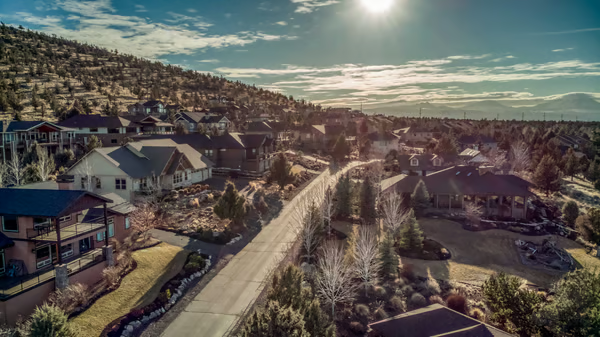
Redmond’s high desert setting and Cascade mountain backdrop provide the Central Oregon lifestyle at a fraction of Bend’s price premium
2026 Economic Outlook
- Redmond Airport expansion adding aviation employment and connectivity
- Redmond Industrial Park growth attracting new manufacturing and tech employers
- Downtown Redmond revitalization investment improving walkability and amenities
- Continued Bend overflow as Bend median price remains well above $600,000
- Eagle Crest resort area STR demand growing with Central Oregon tourism
Why Redmond Gets Overlooked — And Why That Is an Opportunity
Redmond suffers from a branding problem in the investment community. Bend is internationally known for its outdoor lifestyle, craft beer culture, and booming real estate. Redmond is known primarily as the city 16 miles north of Bend where the airport is. This perception gap creates a systematic mispricing that disciplined investors can exploit:
- Same Cascade access, lower price: The high desert climate, juniper forests, and Cascade mountain views that define Central Oregon’s lifestyle are fully present in Redmond. Smith Rock State Park — one of Oregon’s most dramatic landscapes and a world-class rock climbing destination — is just outside Redmond’s city limits. The outdoor recreation lifestyle that drives Bend demand is equally available in Redmond at 30-35% lower cost.
- Real manufacturing economy: Unlike Bend, which is heavily dependent on tourism, construction, and real estate, Redmond has a genuine manufacturing and industrial base. JELD-WEN, one of the world’s largest window and door manufacturers, has significant operations in Redmond. The Redmond Industrial Park employs thousands. This employment base creates stable LTR demand from working professionals who are not dependent on tourism cycles.
- Airport employment anchor: Redmond Airport (RDN) is the primary commercial airport serving all of Central Oregon, including Bend. The airport employs hundreds directly and supports thousands of indirect jobs. Airport-adjacent employment creates consistent housing demand from workers who need Central Oregon access without Bend pricing.
- STR market that still works: Bend’s STR permit system has been effectively closed to new investors through a competitive lottery and density caps. Redmond’s permit process, while requiring compliance, does not have the same closure mechanism. Eagle Crest resort community, Smith Rock adjacent properties, and Cascade view homes in Redmond can operate as STRs with permits that are actually obtainable.
Historical Performance
| Period | Market Driver | Avg Annual Appreciation | Key Event |
|---|---|---|---|
| 2010-2014 | Recovery, manufacturing employment stability | 3-5% | Redmond stabilizes faster than rural Oregon due to manufacturing employment floor |
| 2015-2019 | Bend overflow begins, airport expansion, manufacturing growth | 7-11% | As Bend prices rise, Redmond absorbs first wave of working-class overflow migration |
| 2020-2022 | Pandemic remote work migration, inventory shortage | 14-20% | Remote workers choosing Redmond over Bend for affordability; prices surge but remain far below Bend |
| 2023-2024 | Rate normalization, market rebalancing | 2-4% | Market pauses; Redmond’s employment base sustains vacancy better than rural Central Oregon |
| 2025-2026 | Rate stabilization, continued Bend overflow, airport and industrial growth | 4-7% (projected) | Redmond Industrial Park expansion, airport employment growth, sustained Bend overflow |
Key Demand Drivers
- Bend Overflow — Structural and Growing: As Bend’s median price has risen above $600,000 and rents have followed, working-class and middle-income households are being systematically priced out. Redmond is the natural landing zone for these households, who need Central Oregon employment access but cannot afford Bend. This overflow is structural and will intensify as Bend’s premium continues to grow.
- Redmond Airport Employment: RDN serves as Central Oregon’s air gateway, handling hundreds of flights and significant cargo volume. Airport-related employment — from airline staff and TSA to cargo handling and aviation maintenance — creates consistent housing demand from workers who need proximity to the airport specifically.
- Manufacturing Base Stability: Redmond’s industrial employers provide recession-resistant employment that tourism-dependent Bend lacks. JELD-WEN and the Redmond Industrial Park tenants employ workers year-round regardless of tourism cycles, creating a more stable LTR tenant base than Bend’s hospitality-weighted workforce.
- Smith Rock State Park: Smith Rock is located 9 miles outside Redmond and is one of Oregon’s most visited parks and a global rock climbing destination. Properties that can credibly market Smith Rock access as a STR amenity command significant premiums in both nightly rates and occupancy.
- Remote Worker Migration: Redmond’s combination of outdoor recreation access, Central Oregon climate (300+ days of sunshine), and meaningful affordability below Bend continues to attract remote workers who want the Pacific Northwest lifestyle without its highest-cost markets.
- Growing Technology Sector: Several technology and data companies have established operations in the Redmond area, drawn by available industrial land, power infrastructure, and Central Oregon’s quality of life. This sector adds higher-income employment that supports premium rental demand in newer Redmond neighborhoods.
📚 New to real estate investing? Master the fundamentals with our professional course Learn more →
2. Neighborhood Hotspots
Redmond Investment Neighborhood Map
Interactive map of Redmond’s investment neighborhoods and surrounding Central Oregon markets. Green stars show top hotspots, blue circles mark established markets, and orange circles highlight emerging areas.
Core Investment Neighborhoods
Detailed Submarket Analysis
| Neighborhood | Price Range | Cap Rate | Growth Drivers | Best Strategy |
|---|---|---|---|---|
| Downtown Redmond | $380K-$580K | 5.5-7.0% | Downtown revitalization, young professionals, Bend commute | Best appreciation play, revitalization trajectory |
| NE Redmond Growth Corridor | $430K-$600K | 5.5-7.0% | Bend overflow families, newer stock, schools | Family LTR, school access, Bend overflow |
| Airport / Industrial Corridor | $360K-$500K | 6.0-7.5% | Airport employment, manufacturing, industrial workers | Best workforce housing yield in Redmond |
| Eagle Crest Resort | $400K-$700K | 5.5-8.5% | STR viable, resort amenities, Cascade views, golf | STR alternative to Bend, resort LTR, lifestyle rental |
| Smith Rock Adjacent | $420K-$650K | 6.0-9.0% | Global climbing destination, outdoor recreation STR | STR premium, outdoor recreation niche, unique positioning |
| West Redmond Established | $350K-$490K | 6.0-7.5% | Older affordable stock, workforce demand | Value-add, BRRRR, workforce housing |
| South Redmond / Hwy 97 | $380K-$540K | 5.5-7.0% | Bend commute, improving amenities, family demand | Balanced yield and appreciation, family LTR |
| Terrebonne / Powell Butte | $310K-$450K | 7.0-9.5% | Most affordable in Central Oregon, Smith Rock adjacency | Highest cap rates, rural appeal, most affordable entry |
Expert Insight: “The conversation I have with every out-of-state investor who calls about Central Oregon is this: Bend is where you want to be, but Redmond is where the numbers work. The yield differential between Bend and Redmond is 2-3 percentage points. On a $450,000 Redmond property, that is $9,000-$13,500 more in annual income than the Bend equivalent. And in Redmond, your STR permit is actually obtainable. I’ve had clients wait 3 years for Bend STR permits. In Redmond, we get them in weeks.” – Dan Marsh, Principal, Central Oregon Investment Realty
3. Property Types
| Investment Goal | Best Property Type | Best Neighborhoods | Minimum Capital |
|---|---|---|---|
| Maximum LTR Cash Flow | Workforce SFH near airport corridor | Airport corridor, West Redmond, Terrebonne | $88,000+ |
| Best STR Return | Eagle Crest or Smith Rock adjacent | Eagle Crest, NE Redmond rural, Terrebonne | $100,000+ |
| Best Appreciation | Downtown or NE Redmond newer SFH | Downtown Redmond, NE Redmond | $97,000+ |
| Lowest Entry / BRRRR | Value-add older SFH or Terrebonne rural | West Redmond, Terrebonne, older South Redmond | $78,000+ |
Don’t guess the costs. Our Complete Renovation & Remodeling Cost Guide covers 400+ pages of project-by-project breakdowns with real contractor pricing ranges.
4. Cost Analysis
Acquisition Cost Breakdown (Redmond — NE Corridor Example)
| Expense Item | Typical Cost | Example ($430,000 Property) | Notes |
|---|---|---|---|
| Down Payment | 25% (investment) | $107,500 | Well below Bend’s required capital; all Redmond properties under conforming limit |
| Closing Costs | 2-3% of price | $8,600-$12,900 | Title, escrow, lender fees, recording |
| Home Inspection | $350-$550 | $425 | Central Oregon inspectors with high desert construction experience preferred |
| Radon Testing | $150-$300 | $200 | Mandatory: Central Oregon’s volcanic geology creates elevated radon risk. Test every property regardless of age. |
| Well / Septic (if rural) | $400-$900 | $0 (city property) or $650 (rural) | Terrebonne and outer rural properties often on well and septic; test both before purchase |
| Initial Updates | 0-7% of price | $0-$30,100 | For STR properties, budget for furnishing and staging ($8,000-$20,000 above any renovation) |
| Reserves (6 months) | 6 months expenses | $9,000-$13,000 | STR investors should carry 8-10 months reserves for seasonal income variation |
| TOTAL MINIMUM ENTRY (LTR) | ~28-33% of value | $125,725-$164,125 | Most accessible Central Oregon investment entry; significantly below Bend requirements |
Sample Cash Flow: Redmond NE 3BR SFH — Bend Overflow Family Tenant
| Item | Monthly | Annual | Notes |
|---|---|---|---|
| Gross Rent | $2,200 | $26,400 | 3BR NE Redmond, newer build, Bend overflow family |
| Vacancy (4%) | -$88 | -$1,056 | Bend overflow families stay long; low vacancy in NE Redmond |
| Property Taxes | -$323 | -$3,870 | ~0.9% of $430K (Deschutes County) |
| Insurance | -$130 | -$1,560 | High desert climate; wildfire risk zones increase premiums in rural areas |
| Property Management (10%) | -$220 | -$2,640 | Oregon SB 608 compliant; Redmond-area manager |
| Maintenance + CapEx (9%) | -$198 | -$2,376 | 9% for newer NE Redmond stock; dry climate reduces moisture issues |
| Net Operating Income | $1,241 | $14,898 | Before mortgage |
| Mortgage ($430K, 25% down, 6.5%, 30yr) | -$2,042 | -$24,504 | P&I on $322,500 loan |
| CASH FLOW | -$801 | -$9,606 | Moderate negative carry; materially better than Bend equivalent |
| Cap Rate | 3.46% | NOI / Purchase Price. Better than Bend’s 2.5-3.5% range | |
| Total Return (6% appreciation) | ~18% | Including equity, appreciation, principal paydown |
Redmond vs. Bend Cash Flow Comparison (Same Investor Capital Commitment)
| Item | Redmond (NE, $430K) | Bend (Comparable, $610K) | Redmond Advantage |
|---|---|---|---|
| Monthly Gross Rent | $2,200 | $2,700 | Bend $500/mo higher rent |
| Monthly NOI | $1,241 | $1,480 (est.) | Bend NOI somewhat higher |
| Monthly Mortgage (same 25% down) | $2,042 | $2,895 | Redmond mortgage $853/mo lower |
| Monthly Cash Flow | -$801 | -$1,415 | Redmond $614/mo better cash flow |
| Down Payment Required | $107,500 | $152,500 | Redmond $45,000 less capital |
| STR Permit Accessibility | Obtainable with compliance | Effectively closed — competitive lottery, caps reached | Redmond STR option actually available |
The Redmond vs. Bend comparison makes the investment case clearly. Redmond’s lower mortgage more than offsets the lower rent, producing $614/month better cash flow annually while requiring $45,000 less capital. Over a 10-year hold, the cash flow advantage cumulates to $73,680 — before accounting for the capital efficiency of the lower down payment. And Redmond’s STR market remains accessible where Bend’s is effectively closed.
⚠️ Wildfire Risk: Deschutes County and surrounding Central Oregon areas carry elevated wildfire risk. Verify wildfire risk zone designation for any Redmond property, particularly rural and outer-Redmond locations. Wildfire-zone properties face higher insurance premiums and in some cases limited insurer availability. Budget $200-$600/year more for insurance than the base analysis assumes for any property in a designated moderate-to-high wildfire zone.
Expert Insight: “Radon testing is non-negotiable in Redmond and all of Central Oregon. The volcanic geology creates naturally elevated radon levels that can exceed EPA action thresholds in a meaningful percentage of homes. A $200 radon test at purchase either confirms the property is fine or identifies a $1,500-$4,000 mitigation need. I have had investors skip the test and then discover elevated radon that required disclosure to tenants and retrofit mitigation. Test every property, every time.” – Lisa Okafor, Deschutes County Environmental Compliance, Redmond
5. Legal Framework
⚠️ Oregon Statewide Compliance Notice
Oregon SB 608 rent control and just-cause eviction requirements apply throughout Oregon, including Redmond. Redmond does not have Portland’s additional local landlord ordinances, making the compliance environment simpler. However, Redmond’s STR market has its own permit requirements that must be reviewed carefully before any STR acquisition. Always consult an Oregon-licensed attorney and confirm current City of Redmond STR permit status before purchasing any property for short-term rental use.
Oregon Statewide Law (Applies in Redmond)
- SB 608 Rent Control: Annual increases capped at 7% plus prior year CPI. Oregon OEA publishes the combined cap each October. New construction within 15 years of certificate of occupancy is fully exempt. New DADUs receive their own 15-year clock.
- Just Cause Eviction (after 12 months): Documented cause required after one year of tenancy. Non-payment, material lease violation, damage, and criminal activity are the primary allowable causes.
- Relocation Assistance (State): One month’s rent in certain qualifying no-cause termination scenarios.
- Security Deposit Return: 31 days from move-out with itemized accounting.
- Source of Income: Oregon statewide law prohibits discrimination based on housing vouchers.
- Habitability: 24-hour response for heat and water failures. Note that Redmond’s high desert climate creates extreme temperature conditions (100°F+ summers, 0°F winters) that make HVAC maintenance critical.
Redmond STR Regulations (Critical for STR Investors)
STR Key Points for Redmond:
- City of Redmond requires STR permits; confirm current requirements at City Hall
- No competitive lottery or density cap system like Bend’s (as of 2025)
- Eagle Crest HOA has additional STR rules layered on top of city permits
- Owner-occupied STR may have different permit tier than non-owner-occupied
- STR permit requirements can change; verify before purchase, not after
- Deschutes County STR rules apply to rural properties outside Redmond city limits
Redmond-Specific Considerations
- Deschutes County jurisdiction: Both city and rural Redmond properties are in Deschutes County. Evictions filed in Deschutes County Circuit Court in Bend.
- Well and Septic (rural properties): Terrebonne and outer Redmond properties often on private well and septic systems. Require well quality and quantity tests plus septic pump and inspection before purchase.
- Wildfire defensible space: Oregon law requires defensible space around structures in designated wildfire zones. Compliance affects both property insurance and landlord liability.
- Radon disclosure: Oregon requires sellers to disclose known radon levels. Buyers should independently test regardless of disclosure.
| Regulation | Redmond | Bend (for comparison) | Investor Impact |
|---|---|---|---|
| LTR Rent Control | 7% + CPI cap (SB 608 statewide) | Same SB 608 cap | Identical LTR regulation; no advantage for either city |
| STR Permits | Permit required; obtainable with compliance | Permit cap reached; competitive lottery; effectively closed to new investors | Major Redmond advantage for STR investors |
| Eviction Venue | Deschutes County Circuit Court (Bend) | Same Deschutes County Circuit Court | Identical process; same court for both cities |
| New Construction | 15-year rent control exemption (statewide) | Same statewide exemption | NE Redmond newer stock benefits; own 15-year clock |
| Portland City Ordinances | Does not apply | Does not apply | Neither Redmond nor Bend has Portland’s local ordinances |
| Wildfire Zone Requirements | Defensible space required in wildfire zones | Same requirements | Rural and outer Redmond investors must budget for defensible space compliance |
6. Step-by-Step Redmond Investment Playbook
Choose Your Redmond Strategy — LTR, STR, or Hybrid
Bend Overflow LTR
Buy in NE Redmond and target the Bend overflow family demographic. These tenants work in Bend or Redmond, chose Redmond for affordability, and want to stay for their children’s school years. Long tenancy, consistent payment, low management intensity.
Eagle Crest / Smith Rock STR
Buy in Eagle Crest or near Smith Rock. Pursue STR permit through City of Redmond. Target the outdoor recreation visitor market from the Pacific Northwest and beyond. Active management required but nightly yields meaningfully above LTR math.
Airport Corridor Workforce LTR
Buy near the airport and industrial employment corridor. Target manufacturing workers, airport staff, and healthcare employees. Best pure cash flow in the market. Accept higher turnover than the Bend overflow family demographic in exchange for better yields.
Value-Add BRRRR
Buy dated 1980s-2000s SFH in west Redmond or downtown-adjacent at $330,000-$450,000. Renovate kitchen, baths, and exterior. Refinance at improved ARV. Redmond’s lower cost labor market creates favorable BRRRR economics versus Bend, where contractor costs have risen dramatically with tourism-driven demand.
Build Your Redmond Team
- Redmond / Central Oregon Investment Specialist: Agents who primarily work in Bend do not always understand Redmond’s distinct submarket dynamics. Redmond pricing, Redmond-specific rental demand by corridor, and Redmond vs. outer-Redmond rural market differences require specific local knowledge.
- Oregon-Licensed Real Estate Attorney with STR Experience: If pursuing STR strategy, an attorney who understands both Oregon SB 608 (for LTR fallback) and the current City of Redmond STR permit requirements is essential before any acquisition.
- Deschutes County Property Manager: For LTR, verify Oregon Rental Housing Association membership. For STR, find a Redmond-area STR management company with Eagle Crest and Smith Rock corridor experience specifically.
- Central Oregon Contractor: Contractor availability and pricing in Redmond is better than in Bend, where tourism and construction competition has driven labor costs up. Build relationships with Redmond-based contractors for value-add acquisitions.
- Oregon CPA: STR properties have complex tax treatment (depreciation, occupancy day tracking, personal use allocation) that requires an accountant with Oregon STR experience.
Expert Tip: For STR properties near Smith Rock, invest in professional photography during peak wildflower season (typically late March to early May) and during dramatic weather conditions (stormy skies, fresh snow on the Cascades visible in the background). Smith Rock’s visual drama is the primary marketing asset, and images that capture that drama generate measurably higher click-through rates and booking conversions on Airbnb and VRBO listings. Budget $600-$1,200 for a professional Central Oregon outdoor photographer, not a standard real estate photographer.
Redmond-Specific Due Diligence
Physical Due Diligence
- Radon testing (mandatory): Test every property regardless of age, seller disclosure, or price point. Central Oregon’s volcanic geology creates elevated baseline radon levels. Test before offer removal, not after closing.
- HVAC system inspection: Redmond’s temperature extremes (-10°F to 105°F range) demand reliable HVAC systems. Deferred HVAC maintenance in this climate creates emergency repair calls and tenant dissatisfaction.
- Well and septic testing for any rural or outer-Redmond property
- Wildfire risk zone verification: Oregon State Fire Marshal risk map and property-specific verification
- Exterior and roof: high desert UV exposure degrades roofing materials faster than coastal Oregon; inspect carefully
- STR properties: verify current permitted use and any Eagle Crest HOA rental restrictions before purchase
Market and Regulatory Due Diligence
- Confirm current City of Redmond STR permit status and application process directly with City Hall before any STR acquisition
- For Eagle Crest properties, review Eagle Crest HOA CC&Rs for STR permission, HOA fee levels, and any rental caps
- Pull permit history through City of Redmond Building Division
- Verify Oregon SB 608 new construction exemption status for newer NE Redmond homes
- Review current rent levels against Redmond-specific market data, not Bend data
- Confirm Deschutes County STR rules for any rural property outside Redmond city limits
Competing in Redmond’s Market
- Focus on Bend overflow pipeline: Maintain relationships with Bend-area employers whose employees are relocating to Redmond for cost reasons. JELD-WEN HR, St. Charles Health System employee housing resources, and Redmond Airport staff communications are all channels for reaching qualified tenant candidates before they hit the open market.
- Off-market outreach in west Redmond: West Redmond has long-term property owners who have held 15-20 years and may be ready to exit. Direct mail to these owners produces off-market opportunities at pricing that reflects the seller’s preference for simplicity over competitive tension.
- Act before STR regulations tighten: Redmond’s STR market is currently more accessible than Bend’s. This may not last as Redmond’s growth continues and tourism pressure builds. Investors who want STR exposure in Central Oregon should act in Redmond now rather than waiting for the market to eventually impose Bend-style restrictions.
- Smith Rock shoulder season strategy: For Smith Rock adjacent STRs, the spring and fall climbing seasons (March-May and September-November) are the revenue peaks. Properties that also market winter Cascade access (Nordic skiing is within 30-45 minutes) extend their season meaningfully. Price aggressively during peak season and maintain summer occupancy with outdoor recreation marketing.
Managing Redmond Properties
LTR Management in Redmond’s High Desert Climate
- HVAC priority: Redmond’s temperature extremes make HVAC the most critical system in the home. Maintain annual service contracts and respond to HVAC issues within Oregon’s 24-hour heat and cooling habitability standards.
- Wildfire season preparation: If in a wildfire zone, ensure defensible space compliance annually. Communicate with tenants about wildfire season protocols and evacuation routes. Wildfire smoke events may trigger habitability questions — know your obligations.
- Dust and exterior maintenance: High desert conditions create significant dust accumulation and UV degradation. Build semi-annual exterior cleaning and maintenance into your operating budget.
- SB 608 annual compliance: Same process as all Oregon markets. Check Oregon OEA October publication for new allowable increase cap. Provide 90-day written notice for any planned increase.
STR Management Specifics (Eagle Crest / Smith Rock)
- STR management fees in Redmond typically 20-28% for full-service management
- Peak season cleaning coordination is the primary operational challenge; establish cleaning crew relationships before your first booking
- Outdoor gear storage, fire pit management, and cleaning protocols for dusty high desert climate are specific to the Redmond STR context versus coastal Oregon STRs
- Airbnb and VRBO listing optimization for Smith Rock and outdoor recreation keywords requires specific copywriting — emphasize the “base camp” positioning and specific drive times to Smith Rock, Mt. Bachelor, and Central Oregon recreation
7. Financing Options for Redmond
| Loan Type | Down Payment | Rate Premium | Best For | Redmond Note |
|---|---|---|---|---|
| Conventional Investment | 25% | +0.5-0.75% | LTR investors with strong W-2 income | All Redmond LTR properties under $806,500 conforming limit; full conventional financing available |
| DSCR Loan (LTR) | 20-25% | +1.5-2.5% | No income verification investors, LTR properties | Airport corridor and workforce housing properties can approach 1.0x DSCR; more viable than Bend due to better cap rates |
| DSCR Loan (STR) | 20-30% | +2.0-3.0% | STR investors without traditional income | STR DSCR uses projected STR income (AirDNA data); lenders verify with short-term rental income projections; higher rate than LTR DSCR |
| Portfolio Loan | 20-30% | +1-2% | Multiple properties, self-employed | Umpqua Bank and several Oregon community banks offer portfolio products for Deschutes County |
| Hard Money (Bridge) | 15-25% | 9-12% rate | Value-add BRRRR acquisitions | Oregon and Pacific Northwest hard money lenders active in Deschutes County; west Redmond BRRRR is the primary use case |
| ADU / Construction | 20-25% of total | +1-2% | Adding DADU to Redmond property | HELOC on existing equity often cheapest path; Redmond’s lower land values and labor costs make ADU economics strong vs. Bend |
Redmond Financing Advantage: Every Redmond investment property falls under the $806,500 conforming limit, making standard conventional investment loans fully available with no jumbo complications. Redmond’s better cap rates versus Bend also make DSCR loans viable for workforce housing properties that approach 1.0x coverage, a tool that rarely works in Bend’s lower-yield market. For STR investors, STR DSCR loans using AirDNA-verified income projections are actively offered by several non-QM lenders and have become an important financing tool for Eagle Crest and Smith Rock corridor acquisitions.
8. Frequently Asked Questions

Knowledge Quiz: Redmond Oregon Real Estate Investment
Open Quiz
5 quick questions on what you just learned about investing in Redmond Oregon
1) What is the most significant STR regulatory advantage Redmond has over Bend?
Answer: B
The guide’s most important Redmond vs. Bend differentiation is the STR permit accessibility. Bend implemented a cap on STR permits and a competitive lottery that has effectively closed the market to new STR investors. Redmond has its own permitting process but without the same density caps or competitive system, making STR permits actually obtainable with compliance. The guide’s expert quote specifically notes that clients wait years for Bend STR permits while obtaining them in Redmond in weeks.
2) Why does the guide mandate radon testing for every Redmond property regardless of age or seller disclosure?
Answer: C
The guide’s radon section explains that volcanic rock underlying the Redmond and Bend area has naturally higher uranium content, creating elevated radon gas migration into structures. The guide notes radon is the second leading cause of lung cancer after smoking, and that once a landlord has knowledge of elevated radon they must disclose it and mitigate before renting. The guide calls radon testing mandatory and recommends testing during due diligence (before offer removal) so the mitigation cost can be negotiated or factored into the purchase price.
3) What does the Redmond vs. Bend cash flow comparison in the guide show about relative investment performance?
Answer: A
The guide’s side-by-side comparison shows Redmond at $430,000 vs. Bend at $610,000. While Bend generates $500/month more in gross rent, Redmond’s mortgage is $853/month lower. The net result is $614/month better monthly cash flow for the Redmond investor. Over 10 years, the cumulative cash flow advantage exceeds $73,000, before accounting for the $45,000 less capital required for the Redmond down payment.
4) What makes Smith Rock State Park a distinct STR investment opportunity and what drives the nightly rate premium?
Answer: D
The guide describes Smith Rock as one of Oregon’s most visited parks and a global rock climbing destination that attracts visitors from across the US and internationally. Spring (late March to late May) and fall (mid-September to early November) are the peak climbing seasons, not summer. The guide identifies proximity to the park entrance, outdoor amenities like fire pits and gear storage, professional photography capturing dramatic scenery, and authentic Central Oregon character in design as the key drivers of nightly rate premium. A well-positioned Smith Rock STR at 60% annual occupancy can generate approximately $43,800 in gross annual revenue.
5) Why does the guide describe Redmond as having a more stable employment base than Bend for LTR purposes?
Answer: B
The guide makes this point explicitly and returns to it multiple times. Redmond’s employment base — JELD-WEN manufacturing, Redmond Airport aviation employment, St. Charles Health System healthcare, and the Redmond Industrial Park — creates year-round working professional demand for LTR housing that does not fluctuate with tourism cycles. Bend’s economy is more dependent on hospitality, construction, and real estate, which are more vulnerable during downturns. This is why the guide describes Redmond as having a more stable LTR tenant base than Bend, even if Bend’s overall market is larger and more dynamic.
Work With a Local Expert in Redmond, Oregon
We are building a verified network of real estate professionals across every market we cover.

About Our Expert Network
We are finalizing partnerships with verified real estate professionals across every market featured on Builds and Buys. Each expert in our Redmond network is selected for their hands-on Central Oregon investment experience, STR permit knowledge, and understanding of the Redmond vs. Bend investment dynamics that out-of-area investors most need to understand.
- Proven experience with Redmond LTR and STR investment properties
- City of Redmond STR permit process knowledge and application support
- Eagle Crest HOA expertise and Smith Rock corridor STR positioning
- Radon testing, wildfire risk, and high-desert due diligence experience
- Bend vs. Redmond investment comparison analysis for incoming investors
Services Covered
- Redmond LTR and STR sourcing
- Eagle Crest STR positioning
- Smith Rock STR analysis
- Airport corridor workforce housing
- Value-add and BRRRR guidance
- STR permit navigation
- Legal and title referrals
- Financing and lender connections
- Deschutes County property management
- Insurance and inspection referrals
- 1031 exchange coordination
- Exit strategy planning
Get Connected or Join Our Network
Looking for a Redmond expert to help with your investment? Reach out and we will connect you with the right professional.
Contact us at support@buildsandbuys.com
Find Specialized Redmond Oregon Real Estate Professionals
Ready to Invest in Redmond, Oregon?
Redmond is Central Oregon’s quietly compelling investment story. While Bend gets the headlines, Redmond gets the numbers. Better cap rates, obtainable STR permits, a real manufacturing and aviation economy, Smith Rock on the doorstep, and entry prices 30-35% below Bend for the same high-desert climate and outdoor recreation lifestyle. The investors who identified Redmond before it became obvious are already seeing the results. The window where Redmond is still underpriced relative to its fundamentals is not unlimited. Build your position while the city is still being discovered.
Continue Your Research
Oregon State Guide
See how Redmond compares to Bend, Portland, Eugene, Salem, and other Oregon markets.
Step-by-Step Invest
Complete framework for building a real estate investment strategy from scratch.
144-Lesson Course
University-level real estate education covering financing, law, strategy, and management.
For further guidance, explore our State-by-State Investor guides, browse our expert articles, or follow our Step-by-Step Investment Guide.