Eugene Oregon Real Estate Investment Guide For 2026
A comprehensive resource for investors targeting one of Oregon’s most resilient university-anchored markets, where the University of Oregon creates a permanent rental base, healthcare expansion drives employment growth, and relative affordability makes cash flow achievable in ways Portland cannot match
Quick answers: Top 5 most searched Eugene investment questions ▼
Migration data: Where people are moving from to Eugene ▼
In This Guide
Click on any section to navigate directly to that content
1. Eugene Market Overview
Market Fundamentals
Eugene is the University of Oregon’s home city and Oregon’s second-largest metropolitan area. Known as TrackTown USA for its deep running and track and field heritage, Eugene combines a vibrant university culture with a growing healthcare and manufacturing economy. For real estate investors, Eugene’s most important characteristic is its position as one of Oregon’s strongest cash flow markets, driven by a large and permanent student and employee rental base at entry prices significantly below Portland, Bend, or the Willamette Valley’s northern tier.
Key economic indicators defining Eugene’s investment case:
- Population: 175,000+ Eugene city, 400,000+ Eugene-Springfield metro
- Major Employers: University of Oregon (8,000+ employees), PeaceHealth Sacred Heart Medical Center, Lane Community College, City of Eugene, Hynix Semiconductor, Winco Foods, Bi-Mart
- University of Oregon: 22,000+ students, consistent enrollment growth, major research university status
- Median Household Income: $54,000 city (lower due to student population), $68,000+ Springfield and suburbs
- Vacancy Rate: Under 4% near UO campus, 4-5% metro-wide
- Median Home Price: $425,000, among the lowest of Oregon’s major cities
Eugene’s bimodal economy, split between the large university and student population on one hand and a growing healthcare, technology, and manufacturing base on the other, creates two distinct tenant markets that a well-positioned investor can serve. Near campus, the student and young professional market drives high-yield rental demand. In south Eugene and suburban corridors, the healthcare professional and established family market drives longer-term, lower-yield but lower-management rentals.
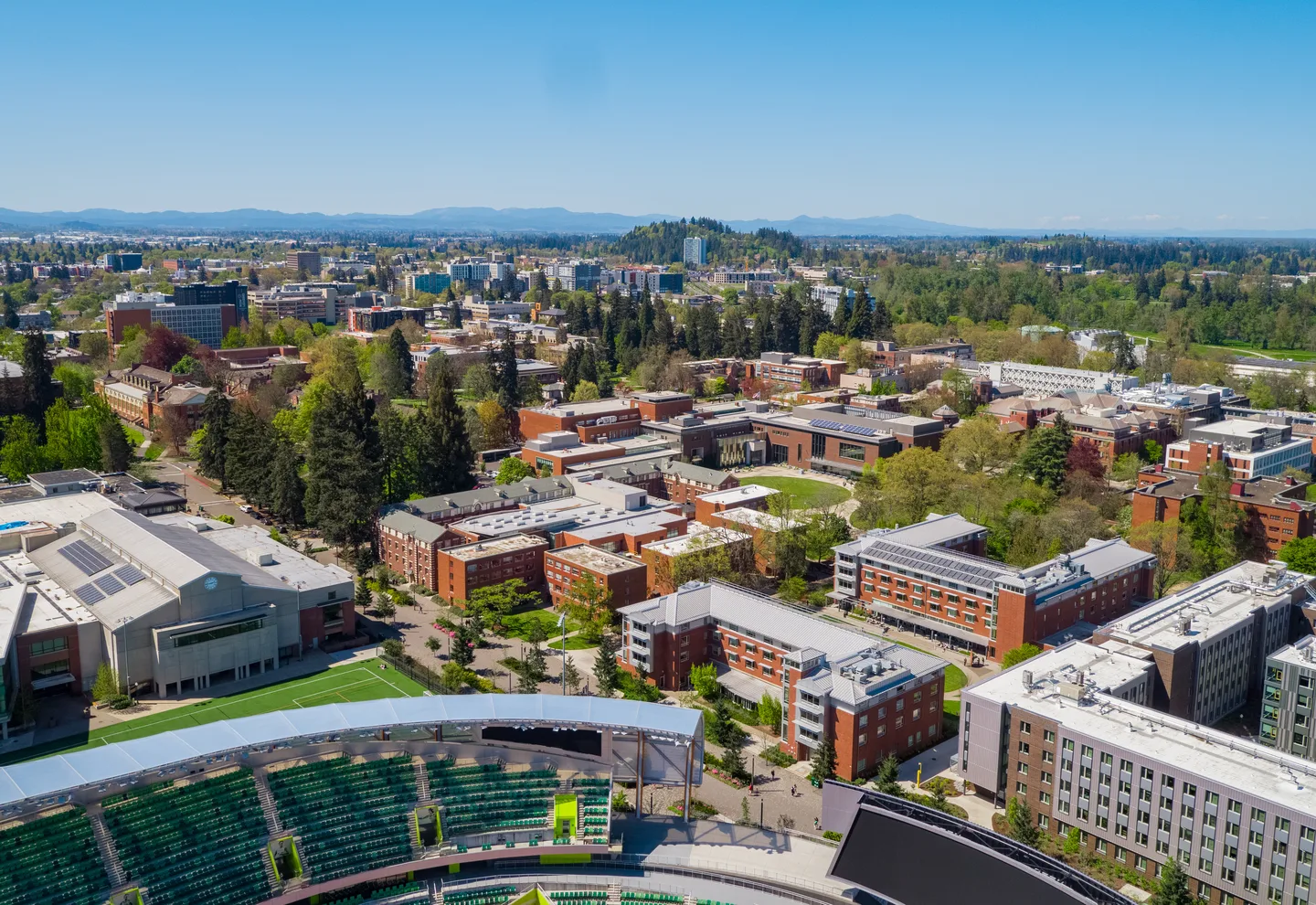
Eugene’s University of Oregon creates a permanent and growing rental base that has anchored real estate demand for generations
2026 Economic Outlook
- University of Oregon enrollment growth and campus expansion driving housing demand
- PeaceHealth Sacred Heart expansion adding healthcare employment
- Amazon fulfillment infrastructure and distribution growth in the metro
- Remote worker migration from Portland continuing as cost differential grows
- Eugene’s selection for national track and field events elevating city profile
The University Anchor Advantage
Eugene’s most durable investment characteristic is the University of Oregon’s role as a permanent and growing demand anchor for rental housing within a 1-2 mile radius of campus. Unlike employer-driven markets that can soften during corporate downturns, university markets have demonstrated remarkable resilience across economic cycles. The UO has been expanding enrollment consistently, with graduate and professional programs growing faster than undergraduate, creating demand for the higher-quality rentals that generate better returns.
- 22,000+ students need off-campus housing, as the UO provides limited on-campus dormitory capacity relative to enrollment
- 5,000+ faculty and staff create a parallel demand for professional-grade housing in south Eugene and suburban corridors
- Academic year reliability means leases typically run August through August, creating a predictable annual leasing cycle that experienced Eugene landlords use to their advantage
- Graduate and international student growth is creating demand for higher-quality rentals beyond the traditional undergraduate housing market
- PeaceHealth and healthcare employment provides a second anchor tenant demographic that supplements university demand with year-round, longer-term professional tenants
Historical Performance
| Period | Market Driver | Avg Annual Appreciation | Key Event |
|---|---|---|---|
| 2010-2014 | Post-recession recovery, university stability | 3-5% | UO enrollment hits record highs; housing demand surges near campus |
| 2015-2019 | Portland overflow, healthcare expansion, tech startup growth | 6-10% | Eugene recognized as Portland alternative; PeaceHealth campus expansion |
| 2020-2022 | Remote work migration, pandemic demand, low inventory | 12-18% | Eugene prices rise sharply but remain below state metro averages |
| 2023-2024 | Rate normalization, market rebalancing | 1-3% | Market pauses; cash flow investors find renewed opportunities |
| 2025-2026 | UO growth, healthcare expansion, Portland migration continues | 3-6% (projected) | Rate stabilization and renewed investor interest in cash flow markets |
Demographic Trends Driving Demand
- University of Oregon Growth – Consistent enrollment expansion with particularly strong growth in graduate, law, and professional programs creates escalating demand for quality rental housing beyond the undergraduate tier
- Healthcare Employment Expansion – PeaceHealth Sacred Heart is the region’s largest employer outside the University, and ongoing healthcare demand is driving facility and staffing expansion that brings high-income medical professionals to the market
- Portland Affordability Overflow – As Portland prices have risen, Eugene has become an increasingly attractive destination for remote workers and professionals who want Oregon city amenities at 20-30% lower housing costs
- Lane Community College – 10,000+ additional students in the metro, primarily in the Gateway and Mohawk areas of Springfield, create a second college town rental dynamic
- Manufacturing Base – Hynix Semiconductor, Ninkasi Brewing, and a diverse manufacturing sector provide stable working-class employment that sustains workforce housing demand
- Outdoor Recreation Draw – Eugene’s access to Cascade Mountains, Oregon Coast (90 minutes), and extensive river trails attracts lifestyle migrants who consistently prioritize outdoor access
📚 New to real estate investing? Master the fundamentals with our professional course Learn more →
2. Neighborhood Hotspots
Eugene Investment Neighborhood Map
Interactive map of Eugene and Springfield’s investment neighborhoods. Green stars show top hotspots, blue circles mark established markets, and orange circles highlight emerging areas.
Core Investment Neighborhoods
Detailed Submarket Analysis: Eugene and Springfield Neighborhoods
| Neighborhood | Price Range | Cap Rate | Growth Drivers | Best Strategy |
|---|---|---|---|---|
| University District | $380K-$580K | 6.5-9.0% | UO campus, near-zero vacancy, student demand | Small multi-family, student housing, buy-and-hold |
| Fairmount / College Hill | $360K-$550K | 6.0-8.0% | Campus walking distance, professional tenant mix | Value-add Craftsman, balanced returns |
| Whiteaker | $330K-$500K | 6.5-8.5% | Arts district, gentrification, creative class | Value-add, BRRRR, best appreciation play |
| South Eugene / Amazon | $500K-$800K | 4.5-6.0% | Premium demographics, top schools, UO faculty | Long-term professional rental, appreciation hold |
| River Road / Santa Clara | $320K-$480K | 6.0-7.5% | Workforce demand, older stock, NW Eugene access | Workforce housing, value-add SFH |
| Friendly Area / Laurel Hill | $420K-$640K | 5.0-6.5% | Walkable retail, family and faculty tenants | Stable LTR, lower-turnover professional tenants |
| Bethel / Danebo (West Eugene) | $290K-$420K | 6.5-8.0% | Affordability, manufacturing employment, workforce | Workforce housing, lowest Eugene entry price |
| Springfield Gateway | $280K-$420K | 7.5-9.5% | LCC proximity, Eugene access, improving commercial | Best cash flow in metro, BRRRR, workforce housing |
| Glenwood | $270K-$420K | 7.0-9.0% | Urban renewal, river proximity, redevelopment upside | Emerging play, patient hold, urban renewal benefit |
| Creswell / Cottage Grove | $230K-$360K | 8.0-10.5% | Highest cap rates in metro, I-5 employment access | Maximum cash flow, commuter workforce housing |
Expert Insight: “The most consistent mistake I see out-of-market investors make in Eugene is avoiding Springfield because of the name. A well-selected Springfield property in the Gateway corridor will outperform a comparable Eugene property on cash flow by 150-200 basis points in cap rate while giving up perhaps 1-2% in annual appreciation. Over a 10-year hold, that cash flow difference compounds into tens of thousands of dollars in actual income. Eugene investors who build a portfolio across both cities tend to outperform those who restrict themselves to Eugene proper.” – Rachel Kim, Managing Broker, Willamette Valley Investment Properties
3. Property Types
| Investment Goal | Best Property Type | Best Neighborhoods | Minimum Capital |
|---|---|---|---|
| Maximum Cash Flow | Small multi-family near UO or Springfield SFH | University District, Springfield Gateway, Creswell | $70,000+ |
| Maximum Appreciation | Whiteaker value-add or South Eugene SFH | Whiteaker, South Eugene, Fairmount | $90,000+ |
| Lowest Management | Professional-grade SFH in South Eugene | South Eugene, Friendly Area, Laurel Hill | $125,000+ |
| Lowest Capital Entry | FHA house hack on duplex near UO | University District, College Hill, Fairmount | $14,000+ |
Don’t guess the costs. Our Complete Renovation & Remodeling Cost Guide covers 400+ pages of project-by-project breakdowns with real contractor pricing ranges.
4. Cost Analysis
Acquisition Cost Breakdown (Eugene)
| Expense Item | Typical Cost | Example ($425,000 Property) | Notes |
|---|---|---|---|
| Down Payment | 25% (investment) | $106,250 | 3.5% FHA available for owner-occupant house hackers on 2-4 units |
| Closing Costs | 2-3% of price | $8,500-$12,750 | Title, escrow, lender fees, recording |
| Home Inspection | $350-$550 | $450 | Older Eugene stock near UO often has deferred maintenance; thorough inspection critical |
| Sewer Scope | $175-$300 | $225 | Strongly recommended for pre-1985 University District and Whiteaker homes |
| Initial Repairs / Updates | 0-8% of price | $0-$34,000 | Student housing often has deferred maintenance from prior landlords; budget conservatively |
| Reserves (6 months) | 6 months expenses | $8,000-$12,000 | Student housing may need reserves for August turnover period costs |
| TOTAL MINIMUM ENTRY | ~28-32% of value | $123,425-$165,775 | Among the lowest total entry costs of any major Oregon market |
Sample Cash Flow Analysis: University District Triplex
| Item | Monthly | Annual | Notes |
|---|---|---|---|
| Unit 1 Rent (2BR) | $1,450 | $17,400 | Student tenants, UO campus 0.4 miles |
| Unit 2 Rent (2BR) | $1,450 | $17,400 | Graduate students / young professionals |
| Unit 3 Rent (1BR) | $1,100 | $13,200 | Single student or professional |
| Gross Income | $4,000 | $48,000 | |
| Vacancy (5% — conservative near UO) | -$200 | -$2,400 | Actual vacancy near UO is often under 3% annually |
| Property Taxes | -$292 | -$3,500 | ~0.72% of $486K assessed value (Lane County) |
| Insurance | -$175 | -$2,100 | Multi-family landlord policy |
| Property Management (10%) | -$400 | -$4,800 | Student housing managers with UO-area expertise |
| Maintenance + CapEx (12%) | -$480 | -$5,760 | Higher than typical for student housing due to turnover wear |
| Net Operating Income | $2,453 | $29,440 | Before mortgage |
| Mortgage ($510K price, 25% down, 6.5%, 30yr) | -$2,425 | -$29,100 | P&I on $382,500 loan |
| CASH FLOW | +$28 | +$340 | Near breakeven — exceptional for Oregon on conventional financing |
| Cap Rate | 5.77% | NOI / Purchase Price | |
| Total Return (5% appreciation) | ~18% | Including equity, appreciation, principal paydown |
This near-breakeven cash flow on a conventional investment loan is exceptional for an Oregon market. Portland and Bend investors typically run $1,000-$2,500/month in negative cash flow on comparable investment structures. Eugene’s lower purchase prices and strong rental demand create a fundamentally different cash flow profile that makes the market particularly compelling for investors who need income alongside appreciation.
Expert Insight: “Eugene’s multi-family near UO is the best-kept secret in Oregon investment real estate. The cash flow numbers actually work on conventional financing, which is almost unheard of on the West Coast. The reason more investors don’t pursue it is that they underestimate the management intensity of student housing. Work with a property manager who specifically specializes in UO-area student housing and knows the August lease cycle, and you’ll find a market that consistently delivers total returns of 15-20% annually with genuine near-breakeven cash flow.” – Tom Bradley, Director, Lane Valley Real Estate Investments
5. Legal Framework
⚠️ Oregon Statewide Compliance Notice
Oregon SB 608 rent control and just-cause eviction requirements apply in Eugene and Springfield. Eugene does not have the additional local ordinances that Portland has, making it a meaningfully simpler compliance environment. However, Oregon’s statewide protections create material obligations for landlords, and the student housing lease cycle creates specific timing considerations that differ from standard residential tenancy. Always consult an Oregon-licensed attorney before acquiring Eugene rental properties.
Oregon Statewide Law (Applies in Eugene and Springfield)
- SB 608 Rent Control: Annual increases capped at 7% plus prior year CPI. New construction within 15 years of certificate of occupancy is fully exempt. This exemption is particularly valuable for new ADUs near UO campus, which can be set to market rent freely during the exemption window.
- Just Cause Eviction (after 12 months): Documented cause required after a year of tenancy. Non-payment, material violation, damage, and criminal activity are the primary allowable causes. No-cause terminations require 90 days written notice.
- Security Deposit Return: Must return with itemized accounting within 31 days of move-out.
- Source of Income Protection (State): Oregon statewide law prohibits discrimination based on housing vouchers. Eugene has a significant Section 8 population and landlords must accept qualifying voucher holders.
- Habitability Standards: 24-hour response for heat and hot water failures, 72 hours for appliances, 10 days for other repairs. Student housing creates high maintenance call volume — systems and response protocols are essential.
Eugene-Specific Considerations
- No Portland-style local ordinances: Eugene does not have Portland’s relocation assistance requirements, first-in-time rule, or mandatory written screening criteria disclosures. The compliance environment is significantly simpler than Portland.
- Student Lease Timing: The UO academic year creates a strong market norm of August to August leases. Properties that deviate from this cycle face higher vacancy risk. Build your leasing calendar around August 15-31 move-ins for optimal University District performance.
- Co-signer Requirements: Student tenants without income typically require parental co-signers. This is standard practice in Eugene’s student housing market and provides important collection protection.
- Lane County Landlord-Tenant Law: No additional county-level ordinances beyond Oregon state law in Lane County.
- Eugene STR Regulations: Eugene requires a Home Occupation Permit for STR operation. Rules are less restrictive than Portland or Bend but operators must comply with licensing and tax remittance requirements.
Key Eugene Resources
- Oregon Rental Housing Association: oregonrentalhousing.com
- Eugene Rental Housing Code: eugene-or.gov/housing
- Lane County Assessor: lanecounty.org/assessor
- Eugene Rental Housing Helpline: 541-682-5533
| Regulation | Eugene / Springfield | Portland (for comparison) | Investor Impact |
|---|---|---|---|
| Rent Increases | 7% + CPI cap (SB 608) | Same cap + 2-month relocation at 10%+ | Eugene landlords can increase up to cap without relocation assistance cost |
| Eviction | Just cause after 12 months; 90-day no-cause | Same + Portland relocation assistance | Lower financial exposure than Portland for tenant resolution |
| Screening | Standard fair housing, no first-in-time rule | First-in-time rule, mandatory written criteria | Significantly simpler screening process in Eugene |
| New Construction Exemption | 15 years from certificate of occupancy | Same statewide exemption | New DADUs near UO campus especially advantaged |
| Rental Registration | No city registration program | RRIO registration required | No registration burden in Eugene or Springfield |
6. Step-by-Step Eugene Investment Playbook
Choose Your Eugene Strategy
Eugene offers four distinct and viable investment strategies, each with a clear neighborhood and property type match:
University Multi-Family Cash Flow
Buy a 2-4 unit property within 1 mile of UO campus. Target the student and graduate student market with August lease cycles. Near-breakeven or slightly positive cash flow on conventional financing is achievable. The most reliable cash flow strategy in the Oregon market.
Whiteaker Value-Add Appreciation
Buy a dated bungalow or Craftsman in the Whiteaker neighborhood at sub-market pricing. Renovate to attract the creative professional tenant demographic. Hold 5-7 years as gentrification momentum builds. The highest-potential appreciation play in the Eugene market.
South Eugene Professional Rental
Buy a quality SFH in South Eugene and target the UO faculty, PeaceHealth staff, and established professional demographic. Accept lower yields in exchange for long-term, high-quality tenants who require minimal management. Best for passive investors and those who want to minimize day-to-day involvement.
Springfield Maximum Cash Flow
Buy in Springfield Gateway or West Springfield at Eugene metro area prices 20-30% below comparable Eugene properties. Target the workforce household demographic. Accept lower appreciation in exchange for the metro’s best cap rates. Best for investors who prioritize current income and are comfortable with the workforce housing tenant profile.
Build Your Eugene Team
- Eugene Investment Specialist Agent: Must understand both the student housing market near UO and the professional rental market in South Eugene. These are genuinely different tenant profiles requiring different acquisition and management approaches.
- Student Housing Property Manager (if University District strategy): The most important team member for university-area investments. Must know the UO academic calendar, have established relationships with the UO Off-Campus Living office, and have systems for managing August turnover efficiently. This is specialized work — a general residential manager without UO experience will underperform.
- Oregon-Licensed Real Estate Attorney: For lease templates, co-signer agreements, and Oregon SB 608 compliance. Ensure they have experience with student housing co-signer documentation specifically.
- Lane County Contractor: If pursuing Whiteaker value-add, your contractor needs experience with Lane County permit requirements and Eugene’s older housing stock, particularly knob-and-tube wiring and older plumbing systems common in pre-1950 Whiteaker homes.
- Oregon CPA: Eugene’s student housing creates specific tax considerations including furnished unit depreciation, co-signer arrangements, and property management deductions that require experienced Oregon tax guidance.
Expert Tip: When interviewing property managers for University District multi-family, ask specifically: “What percentage of your managed units in the University District were vacant during August of last year?” A well-managed portfolio near UO should have essentially zero August vacancies because the lease cycle predictably fills units. Managers who cannot answer this question clearly, or who show August vacancy above 5%, are not specialized enough for student housing management.
Eugene-Specific Due Diligence
Physical Due Diligence
- Sewer scope for all pre-1985 University District and Whiteaker properties; older clay lines common
- Electrical panel: knob-and-tube wiring is present in many pre-1950 Whiteaker and Fairmount homes; verify insurance availability before purchase
- Moisture and mold: Eugene’s high annual rainfall creates persistent moisture risk in crawl spaces and older structures
- Student housing wear assessment: inspect carefully for accumulated deferred maintenance from prior student occupancy including wall damage, flooring wear, and appliance condition
- Roof condition: moss damage is endemic in Eugene’s wet climate
- Foundation drainage: older Eugene lots often have inadequate grading and drainage
Regulatory and Market Due Diligence
- Verify current rent levels for all units against market comparables; below-market rents require SB 608 modeling before underwriting
- Review existing lease terms and expiration dates; in-place leases expiring in January to June in the University District may create August re-leasing risk
- Confirm Oregon SB 608 new construction exemption status for newer properties
- Pull permit history through the City of Eugene for all improvements
- Check for any outstanding code violations through the Eugene Building and Permit Services department
- For multi-family, review any existing property management agreements and their termination terms
Competing in Eugene’s Market
- Target the August lease cycle for acquisitions: Multi-family properties that come on the market in October through January are often being sold by landlords who just completed the August re-leasing cycle and are ready to exit. These sellers are motivated and properties typically have full occupancy, making due diligence on rental income straightforward.
- UO Off-Campus Living relationships: The University of Oregon’s Off-Campus Living office maintains a property database that provides qualified tenant leads to registered landlords. Getting your properties listed with the UO is a pipeline advantage that reduces vacancy risk significantly.
- Pre-inspect University District properties: Older multi-family in the University District often sells quickly when priced competitively. Pre-inspecting before offer submission ($400-$600) allows clean offers in competitive situations.
- Whiteaker direct contact: Whiteaker has a tight-knit property owner community. Many long-term Whiteaker owners have held for 15-20 years and are approaching retirement age. Direct outreach to these owners through the Whiteaker Neighborhood Association produces off-market opportunities at prices unavailable on MLS.
- Springfield stigma opportunity: Out-of-market investors frequently filter out Springfield without analysis, reducing competition for well-priced Springfield properties. This buyer reluctance creates recurring opportunities for investors who do not share the stigma and underwrite based on fundamentals.
Managing Eugene Student Housing
The August Lease Cycle
University District properties follow a predictable annual rhythm that experienced managers exploit:
- November to January: Begin marketing for the following August. The best tenants lease early. Graduate students in particular often sign leases 6-9 months before move-in.
- February to April: Peak leasing season for August occupancy. Target UO Off-Campus Living listings, Craigslist, Facebook student housing groups, and UO departmental email lists.
- May to July: Final leasing push for any remaining vacancies. Adjust pricing if needed to ensure full occupancy before August.
- August 1-15: Move-out inspection, cleaning, and repairs for all turning units. This 2-week window is the most labor-intensive of the year and requires pre-scheduled contractor availability.
- August 15-31: New tenant move-ins. Have all units ready and inspected.
Typical Eugene Management Fees
- Single-family management: 9-12% of monthly rent
- Multi-family management (2-4 units): 8-10% of monthly rent
- Student housing specialist premium: some managers charge 10-12% for the additional lease cycle complexity
- Leasing fee: 50-75% of one month’s rent
- August turnover coordination: some managers charge flat fees of $150-$300 per unit for August transition management
7. Financing Options for Eugene
| Loan Type | Down Payment | Rate Premium | Best For | Eugene Note |
|---|---|---|---|---|
| Conventional Investment | 25% | +0.5-0.75% | Strong W-2 income, good credit | Nearly all Eugene and Springfield properties fall under the $806,500 conforming limit; straightforward process |
| FHA (House Hack) | 3.5% | Standard + MIP | Owner-occupying one unit of 2-4 unit property near UO | Exceptional use case near UO campus; allows ownership with as little as $13,300-$20,000 down on a duplex or triplex |
| DSCR Loan | 20-25% | +1.5-2.5% | No income verification investors | Eugene’s better cap rates mean University District multi-family often qualifies at 1.0x DSCR coverage; more viable than Portland or Bend |
| Portfolio Loan | 20-30% | +1-2% | Multiple properties, self-employed | Umpqua Bank, OnPoint Credit Union, and South Lane-based lenders offer portfolio products for Lane County |
| ADU / Construction Loan | 20-25% of total | +1-2% | Adding DADU to existing property near UO | HELOC on existing equity often the cheapest path; Oregon Housing ADU programs available for some borrowers |
| Hard Money (Bridge) | 15-25% | 9-12% rate | Whiteaker BRRRR acquisitions, quick close offers | Several Oregon-based hard money lenders active in Lane County; Whiteaker value-add BRRRR is the primary use case |
Eugene Financing Advantage: Unlike Portland or Bend where premium pricing pushes many investments into jumbo loan territory, virtually every Eugene and Springfield investment property qualifies for standard conventional financing under the $806,500 conforming limit. This means more lenders competing for your business, simpler documentation requirements, and lower rate premiums. Eugene is also one of the few Oregon markets where DSCR loans are genuinely viable on residential multi-family, because the university rental income creates coverage ratios that simply do not work in higher-price markets.
8. Frequently Asked Questions

Knowledge Quiz: Eugene Oregon Real Estate Investment
Open Quiz
5 quick questions on what you just learned about investing in Eugene
1) What makes the University District near UO campus one of Oregon’s best cash flow investment submarkets?
Answer: B
The University District’s investment appeal comes from the combination of near-zero vacancy driven by 22,000+ UO students needing off-campus housing, strong rental demand that persists regardless of economic cycles, and Eugene’s median purchase prices ($380,000-$580,000 for multifamily) that are significantly below Portland or Bend. This price-to-income ratio creates cap rates of 6.5-9.0% that are genuinely unusual for an Oregon urban market.
2) What is the most important timing consideration for managing University District multi-family properties in Eugene?
Answer: C
The UO academic year creates a strong August-to-August lease cycle that defines University District property management. The guide’s playbook section details the cycle: begin marketing in November to January for the following August, peak leasing in February to April, final push in May to July, move-out inspections August 1-15, and new tenant move-ins August 15-31. Missing this cycle creates vacancy risk that near-zero-vacancy University District properties should never experience.
3) Which Eugene neighborhood does the guide identify as the best value-add and appreciation opportunity in 2026, compared to Portland’s Sellwood-Moreland 20 years ago?
Answer: A
The guide identifies Whiteaker as Eugene’s most compelling value-add and appreciation play. The neighborhood’s craft brewery scene (Ninkasi headquarters), food cart pods, arts district, and annual block party are driving consistent gentrification momentum. The guide’s expert quote compares it to what Sellwood-Moreland was 20 years ago. Entry prices of $330,000-$500,000 for bungalows and Craftsmans, combined with cap rates of 6.5-8.5% and 5-9% appreciation potential, make it the most compelling combined return play in the Eugene market.
4) According to the cash flow analysis, what makes the University District triplex example exceptional for an Oregon investment property?
Answer: D
The guide’s cash flow analysis shows the University District triplex ($510,000 purchase price, 25% down, 6.5% rate) generating $+28/month in positive cash flow after all expenses including management. This near-breakeven on conventional investment financing is described as exceptional because Portland and Bend investors typically run $1,000-$2,500/month in negative cash flow on comparable investment structures. Eugene’s lower purchase prices relative to rents create this unusual cash flow profile.
5) What is the key regulatory difference between investing in Eugene and investing in Portland that makes Eugene a simpler compliance environment?
Answer: C
Eugene operates under Oregon statewide law (SB 608 rent control, just-cause eviction after 12 months, 31-day deposit return) but does not have Portland’s additional local ordinances. Portland landlords face the 2-month relocation assistance requirement for 10%+ rent increases, the first-in-time screening rule, and mandatory written criteria disclosure requirements. None of these Portland local rules apply in Eugene, making the compliance environment materially simpler. The guide’s comparison table makes this difference explicit.
Work With a Local Expert in Eugene
We are building a verified network of real estate professionals across every market we cover.

About Our Expert Network
We are finalizing partnerships with verified real estate professionals across every market featured on Builds and Buys. Each expert in our Eugene network is selected for their hands-on investment experience with University District student housing, Whiteaker value-add strategy, and the Eugene-Springfield market dynamics that drive returns in this unique market.
- Proven experience with University District multi-family and student housing management
- Relationships with UO Off-Campus Living for qualified tenant placement
- Knowledge of the August lease cycle and student housing management systems
- Whiteaker value-add renovation experience and contractor relationships
- Full Eugene and Springfield transaction support from search through closing
Services Covered
- University District multi-family sourcing
- Student housing management referrals
- Whiteaker value-add acquisition
- Investment analysis and underwriting
- ADU feasibility analysis
- Springfield cash flow analysis
- Legal and title referrals
- Financing and lender connections
- Property management referrals
- Insurance and inspection referrals
- 1031 exchange coordination
- Exit strategy planning
Get Connected or Join Our Network
Looking for a Eugene expert to help with your investment? Reach out and we will connect you with the right professional for your market and strategy.
Contact us at support@buildsandbuys.com
Find Specialized Eugene Real Estate Professionals
Ready to Invest in Eugene?
Eugene is one of the Pacific Northwest’s most underappreciated investment markets. The University of Oregon creates a permanent rental base that no market cycle can eliminate. The combination of near-breakeven cash flow on conventional financing, Whiteaker’s genuine appreciation momentum, and Springfield’s exceptional cap rates gives investors three distinct and viable strategies within a single metro. For investors who have found Portland too complex, Bend too expensive, and Seattle unaffordable, Eugene represents a compelling answer: real cash flow, proven appreciation, and a university anchor that has driven housing demand for generations and will continue to do so.
Continue Your Research
Oregon State Guide
See how Eugene compares to Portland, Bend, Salem, and other Oregon markets.
Step-by-Step Invest
Complete framework for building a real estate investment strategy from scratch.
144-Lesson Course
University-level real estate education covering financing, law, strategy, and management.
For further guidance, explore our State-by-State Investor guides, browse our expert articles, or follow our Step-by-Step Investment Guide.